

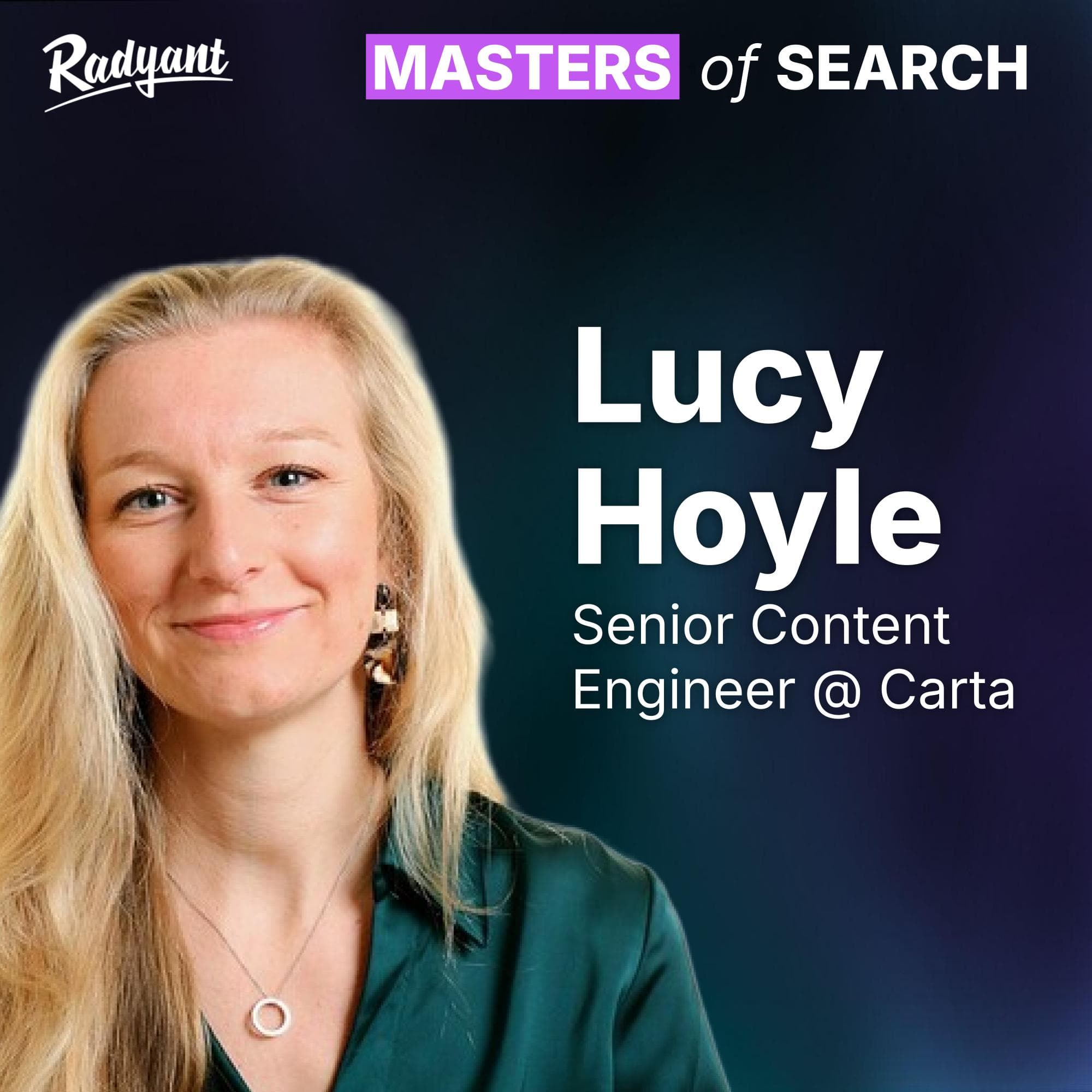
Think like a Content Engineer | Lucy Hoyle, Senior Content Engineer @ Carta
Show notes
SEO has already been a proven growth engine for Carta, and in 2025, they've gained strong AI Search visibility driving real pipeline results. Lucy Hoyle is Senior Content Engineer at Carta, and played a crucial role in that.
She oversees editorial processes, content strategy, and AI workflow optimization for international markets, building scalable systems that turn content strategy into pipeline results.
We talked about how SEO differs from AI Search, why Lucy has been an early champion of the content engineering movement, and her POV on successful content marketing in the Age of AI.
▶ Let's connect! 🔗 Niklas on LinkedIn: https://www.linkedin.com/in/niklas-buschner/ Radyant on LinkedIn: https://www.linkedin.com/company/radyant/ Lucy on LinkedIn: https://www.linkedin.com/in/lucy-hoyle-883381138/ Carta on LinkedIn: https://www.linkedin.com/company/carta--/
Transcript
Full conversation
- 00:00:00Carter is transforming how private capital operates there the leading provider of software purpose built for everyone in private markets.
- 00:00:07from fifty thousand companies managing equity across a hundred sixty countries to eight thousand five hundred funds and SPV's representing nearly a hundred eighty two billion dollars in assets.
- 00:00:20SEO has been a proven growth engine powering this scale and in recent months they've also gained strong AI search visibility.
- 00:00:28that's driving real pipeline results.
- 00:00:32To dive deep into that I'm happy to have Lucy Hoyle as my guest today.
- 00:00:36Lucy is content marketing manager at Carter and she represents a new breed of content marketers, the so-called content engineers.
- 00:00:45She oversees editorial processes, content strategy and AI workflow optimization for international markets, building scalable systems that turn content strategy into pipeline results.
- 00:00:55We'll talk about how SEO differs from AI search, while Lucy has been an early champion of the content engineering movement and her POV on successful content marketing in the age of AI.
- 00:01:07That being said, Lucy, welcome to the podcast.
- 00:01:10Hi Nicholas, thank you so much for having me today and I'm looking forward to diving into all things SEO and AEO.
- 00:01:16Thanks so much for coming on.
- 00:01:18Let's start with a personal question, so just to get going.
- 00:01:22So how did you end up in content marketing?
- 00:01:25So I studied literature and languages at university and I did English and French and undergrads.
- 00:01:32I went on to do a masters for research in French and Francophone studies, which sounds very niche and it was.
- 00:01:39But I picked up the skills that I needed to dive deep into a topic, to kind of understand its nuances and to then figure out how to communicate that knowledge to a non-expert reader.
- 00:01:50And so I think those skills have been so important.
- 00:01:53moving into content marketing and just content in general.
- 00:01:57When I came out of uni I wanted to work in publishing, did a few internships and actually ended up at an ed tech startup.
- 00:02:04that was based in London and they were trying to disrupt the industry.
- 00:02:08So it was kind of like the Spotify for textbooks.
- 00:02:11They were sort of taking quite a traditional industry and trying to innovate it and disrupt it that way.
- 00:02:16So that was a really exciting kind of foray into tech and I realized that I love working on a startup and almost all kind of like the other side of that industry and realised that I probably didn't want to work in publishing.
- 00:02:28It was very slow to change.
- 00:02:30It was very traditional.
- 00:02:31It's quite hierarchical.
- 00:02:33And then when I've been at the company for about three and a half years, I kind of just hit the ceiling.
- 00:02:37I didn't see much room for growth.
- 00:02:40And so I started exploring other opportunities.
- 00:02:43I'd also always looked at, so I was on the content team, I'd always looked at the marketing team and been like, they're having so much fun.
- 00:02:50And so yeah, I realized I probably wanted to work in marketing and yeah, managed to combine what I was doing with content, with marketing, to create content marketing.
- 00:03:00And I also like moved to a kind of faster paced industry, which is like finance or fintech.
- 00:03:05So yeah, that's how I ended up here.
- 00:03:07And do you also have this habit so i'm completely guilty of it that if you look at content that other companies put out you can't just like read it or like enjoy it.
- 00:03:17you always have to like have this x-ray view on the thoughts that are behind that and strategies and everything.
- 00:03:24yeah hundred percent and i was doing that when i was at university as well like i couldn't pick up a book without analyzing it like really really deeply.
- 00:03:30so i think yeah most content marketers have probably got this ingrained sense of like.
- 00:03:35analyzing or criticizing everything.
- 00:03:36but I think that's maybe part of the beauty of it because you're able to read beyond the surface and kind of like try and understand the intent behind a piece of content and ultimately the more aware you are of kind of what's going on in the world around you and how other people are doing things the better a marketer you'll become.
- 00:03:55Now at Carter, you're obviously so to say on the bright side of business because content marketing is working pretty well for you and you have like a big effect on that also.
- 00:04:06But there are also a lot of companies out there, not necessarily struggling with content marketing, but maybe just not seeing the results they had hoped for or they're hoping for.
- 00:04:16So I'd like to know what's like if you look at the industry, like at your industry, but maybe also other industries, B to B SaaS in general.
- 00:04:24What would you say are like some mistakes or like the biggest mistakes you see others doing with their content and maybe also their SEO strategies?
- 00:04:31Yeah, I think there's a few things.
- 00:04:33The main thing I'd say is that like so many companies make the mistake of like writing and publishing content in a vacuum.
- 00:04:39They get kind of overly excited or possibly even obsessed with their product, which is totally fair enough.
- 00:04:44And like if you're a startup, obviously your very product first and you're kind of given instructions to like push the product and benefits and features and stuff like that.
- 00:04:53But they kind of forget to focus on what their audience really wants.
- 00:04:57And yeah, so many people kind of make the mistake of not doing enough kind of audience research or not actually speaking to customers or prospects.
- 00:05:06They also I think failed to think about distribution.
- 00:05:09One of my colleagues.
- 00:05:11who joined our content team recently, she says distribution is the content strategy and I couldn't agree more.
- 00:05:18If you're basically like writing content that only you're interested in or your company's interested in, throwing it up on your blog and kind of just hoping that the views and the leads will come, it's not gonna work.
- 00:05:30Even if you get a little bit of initial traffic, it's gonna fall off a cliff after like a week or so.
- 00:05:36And it's something we've definitely been guilty of at Carter and we're now trying to kind of think about.
- 00:05:41instead of just creating like one piece of content that is going to live for like a week and then be useless, how can we like create like a kind of bucket of content or a cluster of content that can be repurposed by different teams in different formats and for different audiences?
- 00:05:55So I think like, yeah, we've kind of realized the mistakes that we've made in the past and see now the companies do it and we're shifting more towards this kind of like content lifecycle approach where you're taking an idea or a kind of topic and seeing how many kind of pieces of content you can get out of it.
- 00:06:13So yeah I think that's that's who are the kind of key mistakes.
- 00:06:16Another one is specific to BTB SaaS.
- 00:06:18I guess like not having a strong brand identity and not like taking a stand on topic.
- 00:06:26A lot of companies kind of whether they're too scared or they don't really have an opinion on something they'll just kind of regurgitate what they're reading or hearing from other people.
- 00:06:36and something that we've been trying at Cart over the last year or so on our social media channels but also in content is developing a very strong brand voice and If you look at the evolution of our socials over time, it's gone from being quite corporate to very tongue-in-cheek.
- 00:06:52And we're engaging with other companies on LinkedIn and making it a bit more fun.
- 00:06:59And so I think it's a mistake to think that BTB SaaS can't be fun, especially in a regulated industry like finance and equity and fund management.
- 00:07:07I think adding in a bit of personality goes a long way, especially when you've got this glut of AI-generated content these days.
- 00:07:15And do you feel like other companies are just too scared to develop an opinionated voice or take a stand on some issues?
- 00:07:24I mean, it doesn't have to be politics, obviously.
- 00:07:26It can be anything in the industry or having a clear POV.
- 00:07:29I also feel like that's what's probably not just working in socials, it's also working well in content marketing in general.
- 00:07:36But what's holding others back?
- 00:07:39It's difficult to say really without being on the inside of it.
- 00:07:44like maybe small startups like struggle to kind of know what their identity is and and at Carter's are.
- 00:07:50like our brand has evolved so much over like that like the last sort of few years let alone since since we started as ishers rather than Carter.
- 00:07:59so um yeah kind of like not being afraid to to develop your brown voice and to kind of think well we were doing this wrong before like we were able to change now and also changing with your audience.
- 00:08:10Like as we've, Carter was initially just like a cap table company for private startups, private companies.
- 00:08:17And now we're moving into like fund management.
- 00:08:18We do like fund tax.
- 00:08:20We're kind of building this ERP vision.
- 00:08:22And as our audience has changed, like our brand messaging has changed because we realized that speaking to startups isn't going to cut it anymore.
- 00:08:33And so I think, yeah, like maybe some companies just like haven't kind of been on that evolution or they haven't kind of been around long enough to really take a stance on anything and possibly fear drives it.
- 00:08:45I think it's very easy for brands to kind of like try to compete by being too similar to each other.
- 00:08:54and there's this fantastic book called Different and I can't remember who wrote it but it talks about kind of like challenger brands and disruptors and the importance of differentiating your brand and that's probably more important than ever actually in the kind of like the age of AI.
- 00:09:10So I'd say like being able to figure out what it is that makes you different rather than trying to compete with everyone else by doing exactly what they're doing.
- 00:09:21I think that yeah that's a crucial element there.
- 00:09:24And what do you say to people that differentiate between like the good content marketing being, for example, putting out primary research or doing like a survey in the market and then SEO being like this remix content.
- 00:09:40We're just putting out what has been said a hundred times already.
- 00:09:44Like what do you say to those people that have a rather negative or that like see SEO as not being like the real.
- 00:09:53content marketing.
- 00:09:55I would say that you're probably doing it wrong.
- 00:09:59Yeah, I think SCU gets a bit of a bad rap and at the end of the day, it is kind of just like an acronym, right?
- 00:10:04It's like, it can mean what you want it to mean.
- 00:10:08And I think the, yeah, the mistake that people make with SCO is kind of like thinking about only focusing on kind of keywords or just like, what is everyone talking about?
- 00:10:20What are the kind of content gaps and stuff?
- 00:10:22And actually, like you say, the importance of doing that primary research and writing about topics that resonate with your audience, but also drawing on your expertise as a company.
- 00:10:33You don't have to say the same thing as everybody else, or obviously it has to be accurate.
- 00:10:40But I think having a particular spin on a topic is a really good way of actually standing out as a company, but also as a content team.
- 00:10:50And I think as well, getting Getting involved in the issues at source.
- 00:10:54So something that Carter does really well.
- 00:10:56We have a policy team and we they actually go out and they kind of Interact with the US government and they sort of like yeah with Senate and stuff as well And they're trying to improve the private markets for our audiences, but just in general.
- 00:11:14And so we're we kind of at the forefront of these issues and we're actually kind of like helping to Lobby and create solutions for them that we can then write about and communicate to our audience.
- 00:11:23So it's the way that we're building products the way that we're interacting in like sort of like legislation That gives us a stance on something and it allows us to kind of say we're the experts in this and we're actually so invested in improving the way that the industry works that we're going out and we're doing that like a sort of government level.
- 00:11:43So yeah, I think like finding a way of actually like meeting your audience where they're at and showing that you your Invested in kind of like making practical changes as well that you can then talk about in your content.
- 00:11:54Makes a lot of sense.
- 00:11:55So it's basically drawing back on the having a having a stance on things also doing interesting things also like maybe doing things others.
- 00:12:05I'm doing so talking to people others on talking to makes a whole lot of sense.
- 00:12:10Speaking of SEO, as I already said in the introduction, SEO has been a growth engine for Carter over the last years.
- 00:12:17It has worked really well for you.
- 00:12:20But then this, yeah, it's somehow.
- 00:12:24a sudden moment came around with the launch of chat GPD.
- 00:12:28And then everything after that is history.
- 00:12:31Sounds too pathetic.
- 00:12:33But when did you realize that the rules of SEO and everything in that space is changing with what we now call AI search, AEO, GEO, whatever?
- 00:12:45I think it was like most people around the time that Google launched AI Overviews in the US back in May, twenty and twenty four and then obviously it kind of rolled out internationally more gradually.
- 00:12:55So because I live in the UK, I've kind of seen like I've heard about all these changes going on and then like my team's talking about them and then I kind of have seen them a little bit later.
- 00:13:05But yeah, I think that was kind of around the time that we started realizing that things were going to change.
- 00:13:11But initially, there wasn't really like much immediate danger for us.
- 00:13:14Cartier.com is still getting traffic, and we had a healthy e-pipeline from Google.
- 00:13:20And to date, it's still our biggest channel for content-related traffic and touchpoints, even as we're getting more referrals from that GBT, Plexity, and the likes.
- 00:13:31And initially, we were being rewarded by AIO, so Google AI Overviews, for our high-quality content.
- 00:13:39We've always over-indexed on subject matter expertise, drawing on our own data.
- 00:13:44and like yeah sort of internal experts.
- 00:13:47and that hasn't changed.
- 00:13:48and I think that's yeah something that will always hopefully hold true.
- 00:13:54and so we kind of we were like right this is the change is happening but at the moment we're doing quite well out of it.
- 00:14:00And then I think earlier this year, so earlier in twenty twenty five, zero click search trends started really picking up.
- 00:14:07I think we kind of realized it was time to actually let maybe have a bit of a rethink around that time.
- 00:14:13Our CMO, Nicole, who's just been a massive supporter of kind of like.
- 00:14:18Yeah, like the way that our content strategy is changing.
- 00:14:21She got wind of air ops.
- 00:14:22So I know it's a platform you're very familiar with.
- 00:14:26And I think it was an article called the Ten X content engineer, which we're also going to talk about a little bit more later.
- 00:14:32But yeah, she kind of got wind of this article.
- 00:14:34And I think her CMO group on WhatsApp were talking about air ops and people were like, like, has anyone used it?
- 00:14:40And so I think we kind of realized that we started, we needed to Not only kind of rethink our content strategy, but also look at tools that we're going to help us kind of like stay ahead of the curve.
- 00:14:51And that's where Aerox came
- 00:14:52in.
- 00:14:53Very interesting.
- 00:14:55Let's talk about Aerox and everything that's connected to that in a sec.
- 00:15:00Because there's all this new stuff now talk of the town like content engineering, AEO, GEO, etc.
- 00:15:09AI search.
- 00:15:10But there's also a lot of debate and a. So from my feeling, it's especially coming from SEO people that basically AI search and everything is, so depending on who you're asking is eighty to ninety percent SEO.
- 00:15:27So it's just good SEO.
- 00:15:29And like, what's your feeling on that?
- 00:15:31So what's something from the classic, if you can call it that way, classic SEO playbook that you feel like is still relevant today?
- 00:15:38And would you agree with that statement that?
- 00:15:41basically AEO is eighty to ninety percent SEO.
- 00:15:44I would say yes, I agree.
- 00:15:47I think it's it's very easy when when sort of like you see things starting to shift and everyone kind of panics they're like oh there's a new thing and all these new metrics we need to be focusing on.
- 00:15:56and yeah like if you were doing SEO right like you should still be doing well from AEO whatever we come up with want to call it and I think like looking forward like when if the AI bubble bursts and kind of like people then rethink the way that they're thinking about like content marketing like you realize that all of these sort of acronyms don't really matter and it's just all about high quality content that's relevant for your audience or your ICP.
- 00:16:22and that's something that hasn't changed, it hasn't changed in a long time, it hasn't changed.
- 00:16:27from when people were writing books about content they were like yeah like they had to become an expert in something to be able to publish a book on it and they're writing in a way that they think is going to be useful for the people they're writing for.
- 00:16:40And yeah, so I think that that hasn't changed and that won't change.
- 00:16:45Also leaning on like subject matter experts, as they say, we do a lot of Carter, having a strong brand voice and taking a stance.
- 00:16:51Yeah, rather than just kind of regurgitating what everyone else is saying, that ability to stand out and to differentiate yourself was true of SEO and is true of AEO.
- 00:17:01And obviously, there's some stuff that's changed in terms of the way that you structure content and trying to kind of, I think with SEO, the guidance was to not talk about your brand or your products too much and just purely focus on kind of educational content, whereas with AI search, Obviously the information that LLMs get about your brand about your products a lot of it comes from your content and your website.
- 00:17:24so trying to kind of like Mention your brand name as often as you can without kind of trying to kind of fix the system Actually helps because it is so.
- 00:17:36LLMs then learn to associate your brand name with a specific topic and you become kind of like an expert in that in to kind of mind.
- 00:17:45So yeah, there are a few things that have changed.
- 00:17:47But ultimately, if you're focused on writing good content that serves a purpose for the people you're trying to sell to, then you're going to do okay.
- 00:17:56But that's probably the biggest misconception, right?
- 00:17:58Because when people say, eighty to ninety percent AO is SEO, they imagine a person doing really high quality SEO and content work.
- 00:18:09Whereas, I don't know, like, let's say at least probably half.
- 00:18:13of companies engaging in SEO, we're still doing keyword stuffing, putting out three hundred to four hundred word desert articles without any graphic or any like unique insight.
- 00:18:30Would you agree?
- 00:18:31So that's like a little bit of the misconception about this whole SEO equals AO thing.
- 00:18:36Yeah, I think so.
- 00:18:37And as I said earlier, like if you think it's... not working and probably doing it wrong.
- 00:18:43and so yeah like SEO in the sense of like what it should mean in terms of like high quality like genuine like content that people are going to be interested in.
- 00:18:52that is what AO is.
- 00:18:53and yes there's structural differences but ultimately you're going to be rewarded for like quality.
- 00:18:59um I think like thinking about like the way that like content is going and just the way that people are consuming information.
- 00:19:05like I'm quite concerned that the more sort of AI generated drivel there is out there that will then inform the research that people are doing on topics and obviously LLMs are learning off that information.
- 00:19:18so we'll get to a point where like we can't even believe whether the information is true.
- 00:19:21and I think that's why it's so important for people to still be leaning on subject matter experts and like to be fact checking content and making sure that it's accurate because otherwise we're just perpetuating the cycle of like hallucination and misinformation.
- 00:19:34um and so yeah like I would agree that um AO is majority SEO if you're doing it right.
- 00:19:42And if you're not seeing results, then it might be time to kind of like, yeah, rethink the way that you're approaching it and to just go back to basics and like speak to your audience and then go from there.
- 00:19:54You mentioned really important keyword or like topic, which is AI generated content.
- 00:20:00And I already introduced the term of content engineering or content engineer.
- 00:20:08So before we dive into that, can you quickly give us your definition about what is a content engineer?
- 00:20:16or would you describe yourself as a content engineer?
- 00:20:19I think a content engineer is one of those nice terms that's quite fluid.
- 00:20:23So I guess like anyone working content could be a content engineer.
- 00:20:28I would describe myself as a content engineer just because I feel like I kind of embody the mentality.
- 00:20:35the skill set and the desire to kind of like learn that is required of content engineer.
- 00:20:41The way that I see it is kind of like you're marrying the kind of like the technical kind of like logical side of like SEO and kind of search consumption and behaviors with the kind of creativity and strategy needed of a good content marketer.
- 00:20:58And I think like the way that I kind of like came across the content engineer term and why I kind of Decided to like jump on that train was because like I like a lot of kind of content marketers.
- 00:21:09I when I first heard about AI I was terrified that it was gonna take my job.
- 00:21:14I also refused to use AI for content generation.
- 00:21:17It was a couple of years ago and Someone said to me you should really be using AI and I was like, I don't want to I'm a writer like it's.
- 00:21:23it goes against everything I believe in and I think I over time have realized that a adapt or die kind of thing if you don't kind of jump on the train you're going to get left behind.
- 00:21:32but also be.
- 00:21:33it's like just rethinking what writing is and what content marketing is like.
- 00:21:39just because we're not kind of writing everything from scratch anymore it doesn't mean you're not a good content marketer and it's about using that time and the resources that you would have spent researching a topic writing something from scratch and using it to build systems that do that for you.
- 00:21:53and I think a good content engineer has to be someone that has done that writing and has done the the grunt work because you then know how to build the systems that can do it well.
- 00:22:04Whereas if you kind of just come in from an engineering mindset and you don't understand what the output you want is and what the context you need to put into the system.
- 00:22:13then you're going to get something that's kind of not resembling kind of proper content if that makes sense.
- 00:22:21And so I think yeah that like being able to marry the two and to have experience of writing is really, really important.
- 00:22:29And for me as well, I think I was struggling to kind of find my thing.
- 00:22:35As I said, like I was a little bit scared that AI was going to kind of take over.
- 00:22:38And I started to get interested in SEO mainly because my dad has an SEO background and kind of he used to come home from work and talk about it.
- 00:22:46And I was like, this is kind of interesting.
- 00:22:49And then I learned how to kind of apply it in my work.
- 00:22:52But then when AEO started taking over.
- 00:22:55I was like, do I want to really put my eggs in this basket if SEO is going to disappear?
- 00:22:58Obviously it hasn't.
- 00:23:01And it was a case of right place, right time.
- 00:23:03It was a priority for Nicole, our CMO.
- 00:23:05And I was obviously interested in AI search and AI generated content and just jumped on the train.
- 00:23:11And I'm still riding it as far as I can.
- 00:23:15And I think getting signals from the market and SEO influences that.
- 00:23:19this was going to be a big shift.
- 00:23:22I was picking up on a lot of signals that it was important to the business, it was important to the market.
- 00:23:27I was just really interested in it.
- 00:23:30I've always loved patterns and puzzles.
- 00:23:31And I think learning how to prompt an LLM and to build systems is a bit like learning a language.
- 00:23:37And as I said, I studied languages up until master's level.
- 00:23:41So I think it just felt like it clicked with me and my skills up.
- 00:23:47So you're one of the few persons, um, that work in online marketing that don't have a hard time telling their parents what they actually do or living.
- 00:23:58Yeah.
- 00:23:59Yeah.
- 00:23:59I mean, that's
- 00:23:59one key takeaway from me right now.
- 00:24:02It is quite handy.
- 00:24:03Um, I mean, some of the AI stuff does kind of go over their heads a bit, like having kind of being able to speak to my dad about like the way that like.
- 00:24:11people are kind of consuming content and how that's changed and I actually had a really interesting discussion with him over the weekend about it and as they say he kind of had an SEO background but initially he worked in libraries and he was literally kind of yeah like categorizing books and it was around the time that the internet happened and he kind of saw that and was like this is going to be big.
- 00:24:31and so he kind of like similarly jumped onto that train and then he got involved early on enough to really understand how it worked.
- 00:24:41And he then made a career out of using digital advances to improve legacy systems.
- 00:24:47So in the library, the Dewey Decimal system, everything worked by the catalog.
- 00:24:51And so he implemented tech systems and used the internet to streamline that.
- 00:24:58He then went on to do it for universities.
- 00:25:01e-commerce and now he does it for the NHS.
- 00:25:03So it's like, yeah, that kind of journey of like seeing a system that's broken and being like, how can I use tech for good to kind of improve it and still maintain that kind of like human element as well.
- 00:25:14I think it's super important.
- 00:25:17Nice.
- 00:25:17Do you think this story like of your dad and experiencing it first hand was a driver for you to question your early rejecting of AI and to like actually make the decision to say Hey, wait a second.
- 00:25:32He actually had, he was at a similar point in his life and look how it turned out, turned out quite well.
- 00:25:38So maybe I should also like reflect on my position again.
- 00:25:43Possibly.
- 00:25:43Yeah.
- 00:25:44I think like some things are subconscious, right?
- 00:25:46It's not like a conscious decision.
- 00:25:48But yeah, seeing that like you can use like tech for good was quite an important driver.
- 00:25:56But also I'm, I think And I can't put my finger on like the turning point, but I'm just so passionate about it now.
- 00:26:02And I think before I saw it as a threat and now I see it as like an enabler and like an empowerer.
- 00:26:08And also the more that you work with AI, you realize that it's not quite there yet.
- 00:26:12Like you still need a human in the loop.
- 00:26:15And I think there's so much that we can learn from it.
- 00:26:19I always say that like learning how to prompt and learning how to kind of build systems has made me a better communicator.
- 00:26:25Because at the end of the day, like an LLM can only produce what you've told it to and like the output is only as good as the input and the instructions you're giving it.
- 00:26:34and so if you're not really really clear a about what you want the output to look like but b about how you want it to go about creating this content you're going to get something that's really rubbish um and similarly when you're interacting with human stakeholders if you're managing a project you're in a meeting.
- 00:26:50if you're not really specific about what you need people to do when you need them to do it by and what you expect from that output, that deliverable, you're not going to get the result you want.
- 00:27:01And so I think seeing LLMs is actually like a way to improve human communication as well is something that I realized sort of throughout the AI journey.
- 00:27:12And I've kind of like stuck to that and seen AI as like a really positive thing for my development as well.
- 00:27:19So besides yourself and your dad, you already mentioned another person that was influential in like this whole movement for yourself and for Carter, which is Nicole, your CMO.
- 00:27:32She also described you as like an early champion of the continent engineer mindset.
- 00:27:37But so she seems to be a pioneer of like at least within the sea level.
- 00:27:47um uh level um of the whole AI search and seeing it as an opportunity thing.
- 00:27:53but I also hear or like I talk to CMOs or I read their POV on AI search being overhyped and not being relevant to their industry etc.
- 00:28:07so what do you feel like?
- 00:28:08what did she saw or what is something that clicked at Carter and clicked like with Nicole and also maybe from your exchange that hasn't clicked yet for other CMOS?
- 00:28:21It's a really good question.
- 00:28:22I think like we slightly spoiled Carter in the sense that like we were doing really well with SEO and like our content is amazing and we've got like a wealth of proprietary data, we produce data reports and so like we were kind of already ahead of the curve and then when sort of like AI search started happening and we saw that like it was affecting so many companies across the board like in a really negative way but we were still kind of like yeah we were like seeing sort of like side declines and kind of like traffic from google and touch points and clicks but we were still kind of managing to stay level with our with our metrics.
- 00:29:00and so I think seeing that and then she realized that, okay, there's a reason that we're doing well with this.
- 00:29:08And can we double down on that and figure out what's working and then also what we need to be doing to kind of like future-proof?
- 00:29:15Because at the moment, as they say, the majority of our traffic is still from Google, at least to our content.
- 00:29:22But there will come a point where that might flip and the ratio will adjust.
- 00:29:26And so she's always sort of said to us, let's keep doing what we're doing well, but let's keep in mind that there might come a point where we need to shift slightly so that we're indexing more on the stuff that's going to work for AI and just kind of keeping abreast of that.
- 00:29:42and like yeah looking at the matrix seeing what's going on externally and just kind of keeping an eye to the ground and Nicole is amazing at she obviously has to kind of have an overview of so much across our our marketing org because it's like over a hundred people and we operate in like yeah like all over the world.
- 00:29:59but she's she has this ability to kind of dive really deep into something and to ask the right questions and ensure she really understands something.
- 00:30:05and I think seeing that level of engagement from someone in the C-suite is really empowering and it gave us the confidence to kind of be like right we've got this.
- 00:30:18it's working so far.
- 00:30:19let's kind of like continue to build it and to know that she was not only going to invest in tools like Aerox but in us as people and in us as a team.
- 00:30:27and I think yeah like that having a leader that is willing to kind of put their trust in their people to know what they're doing I think is maybe something that other CMOs aren't getting right.
- 00:30:41And what would you say to someone listening or watching now where they're CMO or VP marketing or whatever marketing executive?
- 00:30:52is maybe still hesitant?
- 00:30:55What would your advice be to those people on how to maybe convince the C-suite or convince the marketing executives to lean more towards AI search, experimenting there and placing the first bets?
- 00:31:11I would say try and understand where their hesitance comes from.
- 00:31:15Is it a fear of AI?
- 00:31:16Is it a misunderstanding?
- 00:31:19And yeah, like similar to writing content that should resonate with your user, see this as like a content project, like your audience is the C-suite, your goal is to persuade them to invest in AI search or to invest more heavily in tools or your team.
- 00:31:36And so you need to understand what they need to know, where the kind of knowledge gaps are and what's driving that kind of hesitation.
- 00:31:45Because if it's misunderstanding, then you need to focus on kind of like teaching them about AI search and why it's important.
- 00:31:52if it's fair then you need to reassure them so that that'll affect the tone of the way that you present it and I think trying to be consistent in your messaging like it's not going to be one presentation that's going to change their mind.
- 00:32:05you need to kind of like see all of the touch points like share articles with them.
- 00:32:11kind of maybe go on LinkedIn and try and sort of develop your personal brand and interact with kind of like SEO, AEO influencers.
- 00:32:19and just like build up a kind of almost like a portfolio of kind of like evidence for the importance of kind of AI search rather than just pinning everything on one presentation.
- 00:32:31And just kind of gradually sow the seed and use data, use evidence to show why it's important.
- 00:32:38And I think something I learned from a conference that women in tech SEO, which is a fantastic conference that they run around the world.
- 00:32:46And one of the presenters said something about Even if you don't have your own data on something use like market data or data from another company and then apply it to your company.
- 00:32:57so if you are trying to figure out like what it's costing you to Not be producing as much content as you could be if like if all the air ops could help you produce more you can like use a case study of another company and see how much kind of revenue they've gained by producing X amount of content and you could kind of then trace that back to your own company and say, this is what we're losing because we're not investing in AI search.
- 00:33:20And I think that revenue number and almost focusing on the loss of inaction, the cost of inaction is so important for someone in the C-suite.
- 00:33:31So yeah, coming up with creative ways of persuading them rather than kind of just going AI search is really important and hoping they'll understand.
- 00:33:38I think the cost of inaction, it's a really, so it obviously then drills down into a lot of different parts, but understanding this concept is super critical.
- 00:33:52Now, we already, or you already touched on Aerobs quite a few times and now's the time to dive really into that because there will probably be, since it's a relatively new tool, like relatively in quotes.
- 00:34:07You know it, I know it, but can you explain to someone that has never heard of Aerox before what the F is Aerox?
- 00:34:15And why are we both, I think, raving fans?
- 00:34:20Yeah, I mean, this is the challenge, right?
- 00:34:22It's kind of like zooming out from something you use on a daily basis and trying to make it understandable.
- 00:34:27This is what we're here for.
- 00:34:28Yes, exactly.
- 00:34:30And so Aerofs on the surface is a kind of content creation and optimization tool, which is a load of buzzwords, basically.
- 00:34:38And yes, there's loads of other tools that do that.
- 00:34:40But when we were evaluating various tools that do similar things, the reason that Aerofs stood out was because it's so customizable, and you can basically chain these workflows.
- 00:34:54So rather than sitting down and prompting chat GPT, fifty times a day to produce a piece of content and give it context every time.
- 00:35:02With AirOps, the context is built in, so you create a brand kit, you talk about your ICP, you talk about your products, you talk about your brand voice, and like as I said, taking a stance or something, you talk about like, yeah, your perspective on a particular topic or an industry, you provide it with writing samples, and it uses that when it creates content or when you when you build a workflow, you can draw on that context and you can upload your site map, loads of examples of your existing content, and so you train the model yourself on your own content.
- 00:35:37Being so hyper flexible and personalizable, it's a bit like Lego.
- 00:35:43You just plug in all these different steps and then you prompt the different LLN steps, and then you can chain workflows to build out a grid, and so you can run ten workflows all at once.
- 00:35:55something that would take you maybe a few hours on chat GPT, trying to do ten articles and manually prompting it every time, you can literally just click a button on Aerox and sit back.
- 00:36:06Obviously you've got to build the workflows yourself and I think the amazing thing about Aerox is that they have so many internal experts that are on hand to support you.
- 00:36:15so when we signed up we basically got an onboarding team and they're helping us build things and they offer like training cohorts and sort of.
- 00:36:24they launched this thing called Aeropsy University to try and get people to learn how to prompt and how to build workflows and they're.
- 00:36:31they're not just invested in selling their product they're invested in like this content engineering movement and they've.
- 00:36:36they've understood perfectly that if you train people how to use your product and you teach them the importance of good prompting of systems thinking you're going to get not only like kind of super users but evangelists.
- 00:36:49and they've now got people like us that go out into the world and we rave about aerobics because we've been taught the value of it.
- 00:36:55they've invested in us learning about.
- 00:36:59about kind of AI search, about building workflows, about content engineering.
- 00:37:03And so I see Ereps not just as a tool, but as a kind of movement really.
- 00:37:08And it's the amount of releases they do is amazing, and they're constantly building new things.
- 00:37:15And then they've also got a AI search visibility aspect to the platform as well, that they're kind of developing in tandem with.
- 00:37:26their customers.
- 00:37:26and so we're giving them feedback and then they're building new features.
- 00:37:29and so yeah just that kind of attitude of like growing with your customers I think is so important.
- 00:37:35And how big of a role does Aerobs play now in your content operation?
- 00:37:41It has like a central role but it's not everything.
- 00:37:44So I see it as like the kind of the content engine.
- 00:37:49or the engine behind our content machine.
- 00:37:51So it's kind of like everything is kind of like run through our ops and it helps us like speed things up.
- 00:37:57But you still got to add fuel to the system, you still got to drive the car.
- 00:38:01And so it hasn't taken away from our team, like we've not got rid of anyone.
- 00:38:07It's just like enhancing the way that we do things.
- 00:38:09So it's like an enabler, like an enhancement, but it's not a replacement.
- 00:38:14And so it's just helped us be massively more productive and also to then use that time to spend on other things like more creative projects kind of middle of funnel stuff bottom of funnel stuff because the top of final SEO educational content is.
- 00:38:30we're doing it like that with air ops.
- 00:38:34it's helping us kind of like produce content that's like SEO friendly but also AEO friendly and as I say with that ability to kind of draw on your brand kit.
- 00:38:44it's relevant for our target audience and it has our brand voice at heart.
- 00:38:48so yeah that kind of like increased efficiency and productivity is important.
- 00:38:51but I think the the main gain I think is the mindset like the way that we're thinking about content strategy now the way that we're thinking could do we do this?
- 00:39:00at the moment we do it manually.
- 00:39:02could we do it in Aerox or in another like AI tool or NAN, I use quite a lot.
- 00:39:08Are there other ways of doing it?
- 00:39:09And I think it just encourages you to like think outside the box.
- 00:39:14Quick FYI, we are recording this on November eleventh and just yesterday I quickly checked.
- 00:39:19Arabs announced their forty million series B. So obviously not only Lucy is a raving fan, not only me, but also they're fairly successful at what they do.
- 00:39:32If you think about um a company like I don't know.
- 00:39:37maybe just like Carter um and they had a little bit or like they had a lot of success with seo before but maybe also a company that is uh a very like forward thinking but they don't have like this positively speaking seo legacy.
- 00:39:51uh what would be like?
- 00:39:54how would you decide if erupts is the right tool for someone and when would you say like maybe erupts is not the right tool for you?
- 00:40:02what would be like your our main thoughts around that.
- 00:40:06It's a really interesting question.
- 00:40:10I think Aerox is not the right tool if you're using it as the be-all and end-all.
- 00:40:17If you're literally going to be like leaning on it to do everything for you, it can.
- 00:40:24But I think you'll, if you haven't put enough thought into your content strategy, into your brand voice and into like distribution and the kind of like the output you want and if you haven't spent time really kind of engaging with your audience and and yeah kind of writing the content yourself and realizing the thought process that goes into it um and you're just kind of turning to like a tool like air ops to just kind of do everything for you I think you're not going to get the outcome you want because you don't know what outcome you want.
- 00:40:53um and as I said earlier like the reason that I kind of like just Felt like really resonated with content engineering is because I've had that that content writing background And I kind of I knew how to do it manually and I also knew the pain points of doing it manually.
- 00:41:08So yeah, I'd say like if you're if you don't have a content strategy Yeah, if you don't have a strong brown voice spend some time developing that.
- 00:41:15I'm really kind of like going out to the market engaging with your audience testing different formats and different kind of lengths of content and then use that like really rich context and research to then Builder kind of like a workflow or a grid on our ops.
- 00:41:30I think like what's trying to go from like zero to a hundred and just like rely on AI You're not gonna get very far.
- 00:41:36whereas like kind of yeah go from zero to one manually and then the rest you can kind of scale.
- 00:41:42but what would you say to people that Say hey, there are all these different tools out there.
- 00:41:48I'm not gonna say any names here.
- 00:41:50So I don't get sued That promise me to just like whatever produce two hundred, three hundred articles within like a couple of minutes, fully AI generated.
- 00:42:02Some might even scrape competitor site maps and just like steal the content, so to say, and then rewrite it.
- 00:42:10This takes me like an hour investment and you're now telling me that Aerobs is a super AI powered, but still you need human in the loop and all of that, blah, blah, blah.
- 00:42:20I don't have time for that.
- 00:42:22What would you say to someone like that's arguing that way?
- 00:42:26Yeah, it's a fair point.
- 00:42:28I would say to them, look at the performance of the content after you've published it.
- 00:42:32Are you getting any views?
- 00:42:34Is it falling off a cliff?
- 00:42:35Because the same principles of SEO and cannibalization and competitor content still apply.
- 00:42:41You've still got to rank in AI search.
- 00:42:44You've still got to appear unique and different enough.
- 00:42:47And if you're literally just scraping other people's websites and putting a slightly different spit on it, you're not producing content.
- 00:42:55You're duplicating content.
- 00:42:57and so I'd say yes, it's you're right that it's possible.
- 00:43:00You can use a tool that promises you yet two hundred pieces of content an hour I ever but they're gonna be awful pieces of content at least by the kind of standards of like what humans and what LLMs are looking for.
- 00:43:11So yeah, again, it comes back to my question of what's the purpose of the content.
- 00:43:15are you producing it to to say you've produced two hundred pieces of content in an hour or are you producing it to re resonate with your audience to to take a stand on a topic and to drive leads through that content.
- 00:43:28Yeah, like it feels to me just as a minor addition, it feels like the same get rich quick schemes.
- 00:43:35They never work.
- 00:43:35There's no shortcut to real long-term success.
- 00:43:38You just have to put in the reps, otherwise it won't work.
- 00:43:43Exactly, a hundred percent.
- 00:43:45But speaking of evaluating the content and like what is good content.
- 00:43:49So there's obviously the element of quality, but we also, you also mentioned that you evaluate the content with certain KPIs and that you look at metrics, et cetera.
- 00:44:00And I feel like there's still a lot of debate, like what are the metrics that are relevant now and for the future?
- 00:44:05Like is it visibility?
- 00:44:06Is it impressions?
- 00:44:07Is it traffic?
- 00:44:08Is it leads?
- 00:44:08Is it pipeline?
- 00:44:09Is it whatever?
- 00:44:10So there's like There are a lot of options out there in terms of metrics.
- 00:44:15So which should I pick?
- 00:44:17What metrics are you looking at as Lucy and maybe also as Carter?
- 00:44:22I think like it's a fantastic question.
- 00:44:24I don't think anyone really knows at the moment.
- 00:44:28As you say, there's so much kind of discussion and people are kind of like using a lot of buzzwords and it's all meaningless unless you can like link it back to like your goals as a company.
- 00:44:41your audience, the channels you're distributing through and the the purpose of the content.
- 00:44:46like if you're.
- 00:44:47if you're generating content just to rank then you're obviously gonna look look at tracking rankings on Google or on AI search.
- 00:44:54If you're generating content to generate revenue, you're going to want to look at how it's performing further down the funnel than just traffic and views and stuff and clicks.
- 00:45:06It's so different for each company and for each piece of content as well.
- 00:45:09We wouldn't necessarily look at the same metrics for an SEO blog post is for like a customer case study or like a gated asset.
- 00:45:18We would like, yeah, use different metrics because the distribution strategy for those and the purpose of creating the content are totally different.
- 00:45:26And so I think in general for us, like we still look at views and traffic because it helps us understand how many eyes are we getting on the content and from where.
- 00:45:36So it helps us kind of understand like we're still getting like the majority of our traffic from Google.
- 00:45:40at what point will that change?
- 00:45:42So we still need to kind of keep an eye on that.
- 00:45:44It's also like directionally useful.
- 00:45:47Even if like it's not the be all in an end all anymore, it gives us an idea of like how our performance is evolving over time and whether we need to start thinking about other metrics.
- 00:45:57As I say with stuff like gated assets or middle of funnel, bottom of funnel content, we're looking at like touch points like how many MQLs is this piece of content generated?
- 00:46:04Like how much pipeline are we generating?
- 00:46:06How much like Revenue has it influenced?
- 00:46:09because that helps us kind of understand right like contents not just a piece of kind of a resource that we throw out into the world like it actually Has an impact like throughout our business and that's that's also how we argue for like more budget or for like Helping C-suite understand the importance of content.
- 00:46:29It's not just a blog article.
- 00:46:30It actually drives revenue and it kind of like supports customers throughout their journey.
- 00:46:36And then obviously there's the kind of like the new metrics like brand sentiment mentions citations and that sort of stuff We're still understanding.
- 00:46:43to be honest as I say we use aerox to to track all that and The great thing is is because it's kind of like all on one platform.
- 00:46:50We can then use those metrics to understand like where we're performing and where we're not performing and where perhaps the gaps are and then we can plug that into a grid and then create content based on those metrics.
- 00:47:00so it's kind of like a full life cycle which is quite nice.
- 00:47:03so yeah like I'm not pretending to be an expert in this I don't think like as a company we're an expert I don't think anyone is to be honest.
- 00:47:10um and I think that's that's the beauty of it like we're in this kind of transitional phase where everyone's kind of frantically trying to understand it and like in six months time we'll probably be looking at different metrics.
- 00:47:22So yeah I'd say kind of it's very personal to your company and try not to get kind of caught up in the hype of like what you should be tracking or shouldn't be tracking.
- 00:47:32But even if you're being very humble, you're deep in the trenches and you're probably a little bit ahead of the curve, as you also said, yourself compared to others.
- 00:47:41So it's really interesting to get your POV on this.
- 00:47:44You already mentioned different content formats.
- 00:47:47So a case study, a blog post, a gated asset, et cetera.
- 00:47:52How do you prioritize these?
- 00:47:54So how do you decide like, I don't know.
- 00:47:57from the X pieces of content we are going to produce now in November or like in December.
- 00:48:04We're doing Y log post, we're doing Z case studies.
- 00:48:11How does this process look like?
- 00:48:13We don't really do it on like the number of things we should be doing.
- 00:48:16It's more like the way that our kind of content strategy works is some of it's internal.
- 00:48:22so we'll kind of like sit down we'll be planning a campaign or we'll be thinking like we've got like to refresh or create new sort of like organic content.
- 00:48:32but then some of it's like externally requested.
- 00:48:34so we have a form that anyone in our company has access to and people will request content from us to support campaigns to support like customer campaigns, like sales campaigns.
- 00:48:46So we get pulled into partner content, like doing content for webinars.
- 00:48:51It's so varied.
- 00:48:52And so we have to try like.
- 00:48:53my role specifically is understanding how to balance those priorities and how to kind of like plan on teams resources so that we're kind of like hitting deadlines, but also not kind of completely burning out and where AI tools can help us kind of speed up some of that process.
- 00:49:10So it's, yeah, it's truly kind of like systems thinking.
- 00:49:15And you can't really consider any kind of type of content in isolation.
- 00:49:18It's more, what is the best type of content for this purpose?
- 00:49:23What is the distribution strategy?
- 00:49:25What goals are we trying to achieve here?
- 00:49:26And often if another team has submitted a request for a piece of content and they haven't given us enough detail, I'll go back to them and say, like, why have you asked for a blog post instead of this?
- 00:49:37How are you going to share this with the audience?
- 00:49:39What are you like?
- 00:49:39Are you going to be tracking?
- 00:49:40Do you want clicks?
- 00:49:41Do you want like views?
- 00:49:42Do you want just a wet brand awareness?
- 00:49:44Or do you want to drive revenue from this?
- 00:49:46And I think those are the fundamental questions before you think about what type of content it is.
- 00:49:50So, yeah, I would say we don't kind of attribute like arbitrary numbers to a type of content.
- 00:49:55It's more just like, like, is this going to help us hit our goals?
- 00:49:59makes a whole of sense.
- 00:50:00Now, after zooming in so much, let's zoom in out a little bit again.
- 00:50:06If you think about maybe yourself or your team at Carter, but also, let's say the industry in general, like the SEO, AO content marketing industry, and you look ahead, like imagine us talking again in like two to three years and doing like an update.
- 00:50:23What will be the same and what will be completely different?
- 00:50:26That's
- 00:50:27such a difficult question.
- 00:50:30I'm kind of excited to see where it goes.
- 00:50:32And I think like the change that we've seen even in the last year and a half since Google brought out AI overviews has been like massive.
- 00:50:42And so what I would hope to see is a shift in mindset where people are kind of like kind of almost going back to basics and creating content that is genuinely resonating with the audience.
- 00:50:52isn't just like a load of garbage that they generated using AI, like using AI smartly rather than just like relying on it, as I say, as the kind of like the be-all and end-all.
- 00:51:03I think we're already starting to see a bit of a backlash to kind of like AI generated content.
- 00:51:09Like people's kind of like YouTube channels are growing and Reddit is growing as a channel because people want to hear from other people.
- 00:51:17They don't want to hear from And so I think we'll probably continue to see more of that.
- 00:51:23Like the people have always wanted genuine authentic content.
- 00:51:27It's just the way that they're consuming.
- 00:51:29it has changed slightly over the years.
- 00:51:30And so I think, yeah, we'll see more emphasis on kind of personal stories.
- 00:51:37And like, yeah, people that are genuinely interested in a topic kind of like user generated content as well, kind of like customer reviews, like leaning on that social proof.
- 00:51:47And also like, more face-to-face stuff.
- 00:51:49I think a lot of people are exploring like cohort-based marketing and it's something that Aerox have proven fantastically that it works with their kind of their AI content cohorts and their Aerox University now.
- 00:52:02So I think yeah we'll see more kind of like impersonal online ways of engaging an audience by like teaching them something but not just through the written word.
- 00:52:12So yeah I'm here for it, I'm excited to see where it goes.
- 00:52:15And looking at platforms, do you think that Google and ChatGPT then in two to three years will be basically head-to-head?
- 00:52:23or will Google basically with the whole AI overviews, AI mode, a rollout, will it stay at the top of the game and ChatGPT will be this super successful, maybe a billion plus weekly active users thing?
- 00:52:43like it won't be the company that has basically pushed Google from the throne.
- 00:52:51I don't know, honestly.
- 00:52:53I don't think I'm kind of like deep enough in the platforms to really like make a call from experience.
- 00:52:59I would like, from what I've seen it, it looks like Google's kind of doing that classic thing of trying to, it's seeing competitors kind of catching up and it's instead of kind of like really differentiate like focusing on what has differentiated it.
- 00:53:13thus far, which is a very kind of paired back search experience, it's going down the route of its competitors and it's becoming more like them.
- 00:53:20So I think we're going to kind of see this like merging and possibly we'll get one or two, so like Google if it kind of manages to kind of maintain that market dominance and then chat GPT and possibly Plexity and then I think the others might just kind of disappear.
- 00:53:36But who knows, like maybe people will be consuming content in a completely different way that we haven't even thought of.
- 00:53:41Like, I couldn't have necessarily predicted this three years ago.
- 00:53:45Yeah, like, who knows?
- 00:53:47I think, as I say, like, people will possibly index more to, like, kind of human-based ways of sourcing content.
- 00:53:56And then, obviously, there's this massive, like, trust issue of, like, is the content that I'm reading even accurate.
- 00:54:02So yeah, and I think, like, the way that, like, TV is gone... um people kind of now like focusing on streaming and and like I don't even have a tv aerial in my house so like I don't watch live tv um.
- 00:54:12and so I think yeah anything's kind of up for grabs and I I wouldn't like to to make a bet on whether google sticks around or not but we'll see.
- 00:54:19fair.
- 00:54:19uh probably better not betting any money on it.
- 00:54:22yeah I did have a preference.
- 00:54:23put it that way.
- 00:54:25yeah uh you already showed like a lot of super valuable nuggets during the interview.
- 00:54:31But when wrapping this up, I always like to leave with a last set of very practical and like hands-on pieces of advice.
- 00:54:43So if you think again about someone listening to this or watching this, and it's like a fellow content marketer at a B to B sales company, or maybe like not even a beat-based-ass company, but just a company that is generally interested in this whole AEO,
- 00:55:01content
- 00:55:01marketing, SEO, three-point-o movement.
- 00:55:07What would be your two to three actionable pieces of advice for someone that generally wants to win or generally wants to get results from this new era?
- 00:55:22I would say... like invest in yourself and invest if it's something you're interested in.
- 00:55:28like invest in learning about it and it's.
- 00:55:30it's so easy to get kind of bogged down in the day today and I I'm definitely like guilty of this like kind of thinking oh I'm going to do so much building this week and then it gets to Friday and I'm like I haven't done anything.
- 00:55:42and so I would say like think ahead and like block time out in your calendar for learning about this stuff for building stuff because Otherwise you're never going to get around to it.
- 00:55:51like it it won't seem like a priority until it becomes your day-to-day.
- 00:55:55And so you've got to kind of start Yeah seeing it as like important enough to prioritize over other stuff and make it habit as well like if you put two hours in every Friday morning And you'll end up looking forward to that.
- 00:56:07And so I think yeah like really really investing in it if it's something you're interested in and I finding kind of speaking to people like what I I think what I realized or the nicest thing that I've realized kind of coming into this like kind of SEO kind of bubble is that people are really friendly and they're willing to to share knowledge and stuff.
- 00:56:26and I think like it can because it can get quite technical you get off perp because you're like oh I'm not an expert like I'm gonna sound stupid but people are so willing to just like talk like something like this like I wouldn't consider myself an expert and you possibly would, you possibly wouldn't, but like just being able to kind of genuinely connect with people and like learn from other people is so important.
- 00:56:47You'll come away from it.
- 00:56:49If you do it often enough, you'll come away from it kind of just feeling like you know a bit more every day.
- 00:56:54So yeah, focus on those one percent games.
- 00:56:56Don't try and boil the ocean.
- 00:56:58And if you feel like you're really behind, like, you know, like we're all kind of like learning as we go.
- 00:57:04And the beauty of it is that you don't know where you're going to be this time next week.
- 00:57:09Awesome.
- 00:57:10Even pyramids were built one rock at a time.
- 00:57:13Exactly.
- 00:57:14Keep
- 00:57:15going.
- 00:57:15I started to ask a final question a couple of episodes ago and there were already a few interesting answers.
- 00:57:24So I also am going to ask you this.
- 00:57:26What is one thing that I should have asked that I didn't ask?
- 00:57:33You didn't see this coming, right?
- 00:57:34Oh, I didn't see it coming.
- 00:57:36Oh, gosh.
- 00:57:40I would have maybe, I mean, we talked a little bit about like the way that, like what other kind of BTB SaaS companies might be doing wrong or the way that we kind of like decided that AI search was worth investing in.
- 00:57:50But I guess you could have kind of like dug into like what mistakes have I made?
- 00:57:54And like, what have I, I've talked a lot about what we're doing right, but what have I done wrong?
- 00:58:00And what have I learned from that?
- 00:58:02Cause often I think the, yeah, the mistakes and the gaps often speak louder than the success stories.
- 00:58:09Can you share one two examples?
- 00:58:16I
- 00:58:19think for me just kind of throughout my life, but also I've seen it more in this kind of like this.
- 00:58:26this content shift is like focusing too much on perfection.
- 00:58:29I grew up trying to be perfect at everything, had to do everything like two hundred percent got really frustrated when people made mistakes and when stuff like just wasn't great quality.
- 00:58:40and now I realize that you're never gonna have time to do everything perfectly.
- 00:58:44so something's got to give like.
- 00:58:46you can cut corners just enough to still produce something that you're proud of and something that's gonna do what you meant it to.
- 00:58:54but you don't have to like cross all the T's and dot all the I's like it's.
- 00:58:58The person producing the content is like an artist like if you make a mistake you're the only one that's going to see that unless it's a glaring mistake or you're the only person that's going to think oh I should have done that and nobody else is going to care like if it if it's accurate if it's meeting intent.
- 00:59:14that's all that matters.
- 00:59:14and so I think yeah like learning that good is good enough.
- 00:59:18and things don't have to be perfect.
- 00:59:20And that mindset, I think, has helped me with the shift of onto engineering because you can't be a stickler for everything.
- 00:59:26You've just got to be like, right, that works.
- 00:59:28Let's move on.
- 00:59:29And I think that's the kind of essence behind a growth mindset and a true innovator is ready to just move on and look at the next thing.
- 00:59:40I really know why I started asking these questions.
- 00:59:44There's always something very interesting that comes up.
- 00:59:46Thank you
- 00:59:47so much for sharing.
- 00:59:48Yeah, that I didn't expect at all.
- 00:59:49No.
- 00:59:51Lucy, it has been a very, very interesting interview.
- 00:59:54You shared so much.
- 00:59:57I have to thank you a lot for coming on.
- 01:00:01And I can really see people also enjoying the things you shared.
- 01:00:05And maybe they want to follow along.
- 01:00:08So what's the best place to catch up, to follow the stuff you're doing, like to learn more about what you're up to?
- 01:00:17What's the best platform?
- 01:00:18Probably LinkedIn, actually.
- 01:00:19I'm fairly active on LinkedIn.
- 01:00:22I would love one day to create a YouTube channel, but it's one of those things, never have enough time.
- 01:00:27But yeah, LinkedIn's probably the best place to find me.
- 01:00:29So yeah, I'll send you my LinkedIn handle that you can drop in the description.
- 01:00:34Yeah, I will do it.
- 01:00:35So then, Lucy, thanks so much.
- 01:00:38Really enjoyed it.
- 01:00:39Hope to catch up soon, maybe for the update episode then in two years to see how the predictions are aged by then.
- 01:00:47But other than that, all the best for you, your team at CARTA.
- 01:00:51And hopefully speak soon.
- 01:00:53Yeah, this is brilliant.
- 01:00:53Thank you.
- 01:00:55Thank you so much.