

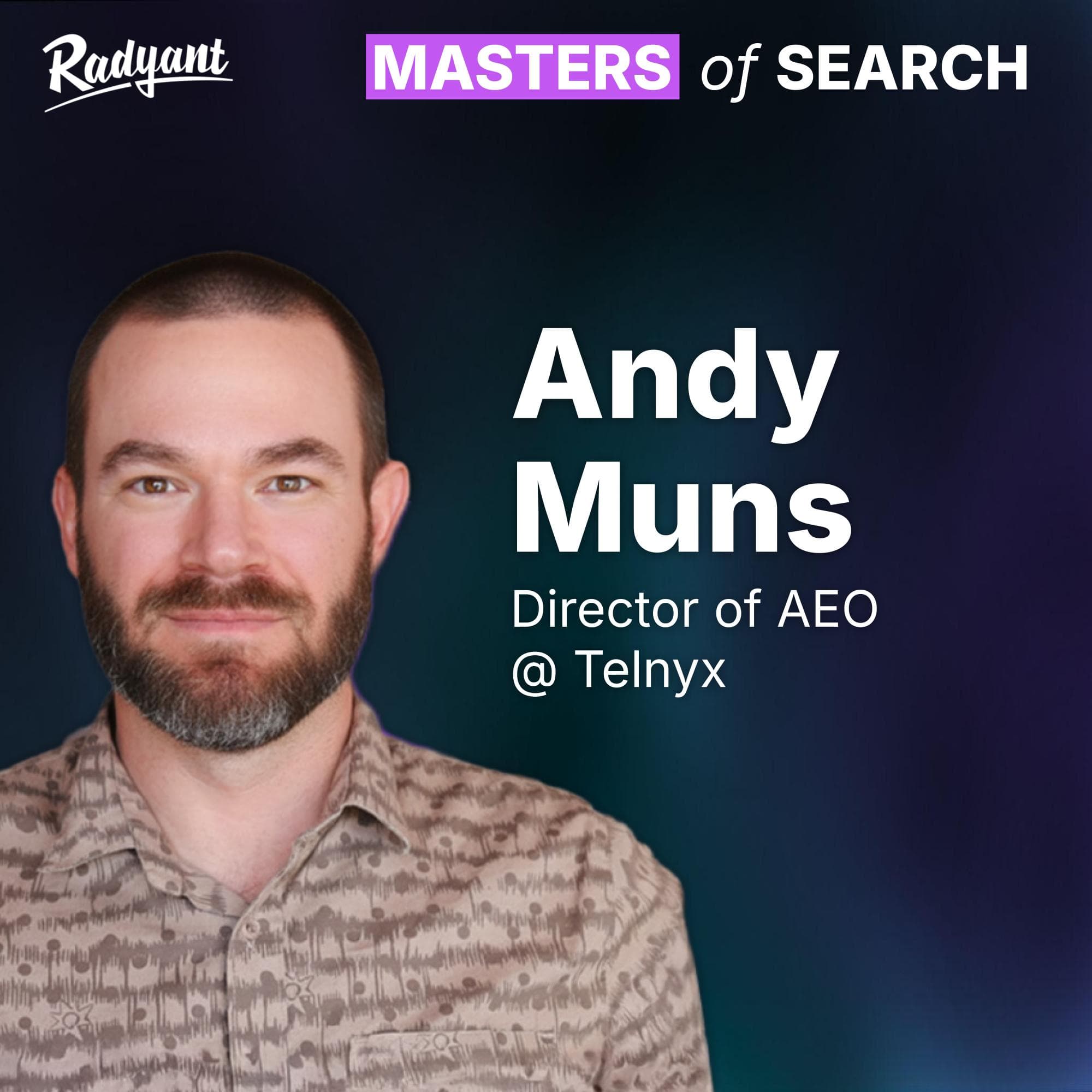
WHY AEO MIGHT JUST BE SEO | Andy Muns, Director of AEO @ Telnyx | #15
Show notes
This might be the most niche flex ever, but I'm pretty sure this is the first ever publicly documented talk with a Director of AEO. Prove me wrong.
Andy scaled a site to Alexa Top 100 and grew revenue from $900K to $22M. Now he's leading AI search strategy at Telnyx with 14K clients like Microsoft, Zillow, and Cisco.
Here's what we covered: → Why AEO and SEO will be the same thing in 1-5 years → why most people are overthinking it → The AirOps content workflow that outranked Cambridge and Stanford → How a 4-person team replaced what used to take 15 people → Why he doesn't trust ChatGPT for commercial decisions → How 10% of Telnyx's traffic comes from AI chatbots → How this traffic converts 3x better than Google → The "airport test" for hiring (+ why skills matter less than you think)
▶ Let's connect! 🔗 Niklas on LinkedIn: https://www.linkedin.com/in/niklas-buschner/ Radyant on LinkedIn: https://www.linkedin.com/company/radyant/ Andy on LinkedIn: https://www.linkedin.com/in/andy-muns/ Telnyx on LinkedIn: https://www.linkedin.com/company/telnyx/
Transcript
Full conversation
- 00:00:00So, if you're still wondering if it's GEO, AEO or LLMO, today we're going to clarify it once and for all.
- 00:00:08My guest today is Andy Mons, who is director of AEO at Telnix, a communications platform company that's working with fourteen K clients like Zillow, Microsoft and Cisco.
- 00:00:22Andy has had a fascinating career journey from frontend developer to UI designer to SEO.
- 00:00:29Eventually helping scale aside to Alexa top one hundred status and growing annual subscription revenue from nine hundred K to.
- 00:00:40Twenty two million dollars.
- 00:00:43he's now leading the charge on answer engine optimization as in AEO and AI content workflows at Telnix.
- 00:00:51but before we dive in Andy thanks so much for joining.
- 00:00:55Yeah, Nicholas great to be on man.
- 00:00:57I'm glad I'm glad you reached out and good to be here.
- 00:01:00Thanks so much.
- 00:01:01So Andy, how would you describe your role as director of AO at Telnix?
- 00:01:06because I we already talked talked about it beforehand.
- 00:01:10It's still a rather uncommon role title and it's something that is it still feels pretty new to me.
- 00:01:16Yes, it definitely is.
- 00:01:18things are changing and yeah, a lot of it still kind of feels the same.
- 00:01:23so I'm Responsible for revenue from a typical organic online sources, Google, nowadays, chat, GPT, perplexity, Bing, all the others.
- 00:01:35And I manage an intentionally small, very lean team.
- 00:01:40We need to be that way, because as a salesperson might say, Steering Microsoft is like steering the Titanic at Telnix.
- 00:01:49It's more like a stand-up jet ski where we need to be able to change directions very fast.
- 00:01:54our engineers Build and ship things super fast here.
- 00:01:57So we definitely have to be agile.
- 00:02:00But it's it's very awesome role.
- 00:02:02I like it.
- 00:02:02I get to work with people from across the org.
- 00:02:05engineers legal Literally get to get my hands kind of in everything.
- 00:02:10So very much similar to what I've been doing the last ten years, but Things have changed a little bit, especially on the content side for me.
- 00:02:20Awesome.
- 00:02:21Let's touch a little bit on your career before Telnix, although it's not necessarily before Telnix, a little spoiler here.
- 00:02:31In a second, but can you walk us through what your typical day-to-day looks like today at Telnix and your role?
- 00:02:40Yeah.
- 00:02:41I try to do my best just to split my days into thirds.
- 00:02:45And so a typical Friday as an example, I'll start the day just prepping for one-on-ones with all my employees, which then I'll take that straight into the meetings with them, a social media manager, content editor slash writer, off page SEO specialist, and a AI automation intern.
- 00:03:05Then I'll just go through those notes.
- 00:03:07That'll help me prep, which I get into next for the following week.
- 00:03:11So from there, I'll just get all the ideas that I've gotten over the last week or two from Slack, from PMMs, engineers, sales, leadership, all the Google Docs that get sent around, like I think most orgs.
- 00:03:24And then I still just use SCM Rush.
- 00:03:28I know there's new tools out there.
- 00:03:30We have Profound and Aerox.
- 00:03:33But for the most part, I'm still in SCM Rush just confirming that, hey, what are the things that we're talking about here and excited about?
- 00:03:40here is their actual demand for them.
- 00:03:43So from there, I'll start running content workflows.
- 00:03:47I use it kind of just for, we'll run about five a week per writer.
- 00:03:53And after each one, I'll just use that to kind of iterate on that workflow.
- 00:03:58So takes a little bit more time than it should, but after each one, I'll look at the output, get back into the prompts.
- 00:04:05and just try to make it a little bit better for every single one that comes out.
- 00:04:10And then something new that I do really every day of the week, but recently met another SEO AEO guy in Denver named Alex Hollingworth, and he was just showing me what he was up to, and I was like, one, damn, this guy reminds me of me back in the day.
- 00:04:29He hustles.
- 00:04:31He's a true one-man show.
- 00:04:33He's building websites, designing them, making the content, doing awesome things with calculators.
- 00:04:39And it was kind of an aha moment for me.
- 00:04:41I'm like, OK, I need to get back to a lot of these things.
- 00:04:46So as a recent, I'll spend, especially on a Friday, the last third of the day, more or less a vibe coding.
- 00:04:53and still trying to figure out what the best, for lack of better word, vibe coding dev environment is for me, and how to do that back and forth and not completely botch it by one wrong copy and paste.
- 00:05:06But that's been a fun.
- 00:05:07part of the job recently, is getting into the vibe coding part.
- 00:05:10And yeah, again, just trying to chase what Alec is doing a little bit here.
- 00:05:15Awesome.
- 00:05:16Let's touch base a little bit on you back in the days because you mentioned that Alex reminds you of yourself back in the days.
- 00:05:24Take us a little bit through your journey because I already spoiled that it's now your second tenure at Telnix.
- 00:05:32You also had a first one, but just maybe give us a little overview because I said it in the introduction that you went basically from front end to UI to SEO.
- 00:05:44A lot of things going on.
- 00:05:46you you wore a lot of different hats and I think it's super interesting.
- 00:05:52Yeah, so mainly the back in the day common is just the fact of like building a website.
- 00:05:57So I kind of disconnected myself from that a bit.
- 00:06:01but back in the day Let's see the first time it would have been about like two thousand sixteen already made plenty of websites for you know freelance type of projects, but just how does CTO come to me and say hey Andy we need a new website for a health website.
- 00:06:18that that we need very simple and Just you know went out and did it in a couple weeks.
- 00:06:24use bootstrap Wasn't cool with the developers or anything, but I mean it definitely got the job done started cranking out conversions and yeah it.
- 00:06:35Anyways, I kind of missed that bit about it after talking with Alec.
- 00:06:39I was like, oh, shoot, man, I used to do this.
- 00:06:42Same with landing pages for PPC.
- 00:06:46My first sentence, Halnex, just after working with developers for a long time, trying to nail Google Core web vitals, just with the amount of resources we had.
- 00:06:56I was like, this isn't going to happen.
- 00:06:58I'm just going to go build these myself and make every landing page as perfect as possible.
- 00:07:03with uh through google page feed insights.
- 00:07:05so yeah that's what.
- 00:07:07uh that's what i'm kind of excited about these days to get back into.
- 00:07:10and um it's a whole new world and you can move a lot faster with with ai which is cool.
- 00:07:16you already um gave a little bit of an insight into how you approach content at telnix and you mentioned aeropes which is a tool that we also use.
- 00:07:29that um basically helps with AI facilitated content workflows.
- 00:07:36Can you tell us a little bit about your experience with AI content workflows?
- 00:07:39Because I also see, so I see people being super hyped about it and I see people being very like, rejected about it and saying it does not work.
- 00:07:49It just produces fluff and I'd like to get your, I guess, more nuanced view on that.
- 00:07:58Yes, so That's another thing.
- 00:08:01first that's just made my job fun again is getting into that whole world.
- 00:08:05It was like, oh, cool.
- 00:08:06Something new to learn.
- 00:08:07SEO just, you know, can become very mundane, very fast.
- 00:08:12And essentially, I think it was about twenty twenty three.
- 00:08:15I was working with Owen, who I think he had on your last, uh, last podcast.
- 00:08:21And we were just in a one on one.
- 00:08:22He goes, Andy, dude, I saw this guy.
- 00:08:24I, it looks like he was running like workflows and prompts out of like Google sheets.
- 00:08:30And, you know, at the time, I do nothing different besides just chatting with GPT and found it a little bit hard to believe, but then he turned me on to this, you know, browser, what would it be?
- 00:08:41Google Sheets Extension called GPT for Sheets kind of helped wire my brain and like how to think about it, started dabbling around with that.
- 00:08:50And then we think got a couple of weeks later, Owen came across AirOps and I don't know how.
- 00:08:56But he sent that my way.
- 00:08:58I hopped into one of their webinars, started poking around with it.
- 00:09:01And that first webinar that I did, it was by that Marcel, I think it's Santelli, out of San Francisco DeepGram, or former CMO DeepGram.
- 00:09:11And that guy, he's the first guy I've seen in a long time, where I was like, I'm learning so much just by seeing what tabs he has open on his browser.
- 00:09:20And just seeing him go work through this in real time.
- 00:09:25look like truly eye-opening.
- 00:09:27So from there, Owen and I, or I think this one was Owen's idea, but we were coming out with like making all these LLMs available on Telnix to use, didn't have any content for it.
- 00:09:39So project one was I was scraping the LLM arena leaderboard, or the Hugging Face Arena leaderboard, and I'd combine that with a bit of data from artificialanalysis.ai.
- 00:09:53And I think I put that in an either Google Sheet or just a CSV, fed that into the workflow and had it generate just a page worth of content for all these LLMs.
- 00:10:05And yeah, that was kind of the first foray into it.
- 00:10:09And it's back then to your statement on, yeah, it can produce fluff.
- 00:10:15We're I think we're using GPT three.
- 00:10:17point five was as good as it got at the time.
- 00:10:20So it I mean it took the whether you call prompt engineering context engineering.
- 00:10:25That was that was the biggest battle just getting it to a point where I could send it to Owen and we could both go.
- 00:10:31okay Yeah, man, that's that's pretty good that or it's good enough.
- 00:10:33Let's let's roll with it.
- 00:10:37But yeah, just getting over those first few workflows it's it's It really changes your mind again on that comment.
- 00:10:44Like, hey, does it just produce fluff or is there a way to get it grounded with as minimal context as possible?
- 00:10:51So it's actually sounding like maybe sounding more like you sounding like something your company would talk about, et cetera.
- 00:10:57But just to sum up the experience in a nutshell, just lots of experimentation and and plenty of times going to own and being like, man, this isn't good.
- 00:11:08This isn't good.
- 00:11:08And him to say, no, do you just keep at it, keep at it, we'll get it there.
- 00:11:13And yeah, sure enough, we did.
- 00:11:16And which type of content do you mainly produce now with ERAPS?
- 00:11:21Is it primarily blog posts and articles, or is it also like social media posts or other stuff?
- 00:11:28So present day, we are using it a bit in the mix of NADN with my social media manager, with literally all of my employees.
- 00:11:39like to get them in the weeds, show them at least at least so they can have the gist of, hey, here's what it does.
- 00:11:45Here's what's possible.
- 00:11:47But we'll use that for first drafts, for posts across all platforms.
- 00:11:53We have one set up that will actually post an X thread via Vista Social, which is cool.
- 00:11:59But what we like to do here is more or less for all workflows is produce five outputs as options.
- 00:12:05then whoever's gonna take to the finish line, whether it's our editor, writer, or social media manager, they have the best five to pick and choose from.
- 00:12:15They can kind of finesse that, put the final touch on it, and then send it.
- 00:12:21Super cool.
- 00:12:23I still see, sorry.
- 00:12:24Yeah,
- 00:12:25sorry.
- 00:12:25And then on the content side, we really will use it when it makes sense.
- 00:12:30Like we have a phone number directory.
- 00:12:33We wanted to add more, you know, useful relevant content to it.
- 00:12:36There's a hundred fifty plus pages or something like that.
- 00:12:40And so for cases like that, we'll use it to write sections of the page.
- 00:12:44But on the content side over the last couple of weeks or probably in a couple of months, mainly just using it to.
- 00:12:51prepare briefs and grab research and stats for a writer.
- 00:12:58Awesome.
- 00:12:59Um, I still see a lot of people struggling with the implementation of these types of workflows.
- 00:13:06So they might have already, uh, made the transition from just using chat or Claude, like in a one on one chat or like simple chat to.
- 00:13:19using like a custom GPT or maybe a cloud project where they have like knowledge and a system prompt or instructions.
- 00:13:27But they still have a hard time imagining how these like grid based workflows in Arabs, for example, work.
- 00:13:36So what do you think like what were some of the key learnings you made over time that helped you overcome this transition to the state you're in now?
- 00:13:49Gosh, more than a technical issue was.
- 00:13:53the writers that I had at the time were just completely against AI content.
- 00:14:00They wanted, I mean, they'd use ChatGPT, I guess, here and there to help them write.
- 00:14:06But when it came to like, hey, let's load up, you know, AirOps grid with like, thirty keywords.
- 00:14:14generate first drafts with it.
- 00:14:16You guys can take them and run with them.
- 00:14:19They were just held against doing that.
- 00:14:22So one, but one of the writers and both of them are awesome and I love them both left for another job.
- 00:14:30And then the other one ended up or timed up nicely.
- 00:14:33But what we ended up doing was just finding a new writer editor that, hey, we could just plug them in there in the system that already exists.
- 00:14:42where, hey, we're going to We're going to base our work off of this workflow.
- 00:14:48And if it's not as good as it can possibly be, let's talk like we do regularly and continually iterate and improve this thing.
- 00:14:56But yeah, the biggest challenge is getting a writer who may already be on staff who wasn't using AI, was there before all of this came about to tell them, hey, I know normally you're producing two blog articles a week.
- 00:15:11Now we want you to do five.
- 00:15:13For whatever reason, even with AI, and whether you're chatting using a flow like AirOps, it just didn't land and was way harder than expected.
- 00:15:26So yeah, just getting someone fresh in, someone new and like, hey, here's the new way.
- 00:15:29Here's how we're doing it.
- 00:15:31His worked wonders so far.
- 00:15:34Funny, right?
- 00:15:35How the human element is key to actually leveraging AI fully.
- 00:15:40I find this a little bit, so a little bit.
- 00:15:43It's a funny coincidence.
- 00:15:45I agree.
- 00:15:46It definitely is.
- 00:15:52So you also worked in SEO when basically AEO or GEO wasn't even a thing because AI overviews or chat GPT wasn't around.
- 00:16:07accumulated a lot of knowledge about the space before we went into this massive ecosystem shift now.
- 00:16:15so i'd like to better understand what your what's your take on a e o versus traditional s e o?
- 00:16:23how much s e o is still in a e o and all these types of like questions people have all the time.
- 00:16:33so.
- 00:16:34My take on it is I think they'll be one and the same in one to five years if they aren't already.
- 00:16:42And what I mean by that is I've literally just been sticking to Google Developer Guidelines like I have my entire career.
- 00:16:49And obviously, we're still using AI in many ways, shapes, and forms.
- 00:16:53But I think just a mix of Google Developer Guidelines for SEO plus pay, we're always looking for ways to improve our internal processes or Kaizan it.
- 00:17:04Whether that's just making somebody on your team's job easier, you know a workflow that produces more output.
- 00:17:12I still think Google developer guidelines for SEO are a Solid that and the way to go.
- 00:17:19Another reason I say that Nick less is I've.
- 00:17:21I've checked so many, you know as a EO guru posts on LinkedIn.
- 00:17:25That kind of like you alluded to earlier.
- 00:17:28They're like all this new workflow did all these incredible amazing things and Man, it's easy enough for people in our world to go.
- 00:17:36go over to a trust SDM rush.
- 00:17:38plug in their domain.
- 00:17:40Look at what they're ranking for in the top ten and in I swear so many cases It's like what is this guy talking about?
- 00:17:47like I'm supposed to listen to him and his he's he's got a you know a spike in traffic back down to zero.
- 00:17:55so I Yeah, I think anybody who's just been you know sick into to good old classic Google developer guidelines is probably in a good boat.
- 00:18:05They're probably going to be optimizing for LLMs.
- 00:18:10For the most part, at least up to ninety-nine percent, they're covering all their bases with that.
- 00:18:17But I do think that the bots and crawlers for open AI, for Plexity, is just examples.
- 00:18:25I think they're really bad.
- 00:18:28Google's been doing it for over two decades, right?
- 00:18:31And they're very good.
- 00:18:33I think they have a solid system for ranking what genuinely should be ranked.
- 00:18:38So thinking about it from us on the other side, just as a normal everyday user of any search engine, I think perplexity and GPT can lead you astray in many ways.
- 00:18:52One silly example is for cooking.
- 00:18:55This I mean in this one really really applies to SEO as well, but I As someone who's done this for for my career.
- 00:19:04I do not ever trust search results for best, you know best recipe for popovers It's going to be.
- 00:19:12you're gonna get somebody's website.
- 00:19:13that the answer that you're gonna get is somebody that's just the best at SEO Doesn't mean they're the best cook.
- 00:19:20If that makes sense, so I'll I'll just go and check.
- 00:19:23Hey if I want to make popovers somebody like Gordon Ramsay England English guys probably gonna have a great recipe for that.
- 00:19:30Yeah, I'm not looking at the search results.
- 00:19:32So but anyways back to AD Oversesio.
- 00:19:35I think I Think the bots GPT bot and the others they'll catch up and they'll reach parody with Google bot, but I just I don't know how, you know, what that timeline exactly looks like.
- 00:19:48I could see it in one to five years, but I think there are.
- 00:19:52point I'm getting at is I think there's ways to exploit LLMs at the moment.
- 00:19:55And we're seeing that with listicles, with content freshness, Air Office put out great data on that and I've tested it and definitely seen truth to it.
- 00:20:06But then I would also argue like those were always good tactics and, you know, worked very well five years ago too.
- 00:20:13So, yeah, I think right now it's kind of like the, you know, twenty fifteen-ish or even earlier in Google where, you know, you can exploit the system a bit, people are doing it.
- 00:20:23I see that gap kind of closing in the next one to five years, though.
- 00:20:28But I can already hear people saying or commenting, but what about Reddit?
- 00:20:34I'm seeing Reddit all the time in my LinkedIn feed.
- 00:20:37You should be active on Reddit.
- 00:20:38What's your take on that?
- 00:20:40That I think you should absolutely like you and you probably always should have been.
- 00:20:46But gosh the unfortunate part for me Nicholas is I just started a Reddit account about a year ago.
- 00:20:53It I found it way harder than expected to like man.
- 00:20:55How do you get anybody to thumbs up anything you say?
- 00:20:58kind of figured it out not not at all how it would apply to my world and tell me specifically but I mean clearly People spend a lot of time on Reddit and they probably will for the foreseeable future.
- 00:21:15You mentioned that you're using profound next to classic SEO tools.
- 00:21:23What made you choose profound?
- 00:21:25What is something that you found most interesting about them?
- 00:21:30How are you using them in your daily workflows?
- 00:21:33Are you just using it to check your AI visibility?
- 00:21:38Are you also using the conversation explorer?
- 00:21:41I think it's this like tool where you can see the at least estimated prompt volumes.
- 00:21:47I think the space is still so new and a lot of people know the likes of Ahrefs, etc.
- 00:21:52and how they work.
- 00:21:53But all the new AI search visibility monitoring tools, it's still something where I feel like everybody is somehow just trying to find their way how to make it work.
- 00:22:07But you don't have like these obvious like five to ten best practice workflows yet, or would you agree?
- 00:22:15Yes, and I am, so we're using Profound, we're still referencing AirOps as well and their new tool and for that, I think they have a long way to go.
- 00:22:27I'm not sure I'm not the only person thinking that.
- 00:22:31I mean, SCM Rush, Ahrefs is only gonna be so accurate.
- 00:22:36There's, I think, like most SEOs, many times in my career, I've referenced that versus what we're seeing in Search Console.
- 00:22:43And its hit or miss seems to trend more or less in the same direction.
- 00:22:49But with either way for LLM and prompt volume tracking, it has a very long way to go.
- 00:22:58At the moment, it's like, hey, it's the best we have.
- 00:23:00It's better to have something than nothing to fly by.
- 00:23:04It's helpful to mainly for me just using the visibility and tracking.
- 00:23:08So, you know, hey, we have at least a general idea that I can share with leadership, like, hey, we're heading in the right direction.
- 00:23:16Obviously, there's tons of arguments of why that data, you know, may or may not be the best.
- 00:23:23One, just being, you know, the search history of every single person's chat GBT instance.
- 00:23:29But it's the best we have for now.
- 00:23:33We we already had air ops and we ended up adding on profound just because they out of everything else I've tried to they.
- 00:23:41they seem like they're they're the closest to it so far.
- 00:23:44The.
- 00:23:45the one challenge I think all of them face including profound though is they're you can't really track anything.
- 00:23:52that's over two to three words so I don't know.
- 00:23:56I haven't really come across a study yet that shows like the average length of a prompt.
- 00:23:59but I think it's safe to say what people ask in prompts, GPT is wildly different and longer and more long form than what people search on Google.
- 00:24:09So that's a challenge.
- 00:24:10I can't wait for people to fix.
- 00:24:13I'm not the guy to do it.
- 00:24:15There are people out there that hopefully will, but yeah, right now I see that as a huge issue in that world.
- 00:24:22Just like, hey, if we can't track keywords, prompts over two to three words, I don't really know what this thing's doing.
- 00:24:30Hmm, makes a lot of sense.
- 00:24:32speaking of showing management that you're moving in the right direction.
- 00:24:37I think in the old SEO world, like.
- 00:24:41Depending on the tool you're using, but you mostly had some sort of visibility index or like position tracking for a set of keywords you're monitoring.
- 00:24:51Then you obviously had.
- 00:24:53traffic in the Google Search Console that you could show where basically everybody like to show graph that go from bottom left to top right because that's how growth looks like, right?
- 00:25:07How are you approaching this now?
- 00:25:09Like how do you try to show progress, show like business impact of the initiatives around AEO, SEO, like everything that's connected to organic growth?
- 00:25:24So really kind of or kind of sort of maybe old-fashioned in that sense of just using a couple GA-IV reports, we're like, hey, we want to.
- 00:25:34we're gonna look at sources that contain, you know, the top five LLMs.
- 00:25:38I think ninety eight percent plus of ours is from ChatGPT at the moment.
- 00:25:44But just showing that.
- 00:25:46conversions, both signups, contact sales, and then just pairing that with the traditional old organics, you know, Sessions dashboard that shows the same.
- 00:25:57We've been, I don't know, fortunate, or again, just sticking to Google guidelines works, but we've seen growth, still strong growth on the organic click side in Google and actual clicks from chat EPT and perplexity.
- 00:26:12So it's People are measuring citations and mentions, and I think it's probably worthwhile doing that.
- 00:26:21But yeah, end of the day, it's easy enough to go, hey, how many sessions have we got from these online sources, and what do they do after they get to the site?
- 00:26:30I think the best way to still track it, that's the actual, actually what's happening, the actual momentum you're creating, the actual value that you're delivering to whatever org you're at.
- 00:26:43So you've not seen impressions and clicks decoupling yet like a lot of people shared with GSC screenshots on LinkedIn?
- 00:26:53No, we have seen.
- 00:26:54so actually I have seen the bit of the decrease in depressions or impressions as of recently but And we have seen like impressions just kind of skyrocket, but our clicks haven't gone in the opposite direction.
- 00:27:09What has happened and there's a ton of truth to is people claiming that like, hey, most of the traffic from AI and just in general is going to our homepage now.
- 00:27:20I think there's a lot of truth to that.
- 00:27:21The people are, they're having their full funnel conversation with an LLM and then they just go straight to the homepage of the site after they've kind of made their decision.
- 00:27:31So we're definitely seeing that if you single out just our homepage, it's a, yeah.
- 00:27:37way up into the right compared to everything else.
- 00:27:41Super interesting.
- 00:27:42And can you share a little bit, not in absolute numbers, but just relative numbers, how is the traffic share between organic search in the form of Google or Bing, whatever other search engine might be relevant, and then traffic from chativity and perplexity?
- 00:28:05because I came across this chart from Webflow, I think they shared where they basically said that now, so they did not talk about traffic, but about signups, but they said that now AI chatbots account for like eight percent of their total signups, which I felt is quite significant.
- 00:28:28Although I mean Webflow is like a, I would call it a general utility tool.
- 00:28:33So basically everybody on the internet needs something like this or needs something like a form builder.
- 00:28:40but Can you share anything around like the proportions between classic organic search and AI search or AI chatbot?
- 00:28:49Yeah, absolutely.
- 00:28:50So we're right around And I can either follow up in like a YouTube comment or on LinkedIn.
- 00:28:57But we are right around that ten percent you.
- 00:28:59and then at least on the session side I'd have to double check on the conversions.
- 00:29:04But what I do know is, I think a week or two ago when I checked, traffic from GPT converts two to three times, I want to say three times higher than even organic search does.
- 00:29:16So yeah, and I do think that's a testament again to people have that full conversation in an LLM if they're closer to making up their mind before they actually get to your site.
- 00:29:30Fascinating.
- 00:29:31I also find it fascinating always to understand how people are using it themselves.
- 00:29:37Can you share a little bit about your usage of AI chatbots or Google?
- 00:29:42Like, when do you still use Google?
- 00:29:45When do you use chat GPT?
- 00:29:46Or do you use something else?
- 00:29:48Do you use cloud or perplexity?
- 00:29:50I think it's just super interesting because we, as marketers, we are always in this dual role.
- 00:29:59We can see it as a channel, but it obviously is also a tool for us that we can use either in a professional capacity or also as just like in a private capacity, like for what did I do?
- 00:30:14Research a restaurant on the street near my home?
- 00:30:19that I didn't know yet, just wanted to check.
- 00:30:22What are the?
- 00:30:22what are the ideas that come up?
- 00:30:25Worked pretty well actually, so I'm curious to hear how you're using it.
- 00:30:29Yeah, so it's um Gosh, I think a lot of my searches these days go to YouTube.
- 00:30:36honestly um There's just so many cases where it's like hey, I like I need to fit fix my garage door opener.
- 00:30:44I could, you know, go to Granger's website, read probably a, you know, way too long article and bore myself to death.
- 00:30:52Or there's probably some guy on YouTube that has a one minute short that gets straight to the freaking point is going to teach you how to fix it.
- 00:31:00I find that that works.
- 00:31:02Use that for cooking a lot as well.
- 00:31:05But yeah, I think I probably use YouTube probably more than Google.
- 00:31:10And then perplexity, I have a funny use case for that is.
- 00:31:13that's how my wife and I will settle arguments.
- 00:31:16It is like, hey, if you can send me the perplexity answer that you got it, you win.
- 00:31:22And which since I'm the one who started it, I can't go back and tell her what I told you earlier.
- 00:31:28is that like, hey, sometimes perplexity definitely gets it wrong.
- 00:31:31And it requires some clicking into those sources and, you know, a little bit of fact checking, but No, it has been fun to use for Plexity, and just for that, for settling silly little arguments with the YFN.
- 00:31:47Gosh, and then what else?
- 00:31:48I don't know, for a lot of things that are major life decisions, I seek an actual human being out, honestly, then over going to the internet.
- 00:31:57I wish I could trust online reviews, but knowing how this whole world works, I don't trust any reviews on the internet, so.
- 00:32:08and around commercial decisions, for example, in your role at Telnix, because I see a lot of people, um, passionately talking about B to B, uh, buyers turning more and more to HPT or perplexity or, you know, the others, um, To make decisions around buying software or maybe even choosing the right service provider.
- 00:32:36I don't know.
- 00:32:37Is this also something you you do for yourself?
- 00:32:42And how do you see it?
- 00:32:43maybe also in your team?
- 00:32:46Um, let's see.
- 00:32:49So that one would be tough again because I mean I would just question again knowing what we know like.
- 00:32:54hey if I ask.
- 00:32:55If I ask what the best, whatever new keyword research tool is, or new, you know, best prompt tracking tool is, the answer, I think most of the time these days is going to be whoever updated or created the latest list that called targeting that keyword.
- 00:33:11So I, again, I still like to hear like, Hey, I know another actual human being that I trust and can tell me like, Hey, yes, I have used this tool.
- 00:33:20Here's what I like about it.
- 00:33:21Here's what I don't.
- 00:33:25But no, I mean to answer your question.
- 00:33:27I I don't trust Chachi BT for for making decisions like that.
- 00:33:32I find it so interesting.
- 00:33:33I feel like like what I hear you saying is somehow similar to people that work with Google ads and that never click on ads themselves because they just know how it works.
- 00:33:47and it's it's.
- 00:33:48It's so interesting because I feel like the closer people are to this whole topic, the more like not in a negative way, but in like a reasonable way, the more cautious they are.
- 00:34:02And they are not like like the hype, the hype people like, yeah, of course, I'm just, I'm casually buying a, a, a ten K yearly subscription tool from chat GBT research.
- 00:34:15Why not?
- 00:34:17Yeah.
- 00:34:18It's, oh man, here's a couple other examples.
- 00:34:22So another workflow that we made, and honestly, this one probably took a day, Max.
- 00:34:31We need to update that section of the site.
- 00:34:33I won't tell you where it is, but I made a workflow, literally, two, three nodes in AirOps.
- 00:34:40It more or less would just accept the keyword, go look at the people, also ask for that keyword.
- 00:34:45in write a seven hundred and fifty word article.
- 00:34:48This was back, you know, twenty twenty three, I think.
- 00:34:51So was there, I think, early enough to the party?
- 00:34:54But we started finding us ranking for these these keywords ahead of.
- 00:34:59like the University of Cambridge, Stanford University, like top tier universities are this AI content is outranking them.
- 00:35:08And I'm like, man, again, I think Google's still the best or the best at it.
- 00:35:13But just seeing that, I'm like, Oh gosh, this makes me question the world of what we do even more now and anything I hear on the internet.
- 00:35:27It's very funny and it's very, how do I say it?
- 00:35:33I think it speaks to you that you have this element of critical reflection, although you have this great success.
- 00:35:41Yes.
- 00:35:42Nicholas, I'll still get duped by a good ad or organic landing page every once in a while.
- 00:35:50After the fact, I'm like, all right, they got me, but I don't know.
- 00:35:55Cool.
- 00:35:56Let's speak a little bit about teams.
- 00:35:59How many people are in your SEO, AEO, everything marketing team at Telnix?
- 00:36:06I
- 00:36:07have four totals and employees right now.
- 00:36:11another one we hired, a technical SEO specialist.
- 00:36:15But yeah, very lean, intentionally small team, which I think is where a lot of tech companies are headed these days, is the amount of work that doesn't even require a workflow that just chat GPT can do for you from a lot of just kind of touch up day to day SEO tasks is absolutely insane.
- 00:36:40So yeah, we're really no plans to grow the team in any way, shape, or form in the near future.
- 00:36:48We're just focused on just continually improving these workflows that we have.
- 00:36:55And yeah, that's more or less how I work with my team.
- 00:36:57present day is like, hey, my writer, my social media manager, how can we make your guys' job as easy as possible?
- 00:37:06So, you know, you can.
- 00:37:08you can spend more time putting that final touch on a piece of content or an article or spending more time creating a better, more meaningful graphic for a page or a social post.
- 00:37:20And then I do work with, we work closely with the PMMs team of like, which will be five or six year in the next few days.
- 00:37:29And then a couple of people on the paid marketing team is kind of like the core group of marketing folks at Telnix at the moment.
- 00:37:35Interesting.
- 00:37:37And since you already had a couple of different interesting positions throughout your career, you had the chance to build a couple of teams.
- 00:37:50Maybe can you share some of your key learnings from all these different team building tenures you had?
- 00:37:59Because I feel like, especially for startups listening, And especially for startups that might be like in seed stage or maybe series a and they're looking to build out their first marketing team.
- 00:38:12So obviously you guys already have like certain building box in place At least that's how it sounds.
- 00:38:20but like what would be your key learnings or the key advice you have for people That want to build also like a highly functional and performant marketing team?
- 00:38:37Things that have gone well for me is, and I've seen them go the wrong way too, sounds super straightforward and simple, but just hiring people that at least have some overlap with interests and hobbies.
- 00:38:51So they don't have to be the exact same person with you, like all the exact same bands and do all the same things, but I think there at least has to be a little overlap.
- 00:39:04I've heard the phrase like, hey, could you, if you were hopping on a flight with this person and you were stuck at the airport for an hour, would you sit there in awkward silence with them or could you talk through it and still have a good time?
- 00:39:18And that one always kind of just stuck with me.
- 00:39:22I've stepped into companies or back into teams and it's like, wow, that's definitely not the case here.
- 00:39:28And yeah, I just think it's so simple and so many people just skip that part and just base, you know, hires straight off, like, hey, their skill set, their experience, where I'd almost argue that just having stuff in common and being able to vibe with those people is more, is equally or more important.
- 00:39:51I think, let's see, what probably works the best too is just, one, having religiously doing stand-ups every single day of the week.
- 00:40:04If you can do it in person, that's the way to go.
- 00:40:08And same with happy hours.
- 00:40:09When I was leading the team, we turned the site into an Alexa top, or Alexa top one hundred website.
- 00:40:17I had something like a three hundred dollar Like credit card that I could use per month to take the team out for beers.
- 00:40:24for you know, whatever we wanted to do and Man that went a long way Just just bringing everyone close together you go out get drinks Same group of their same team.
- 00:40:37we'd go on you know all the way out to drive six hours go camping on the river Lake Havasu, Arizona.
- 00:40:44Those same guys just joining me last year for the trip even though I haven't worked with them in a few years, but Yeah, just building, building camaraderie, just in a very traditional sense, I think is will be every anything and everything else.
- 00:40:58It'll be talent.
- 00:41:01You know, it's better than better than having super, super smart people in the room is having people that pay.
- 00:41:07we all get along and we're buddies in the same room together.
- 00:41:11Honestly, I think the first point you make, like it doesn't feel straightforward to me.
- 00:41:17So actually, I probably I wouldn't have thought about that, especially the airport analogy or the airport story in our own hiring process.
- 00:41:28So I have to steal this from you.
- 00:41:29I hope you won't sue me.
- 00:41:32But this makes a whole lot of sense.
- 00:41:35But I think like the camaraderie aspect, it feels like you are really leaning.
- 00:41:43heavily towards working in person at least it sounds.
- 00:41:46can you give me a little bit of the perspective?
- 00:41:48because obviously it's always a question that especially high growth companies ask themselves are we gonna go remote?
- 00:41:58are we gonna go in person?
- 00:42:00do we do hybrid?
- 00:42:01because they're thinking about hiring the best talent sometimes.
- 00:42:05Supposedly the best talent is not available at the location of the headquarter.
- 00:42:10so what's your take on that.
- 00:42:12Um, so I am.
- 00:42:14I'm so sick of fully remote work and I I mean when you work with people you never get to meet them in your entire life in person.
- 00:42:22It's kind of.
- 00:42:22it's just kind of weird.
- 00:42:25You don't really have a sense of who that person actually is.
- 00:42:29There's just so much that gets you know lost in the message over slack and in zoom calls, but Sad reality, I think they carried over from twenty twenty and you know the COVID days.
- 00:42:42But we're going to go back to the office.
- 00:42:45This new team that I hired, I intentionally found people locally.
- 00:42:49It was a hell of a lot harder to do.
- 00:42:51I live in South Metro, Denver, Colorado, and not a lot of big time or heavy hitting tech companies here.
- 00:42:59So it did take a lot way longer than it normally would have defined somebody.
- 00:43:04But we're in the process of finding an office right now, just a smaller space for five or six people.
- 00:43:09We'll have a couple other people from... different parts of the org just join us because they're in town.
- 00:43:15But we'll be in there Monday, Wednesday, Friday.
- 00:43:18And yeah, I just I really don't.
- 00:43:20I've seen countless, you know, news stories, studies of the effectiveness of remote work and, you know, compared to in person and goes both ways.
- 00:43:32In my personal experience, there's you can't tell me that people don't get more done when they're there together, they're working together.
- 00:43:40They're going out after work, hanging out after work, and yeah, they just get that in-person office experience.
- 00:43:50I honestly, I feel bad for this new intern that we started coming in remotely and for any, if you're getting into this world present day and your first job is fully remote, I think these kids, for lack of better words, are going to build horrible habits that they're just gonna put them in a bad place one day when they do have to go into an office.
- 00:44:13But yeah, I'm so sick of people saying, we're like, hey, let's do this async.
- 00:44:21When you're in the remote world, it's like, all right, we already don't get to see each other.
- 00:44:25And now you're telling me best you can do is message me on Slack about this super complex issue we need to solve.
- 00:44:32Dude, let's just... Let's jump on a Google Meet for five minutes and figure this thing out.
- 00:44:39Yeah, there's so many things that just get stretched from like, hey, this could have taken us five minutes to fix if we huddled together in a room.
- 00:44:46Now it's a two-week process, and there's a day in between a back and forth, especially if you're teammates in Europe, you're in America.
- 00:44:57It creates so many issues.
- 00:44:58I'm really excited to get back into the office and at least Monday, Wednesday, Friday with this new team that I have.
- 00:45:06Sounds cool.
- 00:45:06Actually, it sounds fun because it somehow feels very entrepreneurial that you have your own small sub-office from the headquarters.
- 00:45:19I don't know where Tenix is located.
- 00:45:21Is it in Austin, Texas, right?
- 00:45:25Yes.
- 00:45:26Their main office is... Right or we're in Chicago, which is kind of where the company was founded.
- 00:45:32Okay,
- 00:45:32and then Dublin just one opening up in Australia.
- 00:45:40Yeah,
- 00:45:42there's.
- 00:45:42there's several offices around But yeah, it will be it's.
- 00:45:47it is kind of neat though that we will just have like a small little remote, you know remote office in a town that Definitely doesn't have a lot of tech companies.
- 00:45:54So
- 00:45:56But that sounds super cool.
- 00:45:57And I feel like this is probably also something that helps you create like a unique culture, right?
- 00:46:05And the culture that you as a team can develop for yourself.
- 00:46:10And I mean, the one thing is the culture, a company as a whole has or tries to facilitate.
- 00:46:16But the other thing is like a culture with the group of people that you're working with day to day, right?
- 00:46:23And I mean, so.
- 00:46:25You also worked with very different companies.
- 00:46:29We chatted about that beforehand.
- 00:46:32So how do you think about the cultural aspect or creating a good culture?
- 00:46:40What is a good culture for a team in a tech company and also in a high growth tech company?
- 00:46:46So I think what I've seen consistent at the places I have been.
- 00:46:54two companies in San Diego, there's positives and negatives to both cultures were different.
- 00:47:02Telnix is very different.
- 00:47:03We're global, you know, with Roots in Chicago.
- 00:47:07And what I've seen just went out across the board is just people with grit that like, hey, I can, I'm not just going to stay in my lane if I need to get something done.
- 00:47:19I need to design a little bit.
- 00:47:21I need to, you know, Make a make a quick GIF animated graphic for a social post.
- 00:47:27There's just so many people these days where it's like Oh, no, that's not my job.
- 00:47:32But yeah, I think just like the general gritty like general online marketer that you know was the thing back ten years ago like those are the.
- 00:47:41those are the people that succeed and and in a just in any Any team environment whatsoever just having gritty people that don't make excuses is what I'm always looking for.
- 00:47:56Yeah, and you don't have to be nice.
- 00:47:58That's what I like about.
- 00:47:59Telnix is compared to a California company, or at least one of them.
- 00:48:04Everyone's just patting you on the back.
- 00:48:06Good job, bro.
- 00:48:07Like you did it.
- 00:48:09And I don't know if it's the Chicago thing, a global thing at Telnix, but people just they'll tell you how it is.
- 00:48:15And I love that.
- 00:48:16Like, hey dude, this sucks.
- 00:48:18I don't like it.
- 00:48:19Fix it.
- 00:48:21Rather than beating around the bush, I think that goes a long way for for any team, but you have to hire the right people that can, you know, they can take that too.
- 00:48:29So
- 00:48:31it's super funny because sometimes people say something similar about Germans.
- 00:48:38So especially when I talk to when I talk to people from the US, they sometimes tell me, you know, with Germans, it's sometimes a little odd because they just get straight to the cause.
- 00:48:50no small talk whatsoever like okay welcome agenda.
- 00:48:55one two three five meeting done.
- 00:48:57okay see you bye.
- 00:49:00it feels like chicago people or telnick's people and germans have a lot in common
- 00:49:05that if uh gosh i should be hiring more people from germany it sounds like
- 00:49:10you should but they have to relocate.
- 00:49:13you have to offer them relocation support.
- 00:49:17that uh yeah that beats up.
- 00:49:18there's probably not many that want to to move to, to Colorado where we're at.
- 00:49:21But no, I would love, that's a, that's kind of the, when I did get to go to Germany a couple of years ago, what I picked up and, and gathered in, and I, I like that part about it.
- 00:49:32Yeah.
- 00:49:33Yeah.
- 00:49:33But Germans can also be very nice and balancing straightness, straightness with being polite and having a good mixture.
- 00:49:43But speaking of gritty, we have to touch on one more topic.
- 00:49:49Specifically, which is somehow obvious if we're speaking of the US and this is football.
- 00:49:58So you have a background in football coaching and I find this like it's just a cool thing because I mean sports and business like.
- 00:50:12there are a lot of similarities like high performing sports teams, high performing business teams.
- 00:50:17But any learnings you you you can translate from football to marketing?
- 00:50:23Yes, I think the the biggest one is is just keeping things simple.
- 00:50:28So I've coached at multiple levels and if let's say around like the like twelve to fourteen year old range, a lot of a lot of these kids have never played the sport and these coaches will come in and give them a playbook that's like that thick, you know, and They're expecting these kids to run a hundred different plays.
- 00:50:48They're screaming at them during the games.
- 00:50:51Like, what?
- 00:50:51How would you get this?
- 00:50:53And I am a hundred percent like, hey, guys, we're going to, I don't care.
- 00:50:57The other team knows what we're going to run.
- 00:50:58We're going to run five plays and we're going to run them very well.
- 00:51:02And we're going to be consistent practicing these five plays.
- 00:51:05We're going to, all of our drills are going to mimic going through the motions that you're probably going to go through when we run these plays.
- 00:51:12Just so we're ready for every scenario from these these five little plays that we do run.
- 00:51:18And that's what I've translated over.
- 00:51:21It's just like, hey, keep it simple.
- 00:51:22Be good at at what you're good at.
- 00:51:25If you're a restaurant, don't be Cheesecake Factory.
- 00:51:28I don't know if the Synology will land.
- 00:51:30Don't be Cheesecake Factory.
- 00:51:31Be in and out.
- 00:51:33Like if you want a burger, that's all we make.
- 00:51:35Come here and get it.
- 00:51:37If you want a bunch of average, you know, a hundred different average things go to Cheesecake Factory.
- 00:51:45So yeah, I just like doubling down on, you know, whatever your team is good at at the time or whatever skill sets you have in-house, like double down on those.
- 00:51:54You need to, you know, experiment a little bit here and there, but yeah, be the in and out.
- 00:52:01makes no sense.
- 00:52:02I feel like the restaurant analogy always lands perfectly.
- 00:52:06And I remember the times when we were still struggling with finding the ICP for us here at Radiant.
- 00:52:13And I was always thinking about, yeah, man, I don't want to be that restaurant that offers burgers and pizza and sushi and cake and all these other things like on the other five pages of the menu like pasta and Like you like nobody will believe you that you can do all of these very well.
- 00:52:36And I mean, there will be people that don't care, but they usually won't be up for a premium price.
- 00:52:45So you will either win on the price in terms of being rather cheap, offering a lot of discounts, whatever, but you will never become like a premium provider.
- 00:52:55And I mean, this is as at least how I feel about it.
- 00:52:59It's a race to the bottom.
- 00:53:01inevitably
- 00:53:02i agree.
- 00:53:04now cool um i'm looking a little bit at the clock.
- 00:53:08we're already talking almost an hour um.
- 00:53:11time has passed a lot i think andi.
- 00:53:13actually we passed the airport test like if we would stuck at the airport.
- 00:53:18could you talk for an hour?
- 00:53:20we we made it actually.
- 00:53:22maybe you should think about the relocation support.
- 00:53:26uh
- 00:53:27no just kidding.
- 00:53:28but so to wrap things up a little bit.
- 00:53:33I'd like to look a little bit into the future with you.
- 00:53:38So obviously it feels like we are somehow working on the future in the future.
- 00:53:43It's like this super fast changing ecosystem.
- 00:53:47I think sometimes it's hard to keep track of everything that's going on.
- 00:53:52But I'd like to know your perspective on where do you see SEO and AEO heading in the coming years like let's say maybe next two to three years?
- 00:54:07um I think what concerns me most is just like is the tracking part?
- 00:54:13um I think on that side it It could go either way where it's just paid three years from now.
- 00:54:20It's paid, you know Most people are using gpt over google.
- 00:54:24Maybe we get to that point or get closer to that point and almost feel like for on the data side like you're just gonna have to separate hey we know we know where paid traffic comes from.
- 00:54:36everything else we're just gonna have to attribute to whoever our organic person is or organic leaders on the team because there's no other way to tell where where these people are coming from.
- 00:54:46and you can't just say like hey oh wow direct traffic is eighty percent of traffic now and People just woke up randomly and dreamt of going to tell mix calm.
- 00:54:55They've obviously were influenced in some other way shape or form.
- 00:55:01So that part I mean either way there's more people out there.
- 00:55:05We'll figure it out.
- 00:55:07But in the meantime it is yeah, there's a. It's a bit unclear, you know for all of us just how we're doing in a sense.
- 00:55:16and then gosh I think So with, you know, playing into, like, Google's Eat scenario, I could see some type of, like, either badge or verification type of thing on content, maybe in the next few years, where it's like, hey, we can verify it.
- 00:55:36Like, I think Grammarly has something in Google Docs that you could turn on if you wanted to, you know, track what a writer is doing.
- 00:55:44But I think there could be something to that.
- 00:55:47Where people are going to want to see like what both of us know people in our world know.
- 00:55:51Hey people are cranking out content with AI.
- 00:55:54Some people are really not doing a good job with it.
- 00:55:56people like my mom my dad They have no idea That that you know, this is all going on like it's.
- 00:56:03it seems like basic page one day one page one stuff for people like us, but I think for the rest of the world.
- 00:56:10when they start, you know the the right Reddit thread starts catching fire and people see that people are doing what we're doing, but it's going to call for something like that.
- 00:56:19Like, hey, we want to, like the average consumer is going to want to know, like, hey, was this actually written by a human that's an expert on or knows something about this topic?
- 00:56:29And is there like, I don't know what that badge will look like, but like, hey, we can verify that this was human created, human researched content, at least to some extent.
- 00:56:40Other than that, though, I think Yeah, GPT will start taking over market share perplexity.
- 00:56:45Well, they're both really good.
- 00:56:48I think it's long uphill battle though to kind of deep grown Google to you know for the amount of just people people using these platforms.
- 00:56:57Long way to go, but yeah people are obviously well LLMs the you know when you start hearing like your mom dad aunt and uncle are starting to use it.
- 00:57:05It's like okay now.
- 00:57:06It's now.
- 00:57:07It's actually catching on.
- 00:57:09Yeah, interesting very very nuanced takes.
- 00:57:13I like the one with the badge.
- 00:57:15I didn't think about that before, but it makes total sense because I mean my LinkedIn profile also like LinkedIn always asks me to verify like with an ID or whatever, but the passport I have like.
- 00:57:31it's not compatible with the provider, unfortunately, but it's already like a way To say, okay, is this just a bot account or is it like an actual human being account?
- 00:57:48If this would be rolled out to like the the the open web It would be interesting to see how this turns out.
- 00:57:57Yeah, there could be.
- 00:57:59there could be something to it.
- 00:58:00It could never be a thing.
- 00:58:01We'll see.
- 00:58:02it's I mean it's honestly want to see as a you know, normal user.
- 00:58:06but
- 00:58:08Let's see how this projection ages within a year and then we'll come back to that.
- 00:58:19So Andy, time has flown.
- 00:58:21Thanks so much for covering so much ground around the AEO, SEO, organic growth, team building, culture aspects, all of that football, coaching, translating to marketing.
- 00:58:35We covered so much.
- 00:58:37if people feel like Hey And he's a smart guy.
- 00:58:42I want to follow him or want to see more about his stuff What he's up to what's the best way to follow you around?
- 00:58:50Definitely LinkedIn.
- 00:58:52Not I don't even have a Facebook or Instagram account or any of that anymore.
- 00:58:56So
- 00:58:58Actually me too.
- 00:58:59I got rid of all private social media Depends a little bit on if you would call YouTube social media or not but Actually got rid of Facebook and Instagram.
- 00:59:11nice
- 00:59:11only LinkedIn YouTube and also actually read it Trying out a few things.
- 00:59:18I don't I don't count those.
- 00:59:20I'm with you.
- 00:59:22Okay Cool.
- 00:59:24so guys And girls follow Andy around.
- 00:59:29I will put the link to his LinkedIn profile in the description of the video below.
- 00:59:35Andy, thanks so much for doing that.
- 00:59:37It was really, it was a blast.
- 00:59:39It was a lot of fun, and I feel like this space is moving so fast.
- 00:59:44Maybe we should do a catch-up in a year.
- 00:59:47Yeah, that'd be awesome.
- 00:59:48Nicholas, thanks so much for having me.
- 00:59:51Keep doing what you're doing, man.
- 00:59:52You're putting out great content.
- 00:59:55I love watching.
- 00:59:56It's really good to hear insights from people in our world.
- 01:00:00Yeah, keep it up.
- 01:00:01I love it.
- 01:00:02Thanks so much.
- 01:00:03Really appreciate it.
- 01:00:05See you guys.
- 01:00:06Bye bye.