

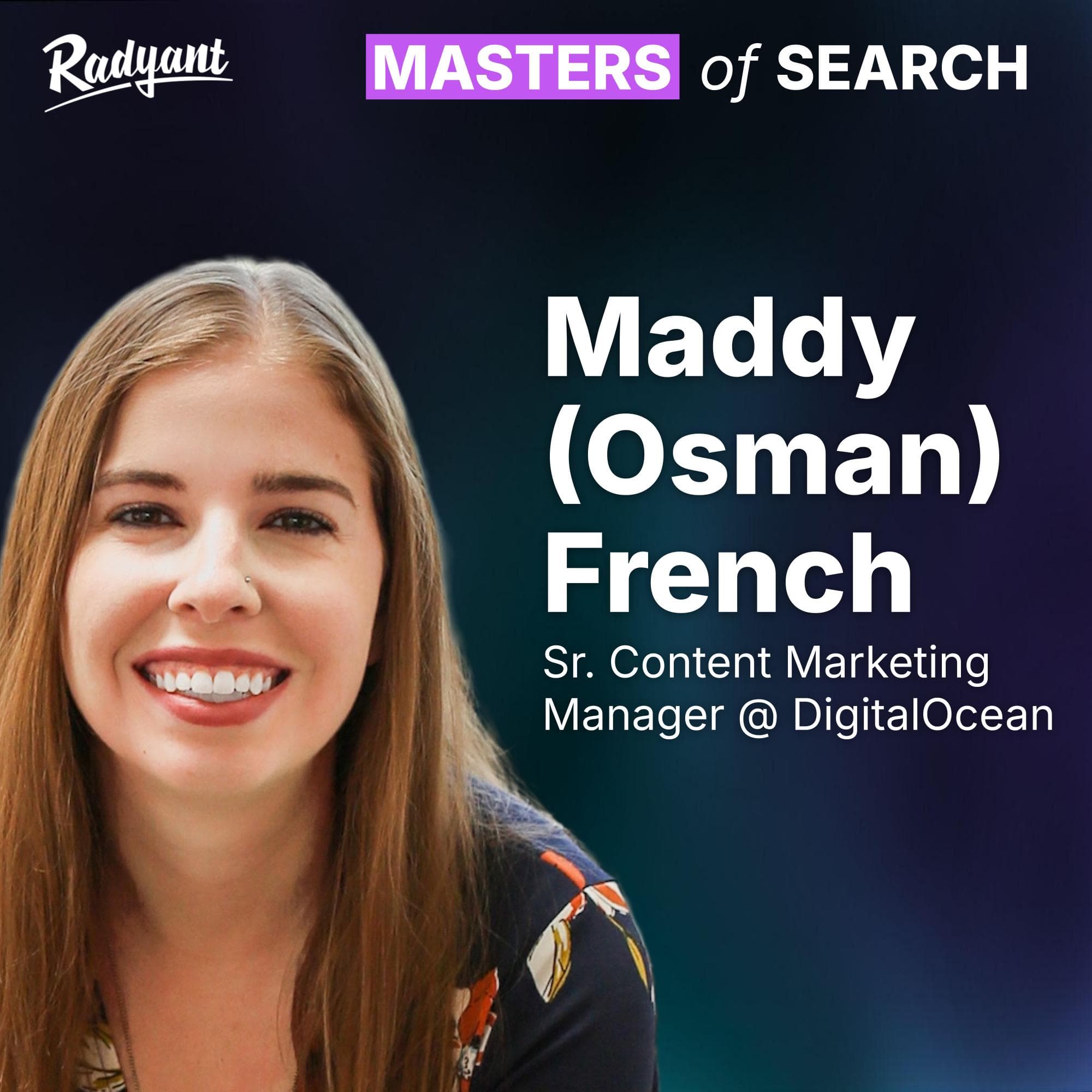
The Modern Content Marketer | Maddy (Osman) French
Show notes
After 10+ years building The Blogsmith into a content agency serving B2B giants like HubSpot and Klaviyo, Maddy Osman French made an unexpected move: she went in-house. Now at DigitalOcean, she represents a "content engineer". A marketer who blend process thinking, technical depth, and AI workflow automation to scale content operations efficiently.
What makes Maddy's perspective particularly valuable is this combination of agency and in-house experience, paired with genuine technical depth. She's a bestselling author of "Writing for Humans and Robots," a certified content engineer from AirOps, and someone who actually builds RAG pipelines with n8n and Pinecone rather than just talking about AI in abstract terms.
We'll explore how content operations are evolving, why she believes most SEO problems are actually process problems, and what it means to be a "content engineer" in 2026 when AI is reshaping how we create, distribute, and measure content success.
▶ Let's connect! 🔗 Niklas on LinkedIn: https://www.linkedin.com/in/niklas-buschner/ Radyant on LinkedIn: https://www.linkedin.com/company/radyant/ Maddy on LinkedIn: https://www.linkedin.com/in/madelineosman/ DigitalOcean on LinkedIn: https://www.linkedin.com/company/digitalocean/ Blogsmith on LinkedIn: https://www.linkedin.com/company/theblogsmith/
Transcript
Full conversation
- 00:00:00After more than ten years building the BlockSmith into a content agency, serving BtoB giants like HubSpot and Clavio, Maddie Osman-French made an unexpected move.
- 00:00:12She went in-house.
- 00:00:13Now at DigitalOcean, she represents a content engineer, a marketer who blends process thinking, technical depth and AI workflow automation to scale content operations efficiently.
- 00:00:26What makes Maddie's perspective particularly valuable is this combination of agency and in-house experience paired with genuine technical depth.
- 00:00:35She's a best-selling author of Writing for Humans and Robots, a certified content engineer from Arabs and someone who actually builds.
- 00:00:44RAG pipelines with NAD and N-PineCone rather than just talking about AI in abstract terms.
- 00:00:50We'll explore how content operations are evolving, why she believes most SEO problems are actually process problems and what it means to be a content engineer in twenty twenty six when AI is reshaping how we create, distribute and measure content success.
- 00:01:06That being said, Mehdi, welcome to the podcast.
- 00:01:09Thank you so much for having me.
- 00:01:11And I really love that intro.
- 00:01:12I think it touches on a lot of the things that I've been thinking about lately that I know we're going to get into today.
- 00:01:19Thanks so much.
- 00:01:20I spent a lot of time on it and really tried to nail it here.
- 00:01:25In the shows.
- 00:01:26Nice.
- 00:01:27So let's start with the elephant in the room.
- 00:01:30After building the Blocksmith for over ten years as I sat in the intro, you went in-house at Digital Ocean.
- 00:01:37A brand that probably a lot of people in the marketing space know.
- 00:01:41Walk me through that decision.
- 00:01:43Totally.
- 00:01:44Yeah.
- 00:01:44I mean, I think the biggest thing and something that we've been talking about is just like personal lives, right?
- 00:01:51And becoming parents and it changes things fundamentally in many ways.
- 00:01:57And so I am about to welcome my second into the world.
- 00:02:03And I feel like, you know, since having my first two years ago, it's like so much has changed in this marketing landscape and operating a company.
- 00:02:14And then I've changed too.
- 00:02:16You know, I think that's like the biggest thing is just it's a different world now.
- 00:02:21And so I think I've always enjoyed the hustle, I've always enjoyed being an entrepreneur, but I'm kind of just looking for something that's a little more normal, I guess in a sense, you know, a little bit more... I'm focused too, I think, on the content itself, on the marketing versus all of the aspects of running a business, the administration, the sales, you know, just like the constant changing and rebranding as an agency in this AI world.
- 00:02:55And so I do still run the blogsmith just at a smaller scale to the side of this job.
- 00:03:01But I really saw it as an opportunity to try something new.
- 00:03:06Also, you know, I think there is a benefit in terms of switching your perspective, right?
- 00:03:11Coming from the agency perspective where you work with a lot of different brands to then being able to fully focus on one in your role.
- 00:03:19And the great thing I think about working at DigitalOcean is I still get to explore a lot of these different sides.
- 00:03:26I'm an editor.
- 00:03:27I'm a strategist.
- 00:03:28I get to touch on GEO.
- 00:03:31I get to work on AI projects that are really exciting, but it's just kind of a different focus now.
- 00:03:39It has the team at DigitalOcean been surprised that a ten-year entrepreneur is applying for an in-house role?
- 00:03:50Yes and no.
- 00:03:52One thing that was really interesting, I applied to two jobs.
- 00:03:57after kind of coming to this realization and got offers from both and the feedback that I really got from both of the hiring managers in this process was, I think, an interest in working with somebody who's a founder who has run their own thing for a long time.
- 00:04:14I think that that's something too, you know, for anybody else who's a freelancer or an agency owner, something like that, who's maybe thinking about making this type of move.
- 00:04:24Like it really is something that helps, you know, in terms of, of course, how you position it, but it's something that I heard really from, from both of those different job offers that It was something that they were interested in and that they employ a lot of people who have gone through that same change.
- 00:04:44I've also seen a couple of posts from startups.
- 00:04:48I think it's even been Arabs, for example, where they said, yeah, we have like X amount of X founders on the team and we're actively looking for people that have like this entrepreneurial spinner spirit.
- 00:05:02And I think from a, like a founder myself, from my perspective, makes a lot of sense to have people on your team that know how to run a business, right?
- 00:05:12Right, exactly.
- 00:05:13I mean, I think there's just, it's like that word, entrepreneur, right?
- 00:05:18Where it's like being an entrepreneur just within an organization.
- 00:05:22And so, I think one of digital oceans, either core values or just kind of how they operate is they want people who are looking for different opportunities, right?
- 00:05:34And then being able to capitalize on those opportunities, not waiting for permission.
- 00:05:39And then once you get the green light, you know, being ready to take that and running with it.
- 00:05:45And so I think, I think any company would benefit from having that mindset.
- 00:05:49There are certain companies, maybe more so.
- 00:05:52even in the tech space that really go and run with it, though.
- 00:05:57And did you have to limit yourself from the full autonomy you had when you were basically the CEO, so to say, now that on the one hand, your spirit is valued, but on the other hand, you also have to align with a team and somehow probably stick to certain guardrails more?
- 00:06:21Sure.
- 00:06:22Now it's an interesting question.
- 00:06:23I think the answer is mostly no.
- 00:06:28I can still, like I still get to design my day.
- 00:06:31I have deadlines, right?
- 00:06:32Like.
- 00:06:32that's the limiting factor, but that's the limiting factor of every job, including the one that I built for myself with other clients.
- 00:06:41Other than that, it's like if you get your work done and you want to, you know, explore a new learning path or if you want to build a new AI process or if you want to look into this thing that, you know, maybe even hasn't been greenlit yet, but you want to pitch this project, all those things are like well within the bounds of, you know, what I'm allowed to do.
- 00:07:03And then from more of like the agency perspective and running my company, you know, Also from just like like a non-compete perspective or whatever they're.
- 00:07:16they're pretty Lacks, I don't know if that's exactly the right word But there aren't a whole lot of guardrails in terms of what I can and can't do Except for you know, of course not to work with like a direct competitor.
- 00:07:28That's pretty much like the guideline that I have to follow.
- 00:07:32Hmm now I can imagine maybe people listening that are currently working as a freelancer or maybe consultant or maybe even like small agency that like if they maybe struggle and then applying for an in-house role that others could see it as a failure of their like entrepreneurial endeavors.
- 00:07:55So to say, what would you say to those people?
- 00:07:59Yeah, I mean, I think there is a part of me that thought that about myself to like.
- 00:08:03you know, like, is this me giving up on that entrepreneurial dream?
- 00:08:08And on one hand, no, because I'm still doing that to the side, just in a different way.
- 00:08:15I think on the other hand, it's like, humans, the world changes the constant, right?
- 00:08:21And I think it would probably be more of his failure to not be willing to adapt with both the changes in my life and the changes in the market and the changes in technology and things like that.
- 00:08:34And so it's like, would I ever, would I, would I never, you know, do something like this again, where I started business and I worked for myself, like?
- 00:08:45I'm not ruling that out.
- 00:08:46I'm not really thinking about it right now.
- 00:08:48I'm not ruling it out.
- 00:08:50Um, I think it's like, it's like there's different seasons, right?
- 00:08:54In your life.
- 00:08:55And right now my season is, I'm an entrepreneur, yes, but I also have to put the mom persona first.
- 00:09:07And I have to work in a way that supports that without me stagnating and without... I still want to use my brain, obviously.
- 00:09:21That's really important to me, and that's something that I've talked to my work about.
- 00:09:26I'm about to go on maternity leave, but I'm very anxious to come back.
- 00:09:31As soon as I can, because there's only knowing from the first child that I had, there's only so much time that I can spend by myself raising a kid before it's like, okay, time to get to work.
- 00:09:44Sounds really empowering, I think.
- 00:09:48your journey can actually be really inspiring for people that might have started like a freelance career.
- 00:09:54And now there's all these changes in the ecosystem, et cetera.
- 00:09:58And they feel like I can't let go of that.
- 00:10:01Applying in-house would be something that other people think badly of me.
- 00:10:08Now that you're a few months in your new role, have there been any surprises?
- 00:10:14Going from like agency founder obviously still running it on the side to an in-house content leader?
- 00:10:21Yeah, I mean I think it's just been interesting right to go from you kind of like make your own schedule and you know you get to choose exactly What you do every day and and again like I still get a lot of that within this role.
- 00:10:36It's it's honestly a perfect fit for somebody who's following this path, coming from running your own thing to then working in-house because it's very remote friendly.
- 00:10:47It's very much like get work done, you know, not a whole lot of meetings, having deadlines, but having the autonomy to meet them, you know, within however you structure your day.
- 00:11:02So I think that was surprising to me, like, that I wasn't necessarily giving a lot up in order to make this work.
- 00:11:09And, you know, just, yeah, like, it didn't feel like a total loss of the way that I like to work to transition into an in-house role.
- 00:11:23I think it's also like and this is kind of a no-brainer but it's like I really miss like working on a team with other people like I still ran a team right but it's a different dynamic to be the boss or whatever and a lot of the people that I work with were contractors.
- 00:11:39so it's even a more different dynamic.
- 00:11:42but now it's like we're co-workers we're kind of on the same level.
- 00:11:46it's more collaborative in a sense and people are less Afraid you know to either say no or to like challenge you and and and I like that.
- 00:11:55I want it to be more collaborative, and that's how I learn.
- 00:11:59so Yeah, I mean a couple surprises, but mostly just that like it's kind of.
- 00:12:07it's kind of working out.
- 00:12:09You know exactly the way that I would want it to you for my ideal work style I guess.
- 00:12:16hmm A thing I know you're passionate about and have been passionate about for quite some time already are content processes or like the process element of content.
- 00:12:28Your LinkedIn bio even says content process consultant.
- 00:12:33Can you enlighten us?
- 00:12:34what does that mean?
- 00:12:37Sure.
- 00:12:37Yeah.
- 00:12:38I mean, I think at the end of the day, it's like, and something that I've learned.
- 00:12:43by throwing myself into like this AI builder world is like the easiest way to go from not knowing how to use AI to then experimenting and like building things that actually work is the foundation in systems thinking.
- 00:13:00And so that's kind of how I built the blog.
- 00:13:02Smith is on the backbone of processes and checklist and standard operating procedures.
- 00:13:11I think one of the reasons I was able to scale the blog smith from me as a freelancer to running it as an agency is by really building out a detailed style guide that represented the way that I think, that represented my writing style so that I could repeat across any new writer that we worked with, as well as any new editor that's enforcing it.
- 00:13:35So that's been one of the more, I think, critical pieces of documentation that's allowed me to scale.
- 00:13:41But it's also things like, you know, what is our process for creating content in general from topic ideation to keyword research to outlining to drafting to editing to creating visuals.
- 00:13:54And so we use a tool called process street, which is just.
- 00:13:59it's very flexible.
- 00:14:01It's very much like you can create conditional logic so that it shows only the steps that are relevant to the task and and brings people in at the exact right moment and not before like their part of the workflow is ready.
- 00:14:16And so anyway, all of this is to say that processes having structure translates really well to then building with AI and using LLMs, whether that's even just like simple prompts in a chat where you're prompting and you're giving context or you're building out repeatable workflows.
- 00:14:37And so, yeah, in terms of like the LinkedIn bio, I think I was kind of playing around with just like, yeah, different, different versions of myself, right, where it's like, okay, I'm this agency owner, but I also like have this you know, content process focus.
- 00:14:54And so maybe, you know, that's a new reinvention of self in terms of different services we could offer.
- 00:15:01And I was kind of playing around with that before landing on the idea to go in-house.
- 00:15:07And so it's like, I use all of these things now.
- 00:15:10But, but yeah, I think, I think that that's, that was a big learning for me was to understand that processes, documentation, being clear, being structured, work plays really well with AI.
- 00:15:23And so I encourage people, you know, if there is a process that you want to build with AI that you have to start with that kind of thinking.
- 00:15:32Let's dig into the systems thinking approach deeper in a second, but first I want to do a personal load because you said you were playing around with the LinkedIn bio.
- 00:15:43I really love that.
- 00:15:45And I think I never assured that, but a little anecdote of how we like transition the value proposition and like, let's say the key statements like not a slogan, but like.
- 00:15:59the main headlines and stuff at Radiant was I was just going like logging into our WordPress backend from our website and I was just going to the homepage straight away and like just changing the headline and changing the subline.
- 00:16:13And a colleague of mine was making fun of me and like, ah, yeah, you changed it again.
- 00:16:18It was like just two, three times every week during a certain period because I felt like if I put it into a Google doc, It doesn't lead to the same thoughts and feelings I have when I put it on the home page.
- 00:16:34It's like, okay, now this is live.
- 00:16:37This is like in the public.
- 00:16:40So when it challenged me to really think, is this the direction we're going to?
- 00:16:44Is it not?
- 00:16:44So I just, I love this idea of putting something out there, just seeing how it feels like sleep at night and then revisit again.
- 00:16:53So yeah, can highly relate to that.
- 00:16:57Yeah, there is a certain psychology to just like putting it out there and trying things and and I think whether it's linked in or your home page It's like.
- 00:17:05it's like forgiving right.
- 00:17:06you can change it you can get some feedback you can You know look at the matrix or whatever.
- 00:17:12do some comparisons and so why not just try and see where it takes you?
- 00:17:17Yeah, I think if I would be a VC backed startup and would have raised like a hundred million dollars or something from like top ten investors I would probably be more cautious, but for me like it always felt right Let's Dig into the system thinking approach a little bit deeper because I can imagine that people Find this very abstract especially the people that have not like pursued this path a little bit more.
- 00:17:46so If you would have to teach like an intern or like someone that is like super junior, like maybe first role after college or something, how would you try to teach someone to start like thinking in systems?
- 00:18:02Totally.
- 00:18:03Yeah.
- 00:18:03And I feel like to an extent I've had to do this with every role in my team, right?
- 00:18:07In order to be able to, to delegate it and to document it.
- 00:18:11So it's definitely relatable.
- 00:18:14Um, I think, you know, The beginning of it is, first of all, just starting really small.
- 00:18:21I think it's very tempting to try to take that whole content process workflow that I just described, drafting, outlining, researching, whatever, and trying to think about that from start to finish.
- 00:18:34The problem with that is I'm very overwhelming.
- 00:18:36There are so many different parts to it.
- 00:18:40And even after I created that workflow, we've since updated it.
- 00:18:46a year or two later just like going in and being like here's all the things we learned.
- 00:18:50and so it's like a lot of these things are different now.
- 00:18:54What would be better is to take a component and maybe even like a smaller component than outlining right.
- 00:19:01maybe it's like outlining for a specific type of client because we did we did kind of or we do have like different directions, you know, if it's like a certain topic, right?
- 00:19:13Like if it's maybe something in more of like a regulated industry like finance, it's like there's going to be a slightly different approach to outlining than if it's more of like a lifestyle topic or a tech topic or whatever.
- 00:19:26So yeah, it's breaking things into components and then trying to break them into smaller components and then going through and documenting and there's different ways you can go about that.
- 00:19:38there are certain tools that you can use.
- 00:19:40You can film yourself doing a loom right of the task itself and then you can use the transcript of that.
- 00:19:47You can use AI to help you to take that transcript and to break that into steps or even just to guide you as you write it yourself.
- 00:19:55You could use a tool like Scribe that records your screen and you can add comments and things like that.
- 00:20:02You could record a voice recording of you just kind of like doing the task and your commentary.
- 00:20:08So you kind of have to find the way that works best for your brain.
- 00:20:12I have found that just trying to write something from memory, even if you have, you know, a tab open with whatever.
- 00:20:19you know, it was your you were going to do.
- 00:20:21It's very hard because it's like you have to confront your inner sensor, right?
- 00:20:26Like as you're writing, you're like trying to edit at the same time.
- 00:20:30And it kind of like gets in the way of just getting something done.
- 00:20:35So that's that's some of the how.
- 00:20:37And then I think the other big thing, especially if you're thinking about it as a freelancer or an entrepreneur, and it's maybe more of an operational task than it is like a creative task or something like that.
- 00:20:52Although there's applications for both in terms of what I'm saying.
- 00:20:56But if it's more of an operational task, it's like you have to kind of like put on that hat.
- 00:21:01So it's like whenever I was ready to expand the blacksmith in terms of a new role.
- 00:21:07So it started with hiring writers.
- 00:21:10well it started really with hiring researchers and then it was writers and then it was editors and then it was you know things like a co keyword researchers um things like you know having like account managers and project managers and then bookkeepers and someone to help me with social media.
- 00:21:29I tried to like be that role for like a month and use you know to basically give them, to make sure that when I put that person in that role, they had something to do and that they would be able to do that job, you know, to the standards that I hold myself to essentially.
- 00:21:49So because I didn't have time for like extra administrative headaches, you know, I didn't have time to like be their manager necessarily outside of just like, you know, here's how that work is.
- 00:22:03changing or here's like major feedback, but I needed to give them a structure because I couldn't take on much more than, you know, just basic approvals with each new person that I added to my team.
- 00:22:15And so, yeah, I mean, essentially it's like you are that role.
- 00:22:19You have to document it really well.
- 00:22:21And then you have to see like how it lands and if it makes sense.
- 00:22:24And if you do have to make updates, which oftentimes you will have to do, but You want to create a solid foundation before you bring new people onto your organization.
- 00:22:36And how would you approach prioritization for documenting things?
- 00:22:40Because I struggled with this myself and I still see a lot of people struggling with that because if you tell them, like if I tell a... maybe a little bit smaller agency owner I talked to.
- 00:22:56Yeah, you should start documenting things.
- 00:22:59He tells me like, yeah, but then I have like, twenty, twenty five things I have to document, like, and there's all this stuff.
- 00:23:06So how would you approach prioritizing the most impactful things to document?
- 00:23:15I don't know if this is going to answer it exactly, but I think the first thing, again, is breaking it down into smaller components.
- 00:23:21Because if you think that you have twenty-five things to do, you're just not going to do any of them, probably, right?
- 00:23:27So it's like, can you create one new SOP per week?
- 00:23:32Or one every couple of days?
- 00:23:36And yes, you should be thinking in terms of what's going to be the most impactful for my organization, because there are going to be certain documents or processes that you use every day versus something like a month-end creating financial statements, right?
- 00:23:52That's going to happen once a month or so.
- 00:23:54And so, if you have to be a little bit more hands-on with making sure that fits what you were looking for, then maybe that process could wait.
- 00:24:03But it is something that you should still think about.
- 00:24:06One thing I think that helps me too is, like, pretend the Blacksmith did have a full-time employee.
- 00:24:13who um We called her our director of content, but she was helping with the client side.
- 00:24:19She was helping like manage some of these different contributors.
- 00:24:22And it's like just having regular meetings with her, right?
- 00:24:26Where we're talking about the things we need and like the things that I need to do to empower her to do her job is also a really great, I think, reinforcing mechanism.
- 00:24:35So it doesn't necessarily have to be an employee.
- 00:24:38That's just the example that I had.
- 00:24:40But somebody who is like checking in with you and keeping you honest, I think is another.
- 00:24:44way to make sure it actually happens.
- 00:24:48Now, speaking of systems thinking on a completely different level, let's look into something you have built, which is a rack, so retrieval, augmented generation upload agent in Anet and for podcast transcripts, which sounds, I think, for some people super complicated.
- 00:25:13WTF.
- 00:25:15Can you quickly walk us through how that works?
- 00:25:19Totally.
- 00:25:19Yeah.
- 00:25:20So the project that you're talking about, I actually built for a client.
- 00:25:23So it was a very specific need, but it's kind of a reusable system now.
- 00:25:28Like if I were to, you know, work with another similar type of problem, it's like I kind of have a structure in my head for what that would look like.
- 00:25:38And so the problem that needed to be solved is this client works with a bunch of different podcast, like he has like a podcast marketing agency.
- 00:25:51And so, you know, they're always going to be putting out new episodes.
- 00:25:55All those episodes have a corresponding transcript that represent the text of what was said, the context really, right, of each episode.
- 00:26:05And it's actually part of like a separate, bigger agent component that is referencing that context in order to then suggest things like um relevant.
- 00:26:18well actually for this one um it's used to be able to respond to social media posts where you know somebody's talking about a certain topic and so you're able to like take the text of that take that post essentially and say oh yeah like we covered this on you know this episode of our podcast and have you know a little bit of like a text blurb that talks about.
- 00:26:40you know why this podcast was relevant to the topic being discussed and so it came from a need to be able to do that action.
- 00:26:52And it needed to be something where, again, it sounds really technical and complicated, but it needed to be something where this person, this client could sustain it himself right without going into NADN and like having to like add new podcast transcripts and also so that like if he needed to pass it on to a client like they wouldn't have to get into the back end either.
- 00:27:18And so the way I built it is like there's basically a Google Drive folder and it integrates with Google Cloud console or something like the Google Cloud projects feature.
- 00:27:31And so it's like Google Cloud Projects is watching this folder for any new activity.
- 00:27:37And you can add Google Docs for each new transcript.
- 00:27:41And it's basically like the title of the doc is the title of the episode.
- 00:27:45And the body of the doc is just like the transcript itself.
- 00:27:49And so it has to be kind of these simple components.
- 00:27:53But then I built.
- 00:27:54a component on top of that that also goes on the podcast website and it tries to find a relevant podcast episode URL because we need something to link to when responding to this social post and it just uploads that transcript to Pinecone.
- 00:28:11for those who are unfamiliar with RAG.
- 00:28:15It's a database.
- 00:28:17It's a very contextual database that makes it kind of easier for these AI tools to search and find meaning than just like a straight up keyword search.
- 00:28:30And so it breaks down the text into chunks.
- 00:28:32And so there's like a billion chunks, you know, for all these different transcripts and all the transcripts together.
- 00:28:39And then it also adds metadata, like the podcast URL is associated with each chunk of text.
- 00:28:46And so then, yeah, when somebody has a social post and he wants to respond to it, for example, it's pulling the most relevant context to create a response and to add that link.
- 00:28:59And yeah, as long as new transcripts are going into that folder, then they get to the right place.
- 00:29:05which is pine cone, which is storing all this data.
- 00:29:07And then pine cone also then is suggesting the answer.
- 00:29:11So it's like, yeah, it sounds very complicated even when I explain it, but that's essentially how it works.
- 00:29:18Okay.
- 00:29:19And do you feel like that?
- 00:29:21Yeah, no, I think you explained it perfectly well.
- 00:29:24But
- 00:29:25obviously for people that, so it might still feel abstract, but I think it's something that You can't give someone like all the knowledge required to understand it in like a three minute explanation.
- 00:29:38They obviously also have to have to do their own research.
- 00:29:41So sorry guys for everybody listening.
- 00:29:44But what I'm interested in is do you think that everyone working like in content roles needs to get comfortable with stuff like that?
- 00:29:57I think it's worth at least exploring.
- 00:29:59And I guess the last thing that I can say about RAG that's maybe relatable, especially for content and SEO, is the whole point of RAG is that it's grounding the AI response in reality, in true context, and in the context that you give it.
- 00:30:16And this is a really big turning point for me in terms of using AI in my job and getting comfortable with it.
- 00:30:26I definitely had my head in the sand for a while where I was thinking about.
- 00:30:30AI is confidently incorrect.
- 00:30:32We can't trust the outputs.
- 00:30:34That's a problem, I think, in terms of using it to help with aspects of content marketing.
- 00:30:41As a brand, you don't want to rely on something that is unverifiable.
- 00:30:47In even RAG, it's not perfect.
- 00:30:49You still have to have your due diligence.
- 00:30:54Yeah, a concept like that really helps me to get comfortable with spending more time thinking about AI, building with AI.
- 00:31:04And so to an extent, yeah, I mean, I think you don't have to be like a coder, right, in order to get a rag workflow in place.
- 00:31:14There are a lot of tools like NaN, for example, but even, you know, There's even less complicated ways of doing kind of what I said or components of what I've said.
- 00:31:28I think that the future of content marketing is going to be this person who is both creative and technical.
- 00:31:35And I think it's been trending that way for a while.
- 00:31:38It's just becoming more and more important.
- 00:31:41The more that we learn about AI, the more that we start to implement it.
- 00:31:46And so I would say it's a mistake to ignore it.
- 00:31:49I don't know that you have to learn development necessarily, but I think that you do have to be comfortable.
- 00:31:56playing around with some of these tools and sort of like learning about automation, for example, if this, then that and the different tools that you have available to build workflows.
- 00:32:09And do you think that leaders should focus more on these skills when hiring, either in-house or when choosing an agency?
- 00:32:17Yeah, I think that it should be something that that definitely is part of the conversation.
- 00:32:23And I think even more than that, it's about hiring for curiosity.
- 00:32:29It's about hiring for people who are willing to get their hands dirty and just like build stuff.
- 00:32:36It's not so much like expecting that whoever you hire is gonna like figure it out immediately, but it's like giving them the time and space to figure stuff out and to try things and to talk about it with the team.
- 00:32:51One thing I really appreciate about DigitalOcean is they kind of have, how do I say this?
- 00:32:58It's very much encouraged to use AI and to play with it.
- 00:33:01And I think especially because DigitalOcean's offering has really evolved to encapsulate being a place where AI builders can build applications.
- 00:33:12But within individual teams, it's expected that you're going to play with AI tools and see what you can build and use them to leverage more efficiency.
- 00:33:24And so one thing that was kind of fun recently is they had like a build day where it was like just like go and experiment and see what you can come up with.
- 00:33:32And I think every company should do that.
- 00:33:37Now there's this concept in AI workflows of human in the loop.
- 00:33:43For everybody that is not familiar with the concept, can you quickly explain it to us?
- 00:33:48Sure.
- 00:33:50So human in the loop is basically I guess a form of a guardrail which is like at some point in this workflow a human needs to be involved to sort of like review or like accept or reject the output of the workflow or an interim step of the workflow and What else is worth saying about that?
- 00:34:13Yeah, basically before you take that output and do something with it, especially if it's like a client-facing thing.
- 00:34:21And where's the line for you?
- 00:34:23When do you also, when you do your systems thinking, when should humans intervene and when should you let automations or agents just run?
- 00:34:34Yeah, so I mean, I think they should always intervene if it is client-facing.
- 00:34:41That's not to say that you can't run a full workflow before then reviewing the output, right?
- 00:34:46I'm not necessarily, how do I say this?
- 00:34:51I'm not necessarily encouraging that you have to have a bunch of interim steps for human in the loop within a workflow.
- 00:34:59It's like, have that workflow run.
- 00:35:01have a way to get it in your face, you know, so that you have to interact with it in some way versus like it runs and then it just sits there because, you know, something else distracted you in your day.
- 00:35:15I mean, I think there is a big line for me right now with just kind of like running something and then using it for whatever the intended purpose is.
- 00:35:24There has to be some sort of review in there and oftentimes for me it's pushing that output to slack because it's like.
- 00:35:32I know I'm gonna check that and it's just.
- 00:35:34it's convenient it works with my workflow.
- 00:35:36for you it might be something else right.
- 00:35:38like it's like.
- 00:35:39what tools are you using?
- 00:35:40on a normal basis it could even be your gmail or something but like getting it off the tool where the automation is occurring for example.
- 00:35:49um But yeah, I would err on the side of having more human in the loop components versus less.
- 00:35:57And then over time, you start to test things, right?
- 00:36:00And you see what happens if, you know, I have a workflow with maybe three points of humans interacting with it.
- 00:36:07What if I take one away?
- 00:36:08Do I still get the same results?
- 00:36:10And so removing those guardrails is really the result of testing.
- 00:36:15And it's also the result of technology getting better AI technology.
- 00:36:21And what would you say to people that if they hear like you should always have a human in the loop, maybe you should even have like multiple checkpoints?
- 00:36:32What would you say to people that then say, yeah, but what about like the whole beautiful AI productivity gain then?
- 00:36:42Like it's all going away if I have to still like.
- 00:36:46Let my team check this stuff like all the time at like these multiple checkpoints.
- 00:36:50What would be your response to that?
- 00:36:53Yeah, I mean, I would say it's just like flawed logic, honestly, because it's like, I mean, it's just like at the end of the day, like AI does speed up a lot of workflows.
- 00:37:04I don't think that.
- 00:37:05Having a human review them changes that fact, right?
- 00:37:09Like, I think you have to build in that understanding that a human should review the output with the state of where AI is right now.
- 00:37:17The fact that it is confidently incorrect, the fact that it is non-deterministic, so you're always going to get different results.
- 00:37:24It's just kind of the reality of like how we use AI right now.
- 00:37:30But yeah, I mean, like for example, another workflow that I built for the same client is it's like taking relevant news from the past twenty four hours and creating social posts using like a specific style guide.
- 00:37:46There's a couple of other pieces to it, but it's like, do I have time to go out and like.
- 00:37:51look at all this news and decide if it's relevant and then also reformat it in a way so that it works that this client could post it, you know, on his client's social media profiles.
- 00:38:03I really don't.
- 00:38:04And so it's like just the fact that this workflow is running means that the work is getting done.
- 00:38:09Whether he uses it or not, whether he reviews it or not is his choice ultimately.
- 00:38:14But he has this, the results of that workflow being delivered to us in max every day.
- 00:38:19So he has to confront it in some way.
- 00:38:22And, um, yeah, he could post it or not, but like none of that work would have gotten done if not for this workflow or, you know, it would have been a major time suck.
- 00:38:31And so it's like, it's like people who maybe have that question have to maybe reconsider what they mean about ROI or like, you know, like what, what should be or shouldn't be.
- 00:38:42It's like at the end of the day.
- 00:38:46It's already a much more efficient workflow than it was.
- 00:38:50What are you most fascinated about with AI?
- 00:38:54Probably the RAG concept and continuing to figure out like I think that's like my my twenty twenty five and really my twenty twenty six goals.
- 00:39:03Like how can I take what I know about this and apply it to what I'm doing in content marketing to make sure that whether it's for my clients the blog Smith or the work that I'm doing at Digital Ocean.
- 00:39:16that I'm creating content in an efficient way that's really rooted in the reality of the brand.
- 00:39:26I think there's a lot to it and I think it's like one of the things I maybe struggle with is I think that RAG has been used in a lot of different ways in a lot of different departments but I haven't seen a lot of marketing use cases.
- 00:39:40so I feel like I'm trying to to figure that out without a lot of guidance.
- 00:39:44And I'm the type of person who I learn best when it's like sharing stories and experiments and things like that.
- 00:39:50So it's maybe like getting a little bit outside of my comfort zone to just like experiment myself and, you know, try to figure out how to apply it there.
- 00:40:00But I think it's like a worthwhile use of time to experiment in that way.
- 00:40:06Super interesting.
- 00:40:07Because I feel like that People that are more advanced in the use of AI they often rather turn to these like concepts where you have a lot of base knowledge and like you have a lot of also.
- 00:40:25input thinking like what's the best input for this workflow etc.
- 00:40:28whereas people that are just starting out their AI journey so to say still see the AI itself as like the super brain where like all the all the stuff is coming out whereas other people more see like a synthesizer in the middle like you have to have really strong input and then be able to like use database concepts etc.
- 00:40:51do you also have you also observe this?
- 00:40:56That's a great question.
- 00:40:57I think it's kind of different for different projects.
- 00:41:03But I think, I think, yeah, it is kind of more of like that.
- 00:41:05middle, middleman, middleware, whatever, where it's like, you have to be the way that I've always thought about AI, at least thus far is like, you have to be an expert operator in order to get the best results, because otherwise you ask mediocre questions, you get mediocre outputs, you know, garbage and garbage out or whatever people say.
- 00:41:28And then like another concept that maybe changed AI for me is the idea of vibe coding.
- 00:41:34So I have a background as a web designer.
- 00:41:37So I have some coding knowledge, but I don't have like software coding knowledge.
- 00:41:42And I've just been having a lot of fun using tools like Replit or Bolt or Lovable.
- 00:41:48And just like building little components, whether it's, you know, just like, kind of for fun, like, you know, to see what I could do.
- 00:41:55Or, you know, if it's something that's like helpful for me, either with blog Smith or with digital ocean components that can help me do my job better.
- 00:42:04And in that case, it's like, you know, I'm asking the AI, like, how do I build, you know, this specific thing?
- 00:42:10How do I, how do I describe it?
- 00:42:12Because I don't, you know, want to just like, brain dump the idea in one of these tools, I want to have like a structured way of thinking about it.
- 00:42:21And so in those ways, it's maybe it's kind of leading me, but I'm also still leading it because I'm saying what I want, right?
- 00:42:29And then I'm evaluating what the AI is telling me and taking some of what I like and, you know, leaving some of what I don't.
- 00:42:37So, yeah, I really do think it kind of operates in this sort of like middle layer, right, where it's like, You have to give it a lot of guidance to get what you want out of it.
- 00:42:49I love the expert operator idea.
- 00:42:51Maybe a little side story.
- 00:42:54I also told a couple of my colleagues.
- 00:42:57There is this car rental company from Germany.
- 00:43:00It's called SIXT.
- 00:43:03They have actually also expanded a little bit into the US.
- 00:43:07They were probably not as big as... Hertz or like the big US brands, but still they should be there at the big airports and the the the old six.
- 00:43:18so he's now I think eighty or something like I think in the in the eighties or in the nineties and he told the story on a podcast They had to build like a software for themselves like with dispatching the cars and like doing the yield management and all that stuff.
- 00:43:37and he decided to just learn coding himself and build the software himself because he said his fundamental belief is you have to know the business inside out to be able to make the right choices and the right calls in the software.
- 00:43:54And I feel like it's a full circle moment now with AI and vibe coding because a lot of people like the key.
- 00:44:04missing piece of the puzzle has always been the coding knowledge and obviously there's also a lot in terms of infrastructure thinking etc.
- 00:44:13like how do I make something scalable.
- 00:44:15But in the end it's exactly this expert operator idea if you know things inside out now with AI you have the tools to actually build what you previously could have only imagined.
- 00:44:27So yeah
- 00:44:29no hundred percent.
- 00:44:31It's a current story anyway.
- 00:44:33Scaling content is something that I wanted to talk to you about also because Scaling content is actually way easier now.
- 00:44:42We've already been talking about AI workflows, etc.
- 00:44:45So people.
- 00:44:46this also why I Why I brought like the devil's advocate question about the AI.
- 00:44:52productivity gains are all gone with humans in the loop.
- 00:44:55I just want to have my agents that are creating like hundreds of pieces of content every month and like get it out there.
- 00:45:02So what would you say?
- 00:45:04What are the biggest mistakes you see content teams making when they try to get content especially now that AI makes it easier than ever?
- 00:45:13Yeah, I mean, it's falling into that trap, right, that you can do it so easily.
- 00:45:20So a couple of things.
- 00:45:22I think the first thing is, again, going back to that expert operator idea and really thinking about the inputs that you give it and starting from a place of originality, right, where it's not just like, Hey, come up with this idea and then come up with the draft.
- 00:45:38It's like, you have to have the idea and you have to give it some context.
- 00:45:42So like, for example, something that I like to do before I write pretty much any article is I like to just like do a voice recording of myself like rambling through the topic, you know, it's like, okay, so this is the topic, you know, that I'm going to write.
- 00:45:58And here are some of the things that I know that I need to cover, whether that's a brief from a client or just maybe some things that I know about the topic that I want to make sure to include.
- 00:46:09And oh, it's going to need this section.
- 00:46:11And I'm probably going to need to research a stat about that to substantiate my point.
- 00:46:18And oh, I remember.
- 00:46:20This was something that was being talked about on LinkedIn recently that people had a lot of opinions about.
- 00:46:25So that's, you know, something to weave in just from like a human interest standpoint.
- 00:46:28And so it's like, again, like confronting that inner sensor.
- 00:46:33If I sat down and wrote this, I would get in my own way.
- 00:46:37But if I could just talk through it.
- 00:46:39what AI is really good at is then like organizing those thoughts into more of a brief or more of an outline.
- 00:46:45And, you know, from that point that I might use AI to flesh out section by section, there's almost no world where I would have AI.
- 00:46:55take that and make a draft though.
- 00:46:58It's still kind of like, you know, just like without AI, it's like, it still has to be a step by step process.
- 00:47:07in order to get a really good end result.
- 00:47:09I think that that's like a fundamental flaw of AI, at least the AI that we have right now is this idea of going from start to finish, whether it's a really good prompt in context or it's your army of agents or whatever.
- 00:47:21I just don't think that we're there yet and I'm not saying that we'll never be there.
- 00:47:26I'm just saying I wouldn't rely on that.
- 00:47:29And so kind of like another example or way to look at it is like, At Digital Ocean, we do a lot of competitor comparison, like, listical pieces.
- 00:47:40And so they are somewhat formulaic.
- 00:47:43We've really spent a lot of time creating good guidelines for... what we're giving to writers in terms of like, you know, this is the structure we're looking for, this is the why, and this is like a checklist of like what we expect to see.
- 00:47:57And so again, like this process documentation is the backbone of any sort of AI systems we could build.
- 00:48:04And so I kind of ran an experiment recently where it was like, okay, I've sort of like written one of these by hand, right?
- 00:48:12Like without significant AI help.
- 00:48:15But then I had another one that was very similar that I had to write.
- 00:48:19And so I was thinking, OK, well, how can I use AI to speed up these really formulaic parts of the process.
- 00:48:27that we've put a lot of thought into this is how this component goes, and this is how this component goes.
- 00:48:34And we have really great documentation.
- 00:48:36So foreseeably, giving that.
- 00:48:39to an AI system is going to get really good results.
- 00:48:42And so I started to create custom GPTs, and we use Gemini, so the Gems version of that within our ecosystem.
- 00:48:54And so it's things like, OK, this component now has this custom GPT.
- 00:48:59This component has this custom GPT.
- 00:49:01And so again, I'm not trying to create this article in one go, but as I go to each section, I give it the context of the article so far or even like a previous article that I wrote that's going to be very similar to that.
- 00:49:16And it has all this context and it knows that I'm not looking for exactly the same thing, but that I'm looking for, you know, the context of the topic I'm working on, but the backbone of the information from the guidance also created like, you know, here's like a world of like links about all of our competitors that you can use for context and you can use to kind of match up.
- 00:49:39And so when I turned that article in, there were very few edits on it because it just like, you know, it like understood, you know, what I was looking for and it just kind of worked.
- 00:49:53And again, I didn't try to do it all at once.
- 00:49:56It was still a very involved process, but it was a lower lift, you know, it was like easier on my brain to get it done and even just like checking through it's like, yep, that's exactly like, what I would have written myself.
- 00:50:11Now I have to get your expert opinion on a client request that tapped into like this AI, making content scalable, et cetera area.
- 00:50:24The request was, I'm paraphrasing here, why can't we just take like the... Top fifty pieces from our competitor based on like Sam brush or whatever Based on traffic as long as they feel relevant.
- 00:50:45So if it looks like Something that is like completely irrelevant to us.
- 00:50:51Let's skip it, but Why not just take those and then like give it to an AI and then like rewrite it?
- 00:50:59shouldn't this also be a solid strategy?
- 00:51:02What would you respond?
- 00:51:03I would say, like, first of all, it sounds like plagiarism.
- 00:51:08And so that would be, like, my biggest up
- 00:51:10to the line.
- 00:51:10No legal advice.
- 00:51:11Right, right.
- 00:51:13I think, like, this is something that we covered, too, on the blog, Smith's blog, an article that I was really passionate about, which is, like, yeah, like, is AI plagiarism or whatever?
- 00:51:24And it's, like, I think at the end of the day, it's, like, as humans, like there's that book steal like an artist right like we're always learning from our environment.
- 00:51:33so it's it's impossible to say that like we're not inspired by the work of others like you should be.
- 00:51:39and But there's kind of like a way in terms of how you implement that knowledge.
- 00:51:44and it's like if you just kind of like blindly like copy paste this URL or the context of you know this article into an LLM It's like.
- 00:51:52where is the human judgment though in terms of like going through it yourself and like coming up with your own Connections right and like that sort of like preponderance of of the content itself.
- 00:52:06if you're just giving it to an AI it's like at what point do you use your own judgment.
- 00:52:11And so I think that's a problem is that you're not taking the time to sort of like figure out for yourself why it's relevant or not or like what parts of it are useful for then informing your take.
- 00:52:25I mean it's not really giving you an opportunity.
- 00:52:28to create a point of view.
- 00:52:30And AI can help you with that, right?
- 00:52:32Like you can give it brand guidelines, you can give it, you know, different facets of like your voice or whatever.
- 00:52:40But it's like, do we, I mean, I think it comes back to the idea of like, do we really want AI doing like all the fun parts of our job?
- 00:52:47You know, like, it's here to, again, like the competitor.
- 00:52:53There's only so many ways that I can take joy out of rewriting the same thing five different times, right?
- 00:53:00From slightly different angles.
- 00:53:03But it's coming up with a topic that has been covered before, but from the unique angle of the brand that I'm writing it about.
- 00:53:12That's the part that I actually enjoy about this writing process.
- 00:53:17creating content.
- 00:53:18So yeah, I would say on one hand, it's an ethical dilemma.
- 00:53:22On the other hand, it's like, then what point is there in like employing me as a human to do this job?
- 00:53:30What was the other thing I was going to say?
- 00:53:34One of the guidelines that we give at Digital Ocean and at the Blogsmith is like, you know, what is it about this article that you've written?
- 00:53:44that somebody couldn't just go to an LLM and get themselves, right?
- 00:53:47And that really is like the unique angle, the personal perspective, you know, trying to make it relatable or interesting or adding a subject matter expert insight that's original.
- 00:53:59And so I would say like those are the problems that I would have with doing something like that.
- 00:54:04And then the last thing that I'll say too is like, It's been easier than ever to connect SEO data with like your favorite LLM chat using something like model context protocol MCP.
- 00:54:20But again, that's another point of failure.
- 00:54:22potentially, you know if the AI is hallucinating data It's not perfect yet where you know it's sort of like one-to-one going into that dashboard and getting the data yourself.
- 00:54:32sometimes the data itself is flawed and needs to be checked.
- 00:54:35and so if you're just Again, living in quad or chat GPT at this point in time, that can create some major blind spots even just with the data itself.
- 00:54:47and if it's totally relevant and accurate.
- 00:54:50Got it.
- 00:54:52Now, I want you to challenge at this part of the answer I have given to them and tell me maybe what you think about that.
- 00:55:01So here is it.
- 00:55:02I said to them, Hey, you know if we take the competitors content and we basically copy paste it It's basically just a derivative of what they have already created.
- 00:55:16So it would feel strange to me to expect that our content could perform better than those.
- 00:55:23so Are we really going to settle for being number two right from the get-go?
- 00:55:30This does not feel like an ambitious target to me.
- 00:55:34No, I love that.
- 00:55:36And I should have brought that up too.
- 00:55:37It's just the fact that like, the more that yeah, we kind of like feed stuff into AI, right?
- 00:55:44It becomes recursive almost.
- 00:55:47Or even if you're not using AI, but you're just like, you're still kind of like settling for rewriting what's already out there.
- 00:55:54If you're never adding something original, yeah, if there isn't like anything new, then, then yeah, why would you expect that to rank and why would you expect it to perform?
- 00:56:05So I think that's, that's, that's probably like the answer that a brand needs to hear.
- 00:56:11And then my answer is more about like, but think about the ethics too.
- 00:56:16Yeah.
- 00:56:17Yeah, I felt like the the people asking me were very like conversion and like performance driven.
- 00:56:24so obviously this is a context that I could have given you earlier, but I didn't want to like make the question too overly complicated.
- 00:56:32So I feel like your point is also very important.
- 00:56:36And I mean, it's the same with like the beginning of the internet where you could do a lot of stuff, but you shouldn't do everything that is possible.
- 00:56:46So like reminding us of ethics, reminding of.
- 00:56:52reminding us of some like basic legal principles.
- 00:56:55Speaking of plagiarism is definitely an important part of a comprehensive answer.
- 00:57:03Now I want to tap into obviously your unique knowledge from like being an agency owner and then also working in-house again because I feel like that a lot of brands like they aren't really sure which roles to keep in-house, which stuff maybe to hire an agency for.
- 00:57:27So as you have worked both sides now, what's your opinion?
- 00:57:31Like what should be kept in-house and where can an agency be most impactful?
- 00:57:36Totally.
- 00:57:36Yeah.
- 00:57:37I think the really simple answer to this question is like.
- 00:57:41in-house is like the master of the brand.
- 00:57:46Probably also the master of the strategy, although I think as you get to smaller operations, they might lean on an agency to help supplement that or to set it, especially if it's just for a specific capability that they don't have in-house.
- 00:58:01Like if they don't have, you know, an SEO team or maybe they just have one person, then strategy might be something that they lean on an agency for.
- 00:58:09I think where an agency is really impactful or a freelancer really, or multiple freelancers, is the execution side of things, being able to sort of like scale up or down according, you know, to current needs, you know, to be able to address certain capabilities they don't have in-house because maybe you have somebody who handles like your blog writing but then you have a research report and so, you know, or maybe, you know, you need to write like a white paper or a e-book or something and that's a slightly different skill set.
- 00:58:43And so agencies can just supplement essentially like whatever it is that you don't have access to in-house and in a really, I think, cost-effective way more so than onboarding, hiring, you know, going through all that stuff.
- 00:58:57Got it.
- 00:58:59Now we're wrapping up the conversation slowly.
- 00:59:03I want you to look into the glass ball with me.
- 00:59:10Where do you see, you obviously already shared a couple of thoughts on that, but where do you see the content marketer role heading in the next, let's say two to three years?
- 00:59:21Sure.
- 00:59:22Yeah.
- 00:59:22I mean, I think it is this, this technologist side is going to be important.
- 00:59:28And I think, you know, as.
- 00:59:33like a practice as an industry, as a field, whatever we want to call it.
- 00:59:37It's like content marketers really need to sort of heed the call of like AI and get their heads out of the sand, you know, kind of like I did.
- 00:59:47I really got stuck in this perspective of like, you know, like I don't want to use it.
- 00:59:56It has all these like negatives.
- 00:59:58I think anybody who's still holding on to that, you're really at risk of just being hard to make money in this profession in the next one to two plus years.
- 01:00:10And so my recommendation to people like that would be to just go out and experiment and figure out what flavor of AI meshes with your line in the sand, your ethics, even just your enjoyment.
- 01:00:28So yeah, I think that's the biggest thing is that you are going to have to be sort of increasingly more technical.
- 01:00:35You are going to have to be willing to change, and frequently, whether that's within your own freelance agency, whatever world, or even going in-house.
- 01:00:48I mean, things change with like the guidelines we're creating at DigitalOcean.
- 01:00:52like constantly some things some things are foundational and they more or less stayed the same.
- 01:00:57but the way that we approach problems I think differs even in you know just a few months that I've been there.
- 01:01:03so yeah it's being comfortable with the ambiguity it's being curious it's being willing to learn it's being willing to build.
- 01:01:12I don't know it is.
- 01:01:13it is hard though to look into the future and and see exactly what that looks like.
- 01:01:20But I think it's fair to say that the skill set needed to succeed will continue to change.
- 01:01:25And so you have to put yourself at the forefront of what those changes are.
- 01:01:31You have to try to anticipate them.
- 01:01:33You have to follow the trends to an extent.
- 01:01:36It's not necessarily chasing every shiny thing, but having some discretion in terms of what's impactful, what brands care about, right?
- 01:01:48And at the end of the day, like what helps you do your job really effectively in terms of both efficiency, but also in terms of quality.
- 01:01:57But it sounds like then that it comes down even more to mindset than it comes down to actual skills.
- 01:02:05Is that fair to say?
- 01:02:07I think so.
- 01:02:08Yeah.
- 01:02:08I mean, I think it's, I think even from my own experience, it's really easy to get in that sort of like doomsday like.
- 01:02:15you know, like will it even matter seven years from now and the robots take over and might doesn't matter anymore or whatever.
- 01:02:24I think that's like getting really ahead of ourselves.
- 01:02:26And so it's like, I don't know, to some extent you have to kind of just like live each day, right?
- 01:02:32And like do what you can with it and try to use it to learn and to experiment and to stay positive for sure.
- 01:02:42But yeah, we don't know what the future holds.
- 01:02:44So it's kind of an exercise in futility to forecast too far ahead.
- 01:02:50And so I think that's hopefully something to protect your mindset is don't go too far down any rabbit holes.
- 01:03:00Just learn what you can, follow the trends, see where it takes you.
- 01:03:06Sounds good.
- 01:03:07Sounds good.
- 01:03:07Do you have anything that helps you personally like keep this like optimistic view of the future?
- 01:03:16Because I mean, not only with AI, but somehow also with all the stuff that's going on in the world.
- 01:03:23I
- 01:03:25have the feeling that there are people that tend to have a more pessimistic view of the future than maybe.
- 01:03:33five years ago or something.
- 01:03:35So is there anything that like that gives you like that helps you in keeping also this optimism?
- 01:03:43I think in a way it's like a forced optimism because as a parent now, you know, I'm bringing new life into this world and I want to be a good example for this new life.
- 01:03:55And I also want to like build the world that they will inherit, right?
- 01:04:00And so it's like, being a good citizen, standing up for what I believe in.
- 01:04:09And yeah, just trying to like pave that path for them.
- 01:04:11It's like I have to be positive because otherwise like why am I doing this, you know?
- 01:04:18And that's not everybody's experience, right?
- 01:04:21And I'm not saying that you have to be a parent in order to think that way.
- 01:04:24But I think it definitely, it changes you and it forces you to think and act in a way that that meshes like with that reality.
- 01:04:35That's extremely powerful.
- 01:04:36Thanks for sharing that.
- 01:04:39Now, we have talked about like all sorts of stuff from the content to M.A.
- 01:04:45then to Rack, humans in the loop, car rental companies building their own software.
- 01:04:53All
- 01:04:54the important things.
- 01:04:56Exactly.
- 01:04:58And I always keep one question for the end, which is, what should we have talked about that we didn't talk about?
- 01:05:08Well, that's a great question.
- 01:05:11I stole
- 01:05:12it from Lenny's podcast.
- 01:05:13I am giving credits.
- 01:05:14This is not plagiarism.
- 01:05:16Not plagiarism.
- 01:05:17Yes, always set your sources.
- 01:05:20Which, by the way, is an excellent podcast and community and how I've been able to afford my vibe coding addiction by using all the tools that he includes in his product path.
- 01:05:33Yeah, this is actually an incredible value for money.
- 01:05:39Absolutely.
- 01:05:42You know like like books were reading or like or it could even be like articles or something like that something that's like Resonated with with you and then I can answer the question to recently and things of interest there Because that's how we learn right this just like different resources.
- 01:06:02It could be a course So I'll post it to you and then I'll think about my answer while you answer.
- 01:06:10It's a good one.
- 01:06:12I wasn't prepared for that.
- 01:06:14I
- 01:06:18definitely think that it has actually been something that I listened to a couple of months ago.
- 01:06:27This whole story with the rental company.
- 01:06:33I'm not particularly interested in cars.
- 01:06:35I have nothing to do with the car rental business.
- 01:06:38But this way of thinking, the mental model of it's better if I learn coding because I'm an expert in the business than getting an expert in coding and teaching him the business because the context of the business is much more complicated, at least where it's worse.
- 01:06:58Unfortunately, the episode is in German, but I hope I gave it a TLDR about the core.
- 01:07:09But these stories that have basically nothing to do with AI at first sight, but that tie to these fundamental principles, they really inspire me.
- 01:07:19And I try to think more about those.
- 01:07:22So that's definitely one thing that really stuck with me.
- 01:07:26Yeah,
- 01:07:28I love that and I think that's a good thing to keep in mind in general is like sometimes the best inspiration comes from like outside of the things that are strictly about AI or marketing or whatever.
- 01:07:41And I'm sure that the founder of Sixty would have loved Vibe coding if it was like available to him at the time because it would have then got him much quicker to To his like prototype that he then could have shipped, you know to like a software dev to finalize.
- 01:08:00So
- 01:08:00I think they're still doing decently.
- 01:08:02Well, I think they're doing a couple of billions in revenue.
- 01:08:05Yeah, they're doing fine.
- 01:08:08A book that I read, I don't know if it's like the most impactful, but it's the one that comes to mind for that question, is this book called Cointelligence.
- 01:08:17And I think it was written a year or two ago, like it's not like it was just published, but it's from a professor, I think from Wharton in the US.
- 01:08:29And it's just about like kind of how we think about how we work with AI and how we can like make it mesh, you know, in our existing paradigms and to some extent what students should think about because that's like his perspective that he's bringing into it.
- 01:08:45But there was just something about the book that really resonated with me in terms of, yeah, just like coming to terms with using AI and making it work for my mindset.
- 01:08:57And I've read some other books since then about like writing an AI or like, you know, different like industry or domain specific books, but it was it was this one that was more general that that was like the most useful to me.
- 01:09:11I think in like developing my mindset about it.
- 01:09:15Awesome.
- 01:09:16We will put the link to the book in the description.
- 01:09:20Looks very interesting.
- 01:09:24Thanks for sharing that.
- 01:09:25Mehdi, it has been an insanely insightful conversation.
- 01:09:30I learned a lot.
- 01:09:33I also feel like that there was a lot in it for people to take away.
- 01:09:40So I hope that my goal for this podcast is always to make it entertaining, then informative, and then also practical.
- 01:09:52So I think these are three dimensions that at least maybe i'm not scoring a ten out of ten and all of them but at least if i'm like i have this clear north star then like i can make progress and i think today we are really close to a ten out of ten.
- 01:10:08so
- 01:10:08nice
- 01:10:09um it has been a lot of fun.
- 01:10:11thanks so much for coming on.
- 01:10:13if if people think thank you um if people Want to hear more about the stuff you're doing and more like read more about your thoughts, etc.
- 01:10:24What's the best place to follow around?
- 01:10:27Totally.
- 01:10:28My AirPods keep falling out.
- 01:10:31I need to change the little like bud size, but the next one up is like too big, so I don't know.
- 01:10:38But anyway, LinkedIn is probably the best, so it's Maddie Osmond French.
- 01:10:44I tried to keep it Maddie Asman because that's my maiden name and you and I talked about this, but you know, it's like they changed it when I changed my last name and they like, periodically like, drop one of those names.
- 01:10:57So anyway, just type in the full name and you'll find it.
- 01:11:01And then, yeah, if you want to maybe dive deeper into my brain, I would definitely recommend checking out my book, Writing for Humans and Robots, The New Rows of Content Style.
- 01:11:11It's a little bit more of that formulaic, process-driven approach.
- 01:11:16And it's also a LinkedIn learning course.
- 01:11:18now, if you would prefer to watch instead of read.
- 01:11:21Awesome.
- 01:11:22Okay, we'll also put the link to that in the description.
- 01:11:26It has also like superb... Amazon reviews as far as I can see it.
- 01:11:33So definitely big recommendation.
- 01:11:36Thanks so much for coming on.
- 01:11:38Thanks so much for making the time for sharing a lot of insights.
- 01:11:43I wish you all the best for your role in digital ocean.
- 01:11:49I wish you all the best.
- 01:11:52the second child.
- 01:11:54This is probably the most important part here.
- 01:11:58Yeah, and other than that, just keep your optimism.
- 01:12:01And I think people can learn a lot from that.
- 01:12:04Absolutely.
- 01:12:05I did.
- 01:12:05So thanks so much for today.
- 01:12:08Yes, thank you.
- 01:12:09And thank you for all the great questions.
- 01:12:10They were a joy to answer.
- 01:12:13My pleasure.
- 01:12:15So see you.
- 01:12:16Bye-bye.
- 01:12:17Bye-bye.