

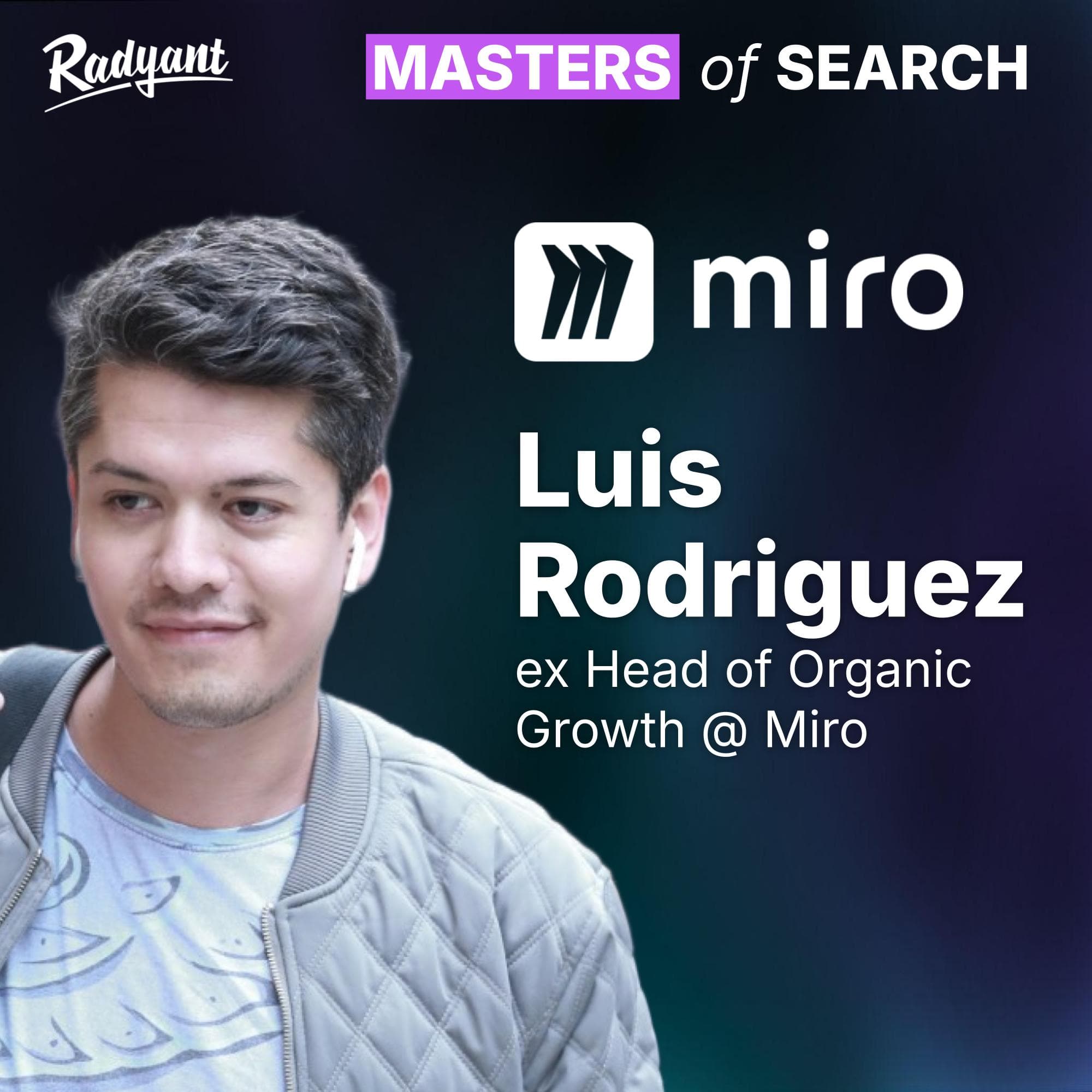
SEO FOR PLG MASTERCLASS | Luis Rodriguez, ex Head of Organic Growth @ Miro | #18
Show notes
Luis Rodriguez has 12+ years of international SEO experience and led organic growth at Uber and most recently Miro. He let me pick his brain for 60 minutes about scaling organic growth in PLG companies. Here are my 4 favorite takeaways.
1) Snake oil is actually useful
All the panic and noise in SEO right now is helping the industry. It's forcing SEOs to go deeper, connect with experts, and prove their value. The smoke and mirrors push people to understand what's real versus what's hype. His advice: don't drink the Kool-Aid, but use the chaos to get closer to what actually drives business results. Check your data, look at your bottom line contribution, and let that be your answer to "is this the end of times?"
2) Templates aren't just acquisition tools, but retention engines
Most PLG companies think templates are just entry points for signups. But templates are collaboration points that bring more people in, create virality, and drive retention. A user can start their journey with a template, but they can also restart it, continue it, and bring more people with them. This opens up organic growth beyond just the acquisition funnel into actual retention loops.
3) Traffic has never been enough as a metric
What generates value for your company is revenue, subscriptions, conversions. The goal isn't to get more visitors, it's to provide growth and business value. For measurement, he focuses on three things: holistic visibility within your category (not just prompts or keywords), sessions as a leading indicator (people still need to come to your product), and retention (are you acquiring repeatable users, not just one-time visitors).
4) SEO profiles need a recalibration
He's attracted to people with automation experience who aren't afraid of tools like Lovable, not just traditional content writers. Someone who started their career with ChatGPT has completely different timelines for keyword research across multiple languages, it's a medium task now, not a huge lift.
▶ Let's connect! 🔗 Niklas on LinkedIn: https://www.linkedin.com/in/niklas-buschner/ Radyant on LinkedIn: https://www.linkedin.com/company/radyant/ Luis on LinkedIn: https://www.linkedin.com/in/luisrodriguezc/
Transcript
Full conversation
- 00:00:00Myro is one of the most successful product-led growth stories in SARS history.
- 00:00:05Founded in two thousand eleven, they now serve more than a hundred million users across the globe.
- 00:00:11To talk about all things PLG, SEO and organic growth, I invited a special guest to the podcast today, Luis Rodriguez.
- 00:00:20Luis led organic growth at Myro with over ten years of international SEO experience.
- 00:00:26He owned the global SEO and AEO strategy.
- 00:00:29created an in-house answer engine optimization framework, built scalable, generative AI workflows for programmatic content creation, and led a cross-functional team spanning content, tech, SEO, and data.
- 00:00:41Before Myro, he led growth and SEO at Uber or compared the market, where he built industry-leading SEO tech and became the most visible platform in the UK.
- 00:00:51So welcome to the podcast, Lewis.
- 00:00:54Hey, Nick, how are you?
- 00:00:55Very good to be here with you.
- 00:00:56I'm so stoked to speak to you because I think you have a few very interesting POVs on the whole industry.
- 00:01:03So before we dive into your whole journey and everything, let's maybe start at the beginning.
- 00:01:09So how did you even end up in SEO?
- 00:01:13Yeah, that's a really good question.
- 00:01:14And I feel that there's not a single path on how you can end up in SEO.
- 00:01:19It's at least something that I've seen throughout my career.
- 00:01:21But my path started starting selling rocks.
- 00:01:25So I was working for a stone company in India called Arbicon International, one of the biggest exporters of granite, marble, these kinds of things.
- 00:01:34And the job was actually called online marketing.
- 00:01:36But most of the business development that I was doing or online marketing that I was doing need to be done throughout the night, given the time zone difference between the markets that I was handling, which was like Mexico, Colombia.
- 00:01:50Spain and I decided not to wake up at two in the morning to work.
- 00:01:55So my proposal was to shift into the leads that were coming to the website.
- 00:02:01This was still the pre-massive approach to SEO or the awareness of it that will be part of any kind of company.
- 00:02:08So it was very much to learn the Google guidelines, webmaster guidelines, reading through forums, making sure to understand how to generate.
- 00:02:16money and leads to a company through the internet.
- 00:02:21And that's how it started.
- 00:02:22I later on moved on to a more professional approach to organic growth in rocket internet and some of the companies that you already mentioned.
- 00:02:32But it's been quite nice to be honest.
- 00:02:35A lot of the things that got me through SEO was I studied international relations.
- 00:02:40And to me, having a little window into what people are searching and what do they want and how do they try to find things was quite a handy thing, particularly when you see it across languages, across borders.
- 00:02:52It's something that got me.
- 00:02:53So yeah, that was for the beginning of my journey.
- 00:02:56So did I get that right?
- 00:02:57You started at a stone company in India.
- 00:03:01Yes, correct.
- 00:03:02How did you
- 00:03:02get that job?
- 00:03:04Through a company called, it's not a company, it's an organization called ISSEC.
- 00:03:08It's a student university type of thing.
- 00:03:11And I was doing an internship.
- 00:03:13They called it online marketing, but in reality, it was business development.
- 00:03:17And it was quite a good strategy where you will get people from the countries, bringing them to India to understand the actual dynamics of the stones and the mines and all this kind of stuff.
- 00:03:29And to promote and sell their products.
- 00:03:32So it was quite a crash course into a lot of things, business development, online marketing, cold calling even, together with international shipping.
- 00:03:42It was a really cool spectrum role to be honest.
- 00:03:46And then you found your passion basically around SEO organic growth and you like specialized or niche.
- 00:03:53down over time?
- 00:03:55I understood that generating money online was a thing and that you could actually generate a lot of money because these deals were millions of euros or it will last for two years type of deals.
- 00:04:08So even when I understood that someone was able to spend two million dollars buying rocks online, it was an eye opening for me.
- 00:04:17And my passion really came through the international part.
- 00:04:20So I've been really lucky being able to work in different countries, different companies and industries.
- 00:04:26And it always had that need.
- 00:04:28regional or at least international approach where I could leverage my knowledge about how different cultures are and really enjoying learning more than anything through the search lens.
- 00:04:40So my passion of SEO organic in general comes through getting to know other people in other places.
- 00:04:47The growth part, it really comes from, I guess, that a natural inclination to move forward.
- 00:04:56I really enjoy seeing things becoming zero one five ten and it's quite an experience to see that your work is actually having an impact into the bottom line of a company.
- 00:05:10My experience took me to companies where thirty percent, forty percent of the revenue was being generated through organics and to me it made a lot of sense.
- 00:05:20Yeah, it's an impactful industry, I would say.
- 00:05:22And now that we are introducing different methods of search, I think that the awareness, the impact that we can make through understanding organic platforms, it's something that I'm finding rewarding now.
- 00:05:39So definitely a good investment back then.
- 00:05:42My obvious next question is now What are the key learnings that help you from the stone company in India for your role at Uber?
- 00:05:52That's a really good question.
- 00:05:53You know, scrappiness.
- 00:05:55I think that one of the biggest things is to do the best with the tools that you have.
- 00:06:00SEO, particularly for a company like Uber, was just not needed.
- 00:06:04The company for the very first five, six years, it grew through international expansion, opening new markets, and ride sharing was not a thing.
- 00:06:12It was not something that people would be searching for.
- 00:06:14When more businesses open like Uber Eats, that's when we started going into the more massive markets, really speaking to the daily people and hitting those really high search volumes because everybody wants a burger delivered across the world in all languages, in all cities pretty much.
- 00:06:30So when I joined Uber, the SEO or at least the organic development was not necessarily at the same size as other more sophisticated parts of the company.
- 00:06:41So we need to invest a lot and do and be handy.
- 00:06:44We need to pull the different strings that we had on our hands.
- 00:06:48So I think that being scrappy was one of the things.
- 00:06:51The second one, being independent, I feel that as an SEO sometimes we get particularly an enterprise level SEO when you're working large companies.
- 00:07:01We tend to overcomplicate things where in reality technology, particularly today, allows us to fast-track a lot of the analysis, fast-track a lot of the research phases.
- 00:07:11and prove really the points about the channel itself.
- 00:07:18So those are the two things.
- 00:07:20Probably the last one, I lost the fear to call calling.
- 00:07:23So at least to me, it was something like, I put myself into the customer shoes quite often.
- 00:07:30And in the Stone Company, it's like some random guy from Mexico is calling me to sell me rocks from India.
- 00:07:37it's not necessarily a call that you would say, oh, I really trust it.
- 00:07:41So, you know, losing fear and just going for it, asking for the things that you want, it's something that in my career I do were really helping out.
- 00:07:48The company is a fantastic place to develop, to learn and to try new things.
- 00:07:54And being able to raise your voice, to raise your hand and say, I want it, I want to try something new was something extremely valuable in the company.
- 00:08:03So the first thing I'm noting down now for me is if you're hiring SEO people, look for people that have at least done cold calling once.
- 00:08:12So they're comfortable embracing the unknown and like growing beyond your comfort zone.
- 00:08:18Definitely.
- 00:08:19And I think that having also a background of.
- 00:08:22something client facing, something where you actually had to sit down with a client or a customer to do that.
- 00:08:28In my case, I worked at a front desk in a hotel when I was in the university.
- 00:08:33And that really helps you out to understand that, yes, they are searching, but it's also a person, right?
- 00:08:40And that person has a persona, has biases, has a profile, and understanding that there's someone behind all of these searches can help you out to make the connection to perhaps better as your strategies, where you move away from what people are searching for and just specify the keyword to really understanding what they mean.
- 00:09:00What do they actually want?
- 00:09:01What is what is motivating this kind of search?
- 00:09:04So if I was to hire, when I hire, I definitely appreciate people that have client-facing experience in any kind of level, customer success, even sales is something that I feel it helps other a lot.
- 00:09:20Now, that doesn't discard anyone because one of the best SEOs in the industry that I've had the chance to work with, he was a former policeman and he was a police for like, twenty-five years.
- 00:09:32High-fives to Mike down there in Australia.
- 00:09:35So yeah, I feel that even thinking about it, a policeman probably has a lot of contact with people and a lot of client-facing situations.
- 00:09:45So being with people helps.
- 00:09:48Awesome.
- 00:09:48I think there's also another uh seo from the uk that has been a policeman.
- 00:09:54i
- 00:09:55can't remember his name right now but um he occasionally writes stuff on linkedin.
- 00:10:01so uh now your last ten year was obviously at myro and i also said in the introduction that myro is like this crazy plg.
- 00:10:13uh sorry so for everybody that's not familiar with the acronym like product that growth.
- 00:10:18um I think there are a lot of cool SEO success stories around there, and some have the PLG approach, some have a more classic demo-lat BtoB SaaS approach, and BtoB SaaS has obviously also been a big, or they used SEO as a key growth driver from times.
- 00:10:39From your experience and also from just your point of view, do you feel like Having a product-led growth model helps more with SEO than a classic demo-led business model?
- 00:10:53I think that the biggest advantage of PLG is that you get a lot of feedback and you are able to touch into the different parts of the funnel and the different feedback loops that you get.
- 00:11:04I think that demo-led tends to bring people to marketing.
- 00:11:09into marketing materials more than actually to the product itself.
- 00:11:13One of the biggest learnings that I had at Miro was the usage of templates, for example, where these templates are not necessarily just an entry point for someone to sign up, but it's actually a collaboration point, something that allows you to actually bring more people in, not necessarily just that one visit transforming to one conversion.
- 00:11:32So I think that PLG and the focus in SEO in this part, opens up a lot of opportunities.
- 00:11:40I believe that SEO has historically been almost cornered into that position.
- 00:11:47But if we really think about it with PLG type of companies, you can really have a lot of retention through that.
- 00:11:54Once again, the template is a really good example where A person can start their journey with Miro to a template, but it can also restart it, can also continue and bring more people and bring that priority to the focus.
- 00:12:07I think another good example of that is Canva.
- 00:12:10Canva definitely is one of the companies that has opened up that idea to bring the people within the product, not necessarily at the top.
- 00:12:20So to me, really, PLG is the dream of an SEO team.
- 00:12:26where you're able to have complete, pre-sixty ideas that continually bring value and bring customers to the product, not just this is.
- 00:12:38Have you read the book, product led SEO from Eli Schwartz?
- 00:12:42Yeah, definitely.
- 00:12:44I like Eli's idea.
- 00:12:45He's a great guy, also high-five to him, and generally think that it opened up the eye, or at least it made it a name.
- 00:12:54I think that sometimes naming things and establish them within the industry can lead to more adoption.
- 00:13:00I also think that it's something that is easily misused or misunderstood, to be honest.
- 00:13:07I also like the thoughts in there and the idea of just trying to make your product the obvious answer for a user's query.
- 00:13:18And I feel like... There are so many cool SEO stories out there.
- 00:13:21So my role, Canva, you also named them.
- 00:13:24I'm always like astonished by Canva when I look them up into Simrush, then they have like a hundred of a hundred authority score, which is like basically just Google or YouTube has that.
- 00:13:35But I also liked, for example, the story of Rippling, where like they're this HR payroll, they have a lot of things, obviously management software in the US, and they had this approach of just constantly launching new products within their range and expanding.
- 00:13:55And I think they call it the compound startup.
- 00:13:58And I feel like it makes so much sense because from an SEO perspective, you always get a completely new set of clusters and intents and user groups you can target.
- 00:14:11So how do you feel about expanding your product?
- 00:14:17in a way that you also open up new demand through people that are interested in other things that you haven't tapped into before.
- 00:14:25Yeah, I completely agree with you.
- 00:14:28Going back to Eli's concept, I think that this means to let the product tell you where the demand is.
- 00:14:33Because when a company focuses into creating a feature or creating a specific product, there's a lot of research behind it.
- 00:14:39We are not creating things because nobody wants them or because nobody has the intention to use them.
- 00:14:44So I think that being able to be in that journey very early into the stages of planning and strategy, making sure that we build products that are also built for acquisition.
- 00:14:56I feel that as the industry evolves and as there are more platforms being open, SEO or organic need to become part of the PLG process and almost like fade away within it, where the product by the inception itself is the one that it's creating the demand, but also answering the demand.
- 00:15:15I think that at least that mirror the way that I'd like to implement.
- 00:15:19that was really understanding beyond, does it rank, beyond, is it visible or be inside it?
- 00:15:27It's more about, right, if somebody wants to brainstorm and finds our template, Do they bring more people to us?
- 00:15:35Do they actually use it?
- 00:15:36Do they end up paying for a subscription or increase the number of boards that they're creating, ranking or being disabled?
- 00:15:44I think that nowadays is just not enough.
- 00:15:48And the real way to do this is to be quite embedded into the product journey, I think.
- 00:15:55I like your idea about the templates and I think templates is a great example for PLG where like product led SEO, you mentioned Miro, you mentioned Canva.
- 00:16:07Now I see an increasing amount of companies that also try to embrace this idea of like free mini products or like parts of their product that they offer for free.
- 00:16:20So for example, I looked at Eleven Labs, it's this voice AI company and they have a big portfolio of voice to text.
- 00:16:30Exactly.
- 00:16:30And a lot of small mini features from their big suite that you can immediately experience as a user and get to know the product.
- 00:16:39So how do you like this approach and what's your overall take on these mini products, mini tools?
- 00:16:45I love it, to be honest.
- 00:16:47One of my favorite things when I was a kid was to go to the supermarket and have little samples of things because it really puts you in a position to have to buy them.
- 00:16:54So to me, it's a bit of a digital translation of that because my approach at least is whenever a product or a feature is being launched, it must have three things.
- 00:17:05To me, it has to have a really good detailed explanation about what this is.
- 00:17:09Sometimes I feel that particularly PLG companies tend to fall too much into the trap of being quite inventive or being quite creative with their namings and the way to position the product.
- 00:17:20that doesn't necessarily reflect search demand or how people want to find these things.
- 00:17:26So having a good explanation is number one to me.
- 00:17:29The second one is what can it do for you?
- 00:17:32Sometimes I feel that it's not quite obvious what a certain feature a product can do for the daily person or for the decision maker.
- 00:17:40One very good example, using Miro could be just a cool thing that you do and put little stickers with a lot of flashing lights.
- 00:17:48But in reality, it helps you out to shorten all of your path between idea production and to actually bring to market those ideas.
- 00:17:55So demonstrating to decision makers or to the everyday person that what is the value of that, that you can spend fifty percent less time ideating.
- 00:18:04and bring into your markets to product is quite important.
- 00:18:08The last one is a way to use it.
- 00:18:10So the templates is, we're going to go back to that example a little bit too much, but I think that having a way to use these products, show you that the art of the possible needs to happen because sometimes if you're searching for something, it's because you do not know it, right?
- 00:18:25And sometimes the answer cannot be that obvious.
- 00:18:27And if you give me a way to use it, it's quite good.
- 00:18:31Another really good example, it's pre-built websites that WordPress started to use a gazillion years ago.
- 00:18:39That is directly PLG.
- 00:18:41You have a pre-built website that you just basically need to adapt a little bit.
- 00:18:45And you're right on in the internet pretty much using the WordPress platform.
- 00:18:50So to me, having that trifecta is probably the best way to approach it.
- 00:18:56Let's stick into the point you made about PLG companies being very innovative and maybe with naming, etc.
- 00:19:04Maybe not taking into account the demand or how users actually name the things a little bit.
- 00:19:11I feel like for SEOs or people generally in organic growth, it's always important to win a seat at the table, to have their perspective heard when, for example, also... product strategy is shaped because we bring this important view for the customer, for the demand and also a little bit as a feedback loop from the market.
- 00:19:36What's your advice for people that maybe are still figuring out how to get the seat at the table?
- 00:19:44How can you justify it?
- 00:19:47Yeah, that's a really good question and definitely one of the best experiences at Mira was working together with the PMM team to precisely marry positioning with search intent.
- 00:19:58And one of the things that helped me out to achieve this was the power of friendship.
- 00:20:04I believe that creating an actual personal relationship with the person that is building these things and understanding what are their problems, how do they approach things, it's a lot more important.
- 00:20:14I think that SEO can be a really good partner to them by feeding information.
- 00:20:19the same way that PMM teams will do user research, will do whole groups.
- 00:20:24SEO, it's also a reflection of the market and how can people start finding these things.
- 00:20:29That's one way, the power of friendship.
- 00:20:32The second one, I'm alluring a little bit to it, so the data ultimately numbers reflect reality and being able to demonstrate what is the capacity of acquisition.
- 00:20:42or retention that these products can have, it's something invaluable for any kind of planning or strategy.
- 00:20:48If you know and what to expect about how many actual people are actually trying to find this and use it today, it can lead you to very different decisions on feature prioritization, on launching times as well.
- 00:21:00It can be that you're building something that is really good for Christmas, you know, and you just put it up for Christmas.
- 00:21:06So those two things held me out.
- 00:21:09The last one, I think that creating a good way to showcase the impact of SEO, it's always a big win.
- 00:21:19Everybody wants to be with the winners, right?
- 00:21:20And if the strategy itself and the steering of the naming of products and the positioning of products does lead to more acquisition and to more adoption of those products, I think that making that visible is extremely important.
- 00:21:35The worst thing that we can do is to do a great job making a product very discoverable and being able to be adopted, but not tell anyone.
- 00:21:46In enterprise levels, I think that it's a common pitfall for SEO teams, where we struggle to translate jargon and specific metrics into business impact, something that every team can understand, at least within my approach of, within Uber Eats, for example.
- 00:22:07that translated to orders, to basket size, to number of restaurants being signed up, and that's something that the company across would understand.
- 00:22:15If I would speak about impressions click through raids, even if for us sounds like the most basic of things, a sales department will probably won't have visibility on that, you know, and it's important that everybody understands the value.
- 00:22:31You already mentioned a couple of really great points and I want to maybe summarize it or like get this point across again for the audience because data and looking at the right data and measuring success I think is more critical than ever.
- 00:22:48because we basically had this introduction of AI overviews and all the different like new things in the ecosystem where suddenly a lot of people learned that Just looking at traffic might not be enough.
- 00:23:03For some, it was no surprise at all.
- 00:23:05But for some, it actually exposed some outdated strategies that weren't supposed to work for quite some time.
- 00:23:13But they, I don't know, fortunately or unfortunately, still worked.
- 00:23:18So if you would have to define a set of data points or metrics to really understand if you're moving into the right direction with your organic growth strategy.
- 00:23:32What would you look at?
- 00:23:33Yeah, that's a great question.
- 00:23:35And before you get into it, I'm not sure if traffic has ever been an enough metric, to be honest, because it almost sounds like vanity.
- 00:23:46And it is great that a lot of people are seeing your things.
- 00:23:49But if you think about SaaS, or generally any product outside of advertising, outside of editorial, I think that it's all about the bottom line, what generates value for the company itself, if that's revenue, if that's subscriptions, if that's following.
- 00:24:06I think that right now what you're facing is just an extreme amount of noise and confusion because I've seen a lot of approaches about reverting to impressions, for example, or river or now I see a lot of noise about as well.
- 00:24:23of counting the number of times that the people agent of ChatGPT thinks your website.
- 00:24:30Cool.
- 00:24:31And so what?
- 00:24:33Ultimately, what we are here to do is to provide growth and to provide business value.
- 00:24:38So my number one recommendation and where I try to point at everyone, it's really don't get into the noise.
- 00:24:48Don't drink the Kool-Aid.
- 00:24:49focus into what generates value for your company and continue going.
- 00:24:52Now, being pretty specific, I really like to separate two things.
- 00:24:56One, those are the business metrics.
- 00:24:58How can we communicate to stakeholders, decision makers?
- 00:25:01What is the valuable part of the company?
- 00:25:03And again, as I was saying most of the time, that revenue and that's value added through the overall business.
- 00:25:11The second part is working metrics.
- 00:25:12Like what helps us out as you were saying to understand if are we moving into the right direction right now?
- 00:25:18To me, I think that the most sophisticated part is the visibility that you can have within any category.
- 00:25:24Right now, I've been working a lot with a tool called EverTune that I really like because it flips the story from chasing prompts, which prompts is just a very long-tailed keyword for all folks like me.
- 00:25:36Long-tailed keywords and prompts are just the same.
- 00:25:41But EverTune flips the story.
- 00:25:43It's about the visibility of your brand, regardless of the actual prompts that people are using.
- 00:25:48And to me, showing up when the user needs it, that is a really valuable thing.
- 00:25:53So visibility comparing to a market full size into the market itself, that helps our luck.
- 00:26:01The second part, I do think that people need to come to the website to do an action.
- 00:26:06So I'm not saying that sessions is something that is particularly enough, but it is a part that we need to measure.
- 00:26:13People ultimately cannot create a template or cannot.
- 00:26:17Can people order burgers in ChatsBT already?
- 00:26:22I think Uber has not yet.
- 00:26:24I don't
- 00:26:27know.
- 00:26:28Maybe they have already integrated with the Agente Commerce Protocol.
- 00:26:32Maybe, I'm not sure.
- 00:26:33Yes, I'll ask around.
- 00:26:38At least right now, for most of the products, you still need to go to the product itself to do something.
- 00:26:44You can find it within the AI tools or the AI overviews, whatever it is, the platform that you're using or the preferred format of your search, you'll ultimately have to go to the product.
- 00:26:55So working with sessions as well, it's really important.
- 00:27:00The last one, to me, retention now becomes a bigger part of what an organic success looks like.
- 00:27:06So making sure that we are acquiring repeatable, that the returning users, it's something that I really like to keep an eye on.
- 00:27:14Let's talk more about burgers real quick.
- 00:27:17The burgers now being an analogy, but I also put some thought into that and I'd like to get your perspective.
- 00:27:25Do you see people anytime soon really like making a whole purchase decision?
- 00:27:34And I'm not talking about the purchase of like five euros or something, but let's say maybe a fifty euro plus or maybe a hundred euro plus.
- 00:27:43Do you see them making the whole purchase decision and actually completing the purchase in ChatGPT?
- 00:27:50Of course, yeah, I think so.
- 00:27:52One of the most difficult things is to jump out of platforms and go to another one.
- 00:27:56And right now, that means going from ChatGPT to Chrome to a browser or to an actual app.
- 00:28:03So I believe that once those use cases are enabled, they will be a massive thing.
- 00:28:08to give you a couple of examples.
- 00:28:10So right now, I think that some e-commerce has been enabled.
- 00:28:14You can not necessarily complete the purchase.
- 00:28:17I think that a deal with PayPal was just announced, but it's particularly enabled all of those transactions within the platform.
- 00:28:24So we are definitely going there.
- 00:28:26Is it a good experience right now?
- 00:28:27I don't think so.
- 00:28:28I think that chat GPT or generally all of our AI platforms are generalists right now.
- 00:28:35They have just any... feature or any kind of use case fit into it.
- 00:28:41And if I was one of them, I will definitely start searching more specific use cases and start tackling them one by one and or creating tools for people to solve those use cases.
- 00:28:52So e-commerce is definitely gonna be a good one.
- 00:28:55I'm definitely looking forward to see what Amazon would think, what all of the e-commerce platforms would think eBay as well.
- 00:29:03once you are able to do the full-on research with high detail, with actual information points about everything.
- 00:29:11So going back to our burgers, if I was searching for the best burger in London right now and I could order it through ChatGPT, I would one hundred percent do it.
- 00:29:20Why do I need to now open my UberEAT account or my Deliveroo account to do so?
- 00:29:25So I don't like to see creativity or these platforms as something That has never happened before.
- 00:29:36the technology definitely has not happened before or perhaps very little times But it's a new platform and it has its own rules and it's gonna have its own evolution.
- 00:29:45You were not able to buy things to Facebook before and for the for now the very little people that use Facebook.
- 00:29:51You can still buy things for Facebook Instagram purchases tiktok purchases.
- 00:29:56So it's all pointing at the same thing.
- 00:30:00these platforms need to generate revenue one way or the other.
- 00:30:03And I feel that chat GBT has opened up a lot of business use cases, a lot of enterprise level type of monetization.
- 00:30:13Now it's gearing up to monetize from the everyday folk.
- 00:30:18Okay, I'm playing a little devil's advocate here because I think that a couple of months ago, Meet meta actually announced yet wasn't July.
- 00:30:34So we're recording this in October, so not too long ago.
- 00:30:39They announced that they will end their native checkout for shops.
- 00:30:44So for Facebook and Instagram, because like they said, they will no longer support order management, post purchase experience, blah, blah, blah.
- 00:30:54And you have to go.
- 00:30:56To the sellers website.
- 00:30:58So as I said playing devil's advocate here.
- 00:31:00Oh, yeah.
- 00:31:01No good point.
- 00:31:02Why do you think that it will be different and a different story with chat GPT and that we won't read the same announcement?
- 00:31:11So like a gente commerce blah blah blah being discontinued in about five years?
- 00:31:18Yeah, well good good points and I was not aware of that.
- 00:31:21nevertheless Facebook.
- 00:31:23It's a dying platform I'm sorry to say that.
- 00:31:26It's definitely not growing in users or use cases as well.
- 00:31:29The audience that Facebook tends to have at the moment is not necessarily the one that was raised with e-commerce embedded, right?
- 00:31:37So I think that now being able to manage all of that purchase journey for younger audiences, it's a lot more important.
- 00:31:44So that would be one of my arguments.
- 00:31:47The other one is mostly the necessity of to create revenue true.
- 00:31:52AI platforms.
- 00:31:53Even if it doesn't last, it's something that they will definitely try.
- 00:31:58The last point is I think that social media is an incomplete journey.
- 00:32:02You need to make an entire purchase decision based on five seconds of a video into three kind of posse words in a bunch of fake likes and fake shares.
- 00:32:12Never the best.
- 00:32:12I think that a journey that is enabled within AI platforms is at the research phase.
- 00:32:19You can have that all very well compressed in maybe those same five seconds, but at least with a lot more reliable information and with different sources.
- 00:32:29So there's, to me specifically, there's a higher level of trust of the things that I would buy through SiteGBT.
- 00:32:37I don't think that I've ever gotten more to your point.
- 00:32:40I don't think that I've ever bought anything through Facebook.
- 00:32:43or any social media.
- 00:32:45But that may be me and a lot of other people.
- 00:32:48Yeah,
- 00:32:49quickly stepping out of my devil's advocate role here, totally plus one, especially to your last argument.
- 00:32:56I also feel like the experience is completely different because you can ask.
- 00:32:59chat.gbt and also maybe other AI systems.
- 00:33:02You can ask follow-up questions.
- 00:33:04You can ask to pull reviews and to compare with other products.
- 00:33:07It was never possible with Meta and with Instagram.
- 00:33:11Now, stepping back into my devil's advocate role here, I started to see or hear people being fearful about ChatGPT losing its magic in the experience and getting biased towards this commercial impact.
- 00:33:30Like as you said, the necessity to drive revenues.
- 00:33:33So there has been a report.
- 00:33:35I don't know.
- 00:33:35I didn't check it.
- 00:33:36So for everybody that's hearing this, please go and check it yourself.
- 00:33:40That OpenAI will probably lose a half a trillion dollars by twenty twenty nine due to their investment into data centers, blah, blah, blah.
- 00:33:50So obviously they have to make more revenue.
- 00:33:53But do you also fear that the user experience will become worse due to this commercial necessity for OpenAI?
- 00:34:08Yes, clearly.
- 00:34:09I think that we need to look back into the previous chat GPT Google.
- 00:34:15Ten years ago, the Google server was very clean.
- 00:34:18It was really wide.
- 00:34:19and you know you would see a lot of empty space pretty much and you would get your answer, your blue link and it would arguably give you better answers than nowadays.
- 00:34:30So if we look at how the SERP evolved to more specific use cases traveled.
- 00:34:36AI modes, images, videos, rich snippets, all this sort of rich snippets of the world.
- 00:34:42Now we are seeing that it's a crowded space with a lot of more components, with a lot of different interactions trying to satisfy specific use cases.
- 00:34:51So I don't particularly see a way out.
- 00:34:54Arguably the open AI folks are really smart people and probably will find a way to create less friction.
- 00:35:00I think to me the key point would be to... generate that revenue with a less amount of friction.
- 00:35:06We're using an example.
- 00:35:08I've been looking into cars lately.
- 00:35:11And in the use case, in the use cars market, it's obviously quite difficult to know if, you know, at a brand X versus another one, it's how good that they are, what kind of common problems do they have.
- 00:35:25If I was able to actually book a drive test, I would have done it in the last couple of days.
- 00:35:32So how to get you to that point to trigger, to actually click and generate the revenue, it's going to be quite interesting.
- 00:35:42Arguably, also OpenAI is making a lot of different revenue streams from the API usage, from the different custom GPTs that you can do, premium plans.
- 00:35:55There's definitely a lot of it to your point.
- 00:36:00There's trillions of dollars to be generated.
- 00:36:03Whenever these companies are going to be taken into the market, it's going to start with a bar this big, like literally off the charts and off the camera.
- 00:36:11So that's going to generate a humongous amount of pressure to start driving and milking as much as they can.
- 00:36:20Right now, the adoption has been fantastic.
- 00:36:24Can we still count it as a new kid in the block?
- 00:36:26A little
- 00:36:27bit, probably, yes.
- 00:36:28the newest kid would call it in the block.
- 00:36:31And there's going to be a critical point in which acquisition or at least new discovery is going to end.
- 00:36:41There's a very good, I recommend everyone to watch the Kano model of product where basically the wow factor starts dying out over time because people assume it as one of the basic things.
- 00:36:54In this Kano model, there's a very good example about Wi-Fi.
- 00:36:58like how Wi-Fi.
- 00:36:59back in the day, fifteen years ago, it was a plus that you would see a hotel with Wi-Fi like right on.
- 00:37:05Right now, if a hotel doesn't have Wi-Fi, you will probably question why are you there.
- 00:37:09So, that inevitably happens to old products and the innovation part in keeping things fresh, it's going to be a challenge for open AI or for any AI platform.
- 00:37:22great example with Wi-Fi.
- 00:37:23actually I had this morning.
- 00:37:24I was stepping out of the subway and I was calling my girlfriend and I looked at this historic building here like in Berlin Germany in the city center we have a lot of historic buildings and I was feeling this excitement about wow how crazy it is that I can like call her now and like I was going through the subway.
- 00:37:42so but it's it's honestly a very very rare moment to still be amazed.
- 00:37:49Yeah,
- 00:37:52correct.
- 00:37:53And I think that OpenAI or chat specifically brought that wow factor to the internet itself, right?
- 00:38:00Like how complex can it be to put all of this tool together?
- 00:38:05It was quite amazing, particularly for all, when I was at Uri, we started to play with the Lee one with the Lee two.
- 00:38:12We started playing out with GPT, like high-five tool of the data science team there in the Uber team because we were really seeing how this thing was evolving.
- 00:38:22One of the very first projects that you got the chance to use this technology was to generate about five million restaurant descriptions in multiple languages.
- 00:38:32Surprisingly, we didn't use GPT.
- 00:38:34GPT was bad at that time.
- 00:38:38seven years ago, six years ago, where this thing was still called machine learning or NLP.
- 00:38:44And we use Alexa system actually to reverse engineer the tax that certain restaurants or dishes had.
- 00:38:55So we can generate descriptions based on that, but there was an LLM behind Alexa pretty much.
- 00:39:01So it's been a lot of fun to see the internet.
- 00:39:07to be cool again.
- 00:39:09That's a very good bridge you built with the Uber Eats descriptions because I just wanted to say that we already tapped into AI and we spoke about AI like as a channel marketing channel distribution.
- 00:39:21But I think like we marketers especially we also use AI a lot.
- 00:39:25as a tool.
- 00:39:26And as I said in the introduction at MIRU, you also experimented with generative AI workflows for programmatic content creation.
- 00:39:35And I just like to understand your thoughts more about how you approach this, because I see a lot of people who also not necessarily always with the best intentions say, yeah, I can just use AI to create hundreds and hundreds and thousands and thousands of pages.
- 00:39:54And yeah, I would just like to hear from someone with a lot of experience.
- 00:40:00How did you approach it?
- 00:40:01How would you approach it?
- 00:40:02Like, what are your key learnings?
- 00:40:04Yeah, that's a really good question.
- 00:40:07I do definitely think that it's so magical, the experience of generating content and words with AI, that it almost oversimplifies the task.
- 00:40:17And I think that's a very big, common pitfall.
- 00:40:19Number one learning to not over rely on AI right now.
- 00:40:22to me that the sweet spot is really on hybrid and assisted models Where you still maintain a human touch point or multiple human touch point depending on how delicate the content is.
- 00:40:33To really accelerate.
- 00:40:35I don't think that the goal right now is to automate.
- 00:40:37I think that right now the most productive is to accelerate delivery and Again, perhaps in the mirror spirit to bring ideas to market a lot faster.
- 00:40:46A lot of the different tasks have become meaningless or have become not time consuming.
- 00:40:52You will research, clustering, analyzing large data sets, making insights, or drawing different conclusions from multiple sources.
- 00:41:00All of that is just a tiny little... prompt nowadays if you have your train models.
- 00:41:06So to me, one of the biggest learnings is to invest into preparation.
- 00:41:11So creating your custom GBTs, creating your own projects within cloud or whatever is the platform that you're using that can help you out with those repeatable jobs is the best thing that we can do.
- 00:41:22So for me, step number one, searching to everything that you do until death, like something that you hate, copy pasting, growing things, downloading, emerging data sets.
- 00:41:32all of that can go into an automation part.
- 00:41:36The second point and one of the biggest learnings is that a human is still needed very much because now the role perhaps of content copywriter or content manager needs to evolve into content strategy.
- 00:41:52At least that's my approach and my concept.
- 00:41:58where still a person needs to understand the customer.
- 00:42:02still a person needs to understand what good looks like.
- 00:42:06Any AI platform right now is not able to discern between good quality and bad quality, at least within the content side of things.
- 00:42:14So having someone, an expert that is able to make that adjustment based on their experience is to me, invaluable.
- 00:42:21A great example of this was a compare the market where all of the content that is generated there has to be compliance to a lot of government rules.
- 00:42:31And you cannot use multiple words that are very common within AI platforms like best, or this is what it's for you, very indicative, very determination.
- 00:42:42So being able to have these intervention points is quite interesting.
- 00:42:46The biggest challenge that we had there was to integrate compliance, like an actual government compliance touch point, to understand if the quality was good enough or not.
- 00:42:56So again, a hybrid model to me is one of the biggest things we can do.
- 00:43:04I would definitely advise everyone to consider what are the repeatable tasks that you can automate and do not lose your expertise, do not lose the control of what you want to tell to your customers.
- 00:43:18You can definitely bring all of the customer feedback, customer success stuff into one melting pot, but ultimately, your expertise is still very much needed.
- 00:43:29What good looks like needs to be defined by someone that has the highest level of quality.
- 00:43:34And right now, it's a person still doing.
- 00:43:37And if Uber would approach you now again and would say, hey, Lewis, we have to create another five million restaurant or whatever descriptions.
- 00:43:51Like, I mean, five million descriptions is very hard.
- 00:43:56to have the human in the loop, right?
- 00:43:58So do you see a scenario where you could actually, I mean, it's super convincing, the content manager to content strategist argument, but do you still, do you see a setup where it's possible to hand over like such a content project to AI, or would you rather argue, maybe guys, it doesn't make a lot of sense to actually create these five million descriptions?
- 00:44:24It's a great question and probably a philosophical one Because I think that you need to determine what good looks like as I was saying and what good enough looks like.
- 00:44:34I think that even QA can be assisted by automation Pretty much like you can actually create an antagonist model that goes in searches for the mistake that you have been identified.
- 00:44:46In this experience that I was sharing we did spend about Two months or three months just really improved restaurant descriptions Jesus Christ, it was a lot of reading, pretty much.
- 00:44:58And we bumped into multiple things, a lot of hallucinations, a lot of things.
- 00:45:02So eventually we learned what to search for in mistakes, because these models, if they make mistakes, they tend to do the same mistakes repeatedly.
- 00:45:11So we were able to capture.
- 00:45:13So if your content is not sensitive, if for you and your audiences and customers, eighty percent is good enough, I would say, fuck it, let's go.
- 00:45:24Let's let's just get it done in the case of Uber Eats.
- 00:45:27I would definitely guys let's go and and now let's.
- 00:45:30we have the ability to do it even better because Creating data pipelines to AI models now.
- 00:45:35It's a game before.
- 00:45:37in that first approach We needed to use some very big computers to dump all of these data.
- 00:45:43We needed to actually tap directly into servers to be able to get the numbers from it.
- 00:45:49Right now, an API between different things in charge of it is the easiest thing to build.
- 00:45:54So I think that we could even do it better.
- 00:45:58What I let an AI completely run and publish without any discrimination.
- 00:46:03No, I will be very smart and use industrial production techniques of quality assurance.
- 00:46:10Those things have existed for, I don't know, two hundred years, three hundred years, and they're true.
- 00:46:16That's how you get your toothpaste good enough without everybody checking age of the toothpaste that are being made, right?
- 00:46:22It's based on a sample.
- 00:46:24Your sample is statistical significance.
- 00:46:26And let's go.
- 00:46:28That makes a lot of sense also with spot testing.
- 00:46:30Like for every hundred piece, you take one out or like every thousand pieces, you take one out and check it.
- 00:46:38And if it's going well, that makes a lot of sense.
- 00:46:41Yeah.
- 00:46:41If you have, if you have used chat empathy enough, you know that there are patterns or at least I can see patterns.
- 00:46:47There are definitely repeatable behaviors that you see.
- 00:46:49So struggling with a specific language, struggling with access to specific type of files or to word certain things.
- 00:46:59Once you read one million restaurant descriptions, you start seeing the pattern, or at least you have to.
- 00:47:04So yeah, it's something that can be done.
- 00:47:06And again, I see it as an industrial production side.
- 00:47:12Very simple question.
- 00:47:14Do you have any preference for chat GPT, cloud, like other providers?
- 00:47:22and especially the models around certain SEO tasks.
- 00:47:25For example, content creation or maybe also analysis of large data sets, interpretation, any sort of task.
- 00:47:34Good question.
- 00:47:34For content projects, I definitely rely on Claude.
- 00:47:37I think that the way that you can create projects and a lot of the different fine tuning that you are able to do their plug and play, it's quite good, particularly because it enables marketing teams to do it by themselves.
- 00:47:50two years ago when I was in Comparter Market, we needed an actual data scientist to help us out fine-tuning and put those three things.
- 00:47:58Now it's just there.
- 00:47:59It was kind of like tidbits a little bit.
- 00:48:01So I like Claude for that.
- 00:48:03I like Gemini to strategize, to create different understanding and to summarize, to compress different things and come up with nice... narratives, I think that is quite good.
- 00:48:14ChatGPT to me is the generalist.
- 00:48:16It's the one that I go whenever I have random questions or random answers.
- 00:48:21I feel that, particularly looking at a better Gemini, the index of information is definitely larger within Gemini because they have Google, right?
- 00:48:31But as the models evolve, there's sophistication.
- 00:48:35ChatGPT to me, it's a yes machine, so you need to retell it.
- 00:48:42please don't just buy a confirmed bias to me because I've seen myself just saying yes so many times.
- 00:48:48it was like I have a big question in the beginning and then every suggestion is so good so proactive that it's a common thing to just yes yeah okay to it yeah and to me that deviates from actually a good strategy or a good outcome if you just end up saying yes to the machine.
- 00:49:08Yeah, right now, those two things for measurement more in specific.
- 00:49:11As I was saying, I really like Evertune approach.
- 00:49:15Very few tools out there are trying to give visibility on brands.
- 00:49:22It's a lot more about giving visibility to the prompt itself.
- 00:49:25And I see the point.
- 00:49:26It's probably a lot more profitable to charge you by prompt than by brand.
- 00:49:31Interesting.
- 00:49:32Evertune, I haven't heard of it before, but definitely something that we will put in the video description below for people to check out and just see how they like it.
- 00:49:45I like to always... make this podcast and the episodes very practical.
- 00:49:52So I obviously like to pick the brains of my guests, but also selfishly for myself, but also for listeners and viewers, extract very practical recommendations.
- 00:50:05So let's quickly imagine that you're a growth advisor, and I would be a PLG sales company.
- 00:50:17I haven't thought of a product, but yeah, you can just make one up if you like.
- 00:50:23And I seek your guidance on our organic growth strategy for the future, obviously with all the different changes going on, AI reviews, AI mode, chativity and all the stuff.
- 00:50:36And the things I like.
- 00:50:38to just keep things focused.
- 00:50:40So I say, hey, Louis, I need you to come up with like three priorities for me, like three things that are critical.
- 00:50:47What would be your advice?
- 00:50:49Yeah, great question.
- 00:50:50And to go to the point, first, invest in your data sets.
- 00:50:53Make sure that you have available data for the teams to use.
- 00:50:56Without the data, the PLG machine does not work, and that is exactly the same for organic growth and for a lot of these machines.
- 00:51:04Right now, we are entering the stage of understanding.
- 00:51:06We need to make sure that machines understand what we mean and what you're trying to do.
- 00:51:12investing that data and that technical foundation of the team.
- 00:51:17The second part is question everything.
- 00:51:20Right now, I think that most of the organic setups and organizations are not set up for this.
- 00:51:26And I'll come to my third point, but I think that right now is the time to really challenge, do titles work, do scopes of work, are the right ones?
- 00:51:35Are we limiting too much and putting people into a corner where they cannot do a full, complete job?
- 00:51:41So I would definitely look into my art and my structure to make sure that people are in the right place working with the right tools, as I was saying.
- 00:51:48And the last one, it's really, really challenged what kind of content are we producing and what kind of content you think that you're doing.
- 00:51:58To me right now, what has happened to SEO or organic is a massive diversification.
- 00:52:03I imagine all of this as what if Bing and Yahoo would have been successful back in the day?
- 00:52:08where you have more platforms to deal with, and those platforms are feeding themselves by other multitude of platforms.
- 00:52:15So a content piece is not just a landing page, it's not just, you know, the written words that go into a URL.
- 00:52:25To me right now, it's really key to have a three-sixty approach to content that continuously feeds multiple platforms with the same message, and that there's a three-sixty approach to what you're saying to your customers.
- 00:52:38So linking to that reorganization part, to me having a team of content that is able to generate multiple formats for multiple platforms, it's one of the biggest drivers of growth.
- 00:52:52Interesting.
- 00:52:55Another question I had where I'm really curious to hear your thoughts on is there's a lot of stuff floating around on LinkedIn and like about SEO, AI search, etc.
- 00:53:13And I feel like with people that are maybe less experienced or maybe they also don't have the time to go into everything in detail and do their own research, they buy into certain things that are snake oil, so to say.
- 00:53:30So I'd like to hear what Like from your experience, from your point of view, what are the biggest misconceptions people currently have about the future of SEO and organic growth?
- 00:53:44Good question.
- 00:53:46The first one is that it's dead.
- 00:53:49I'm not dead.
- 00:53:52there's no massive layoffs of SEOs around the world.
- 00:53:56on the opposite.
- 00:53:57I think that precisely all of this snake oil is helping out to bring some attention and to the value that we actually do create.
- 00:54:04So to me, the biggest misconception is that this is dead.
- 00:54:07It's not dead, it's evolving.
- 00:54:08As I was saying, I see social media as right now the closest channel to what organic is because they have dealt with multiple platforms and new impactful innovative platforms like TikTok most recently, where they have to change entirely how they create the content, how they did it, what are the triggers and the ways to implement these things.
- 00:54:31So that's one.
- 00:54:32The second one is that this is a completely whole new world.
- 00:54:35It is not.
- 00:54:36We are trying to satisfy customer problems.
- 00:54:39And if your SEO strategy or organic strategy was already trying to solve problems for people and trying to drive value to your business, then there is no conceptual change into what you're trying to do.
- 00:54:50there's a different implementation, as I was saying, because it's a different platform and they would like different things.
- 00:54:55But I don't believe that you need to completely change the way that you think that you're doing marketing.
- 00:55:03It's a lot about answering the problems.
- 00:55:05If anything, it's going to drive us closer to customers.
- 00:55:08It's going to drive us closer to what pain points do people have?
- 00:55:13pretty much.
- 00:55:14And then probably the last one and relatively controversial.
- 00:55:23This is not necessarily a misconception, but I think that this snake oil is useful at the moment.
- 00:55:30We do tend to overblow it.
- 00:55:33We are definitely a smoke and mirrors industry.
- 00:55:36And I remember the first apocalypse that I went through, that's twelve years ago, with the introduction of Penwind algorithmic update.
- 00:55:49It helped me out to go deeper into the rabbit hole.
- 00:55:52It helped me out to go deeper and connect with other experts to really know what was going on.
- 00:55:58It's all snake oil, it's all smoke and mirrors.
- 00:56:01So I think that right now, what all of the noise in the industry, it's being helpful for more folks to understand that there's a lot of value that we can create and that the more integrated organic strategy is within the creation of your product and the... in the business itself, the better results you will get.
- 00:56:22Yeah, again, slightly controversial, but don't overdo it.
- 00:56:27Don't drink the Kool-Aid, folks.
- 00:56:29Definitely, you know your industry better.
- 00:56:32You know your data.
- 00:56:34If you have a question about is this really the end of times, go to your report, go to see your bottom line results and the contribution that you're making to the business, there's the answer for sure.
- 00:56:46Awesome.
- 00:56:47I think we already have our LinkedIn hook with like the SEO snake hole is actually helpful.
- 00:56:53So this will definitely be controversial.
- 00:56:57But I think if people hear your whole explanation, it makes so much sense.
- 00:57:03Luis, this has been a super insightful conversation.
- 00:57:06I think you shared so much knowledge.
- 00:57:09It's really great to have you on.
- 00:57:12I started asking a final question a couple of episodes ago, and I'd also like to ask you this one.
- 00:57:21What didn't we talk about that we should have talked about?
- 00:57:23What did I miss in my questions?
- 00:57:26That's a great wrap up question and a rabbit hole itself.
- 00:57:34Perhaps we didn't touch too much about team organization, about roles, about, you know, skill sets that people need to have nowadays, which I think that it's something that is probably one of the most foundational changes that we are seeing in the industry right now.
- 00:57:50To give you a very good example right now, I'm very much attracted to, to, to not necessarily people that have experience within content writing.
- 00:57:59but a lot of experience into automation that they are not afraid of going to loveable.
- 00:58:04They're going to hug and face and just like try out new things.
- 00:58:08High five to my fellow in Miro Federico.
- 00:58:13He showed me a lot about how easy can it be to create automation and create solutions at scale, because now coding is also becoming an meaningless task.
- 00:58:24Exactly.
- 00:58:25Story.
- 00:58:26Obviously not to the level but at least to create really annoying things that no developer wants to do For sure it's getting there.
- 00:58:33So that's why I think that the skill set that people are needing now to be really successful is changing massively.
- 00:58:40I also think that Perhaps that we need to Let go of the old knowledge a little bit and the old bias about how long things are so right now again with the profile perhaps more junior profile.
- 00:58:56I've seen a lot of this snake oil as well about their more entry-level jobs.
- 00:59:03on the opposite.
- 00:59:03I think that an entry-level person is probably on a younger side of things with all of this technology being available to them from the get-go.
- 00:59:12I did not have a chat GPT when I started doing SEO and that's why my timelines are slightly different.
- 00:59:18But just for someone that started working with this, their first interaction or their first career opportunity was through ChatGPT.
- 00:59:28The timelines are completely different, right?
- 00:59:32Completely research in multiple languages is not going to be a long task.
- 00:59:35It's probably going to be medium type of thing.
- 00:59:39So I think that... The profiles are changing, and I think that the organization is changing as well.
- 00:59:46The way that teams are structured right now, in my opinion, is to be completely different.
- 00:59:52Back in the day, you would have your traditional's content, your traditional's technical side right now.
- 00:59:59What do you mean with technical?
- 01:00:02So to me, automation, AI, exploitation, data mining, intelligence itself, it becomes a bigger necessity to have it embedded within the SEO or within organic teams.
- 01:00:16Something that I'm really proud to have done in Nero is to recreate all of that structure and to move it from a traditional SEO org to a automated AI-first structure.
- 01:00:29And that specifically meant, or at least one of the biggest changes in my perspective, was to have an actual team that cares about intelligence.
- 01:00:38There are so many data points.
- 01:00:39There's a lot of different platforms to be looking at.
- 01:00:42that right now is not as simple as looking at your rankings, looking at your revenue, looking at your sessions.
- 01:00:46You need to connect a lot more dots and that's a full-time job.
- 01:00:51But if you are able to identify through your structure where the biggest opportunity are, where are your users adopting better the product across all of the different platforms, then you have better prioritization.
- 01:01:04Yeah, that's a... That's a little bit more about the organization and skillsets.
- 01:01:09I know exactly why I started asking this question due to these insights that then just suddenly pop up.
- 01:01:17Awesome.
- 01:01:17Thanks so much.
- 01:01:19If people feel like me that are listening or viewing and they want to hear maybe more of your thoughts or follow you around, what's the best place to go?
- 01:01:30Reach out to me in LinkedIn, send a message.
- 01:01:32I'm always available.
- 01:01:33I'm always happy to have one-on-one conversations.
- 01:01:36I've been participating a lot into coaching and development of the early stage marketeers nowadays.
- 01:01:45So yeah, reach out to me.
- 01:01:46Don't be shy.
- 01:01:47Nice.
- 01:01:48Luis, we will put your link to the link in the profile in the description.
- 01:01:51People go to Luis and don't spam him, so only politely reach out.
- 01:01:59Send me a lot of snake oil.
- 01:02:01I would love to see more snake
- 01:02:03oil.
- 01:02:03Nice.
- 01:02:05Luis, this has been a really great conversation.
- 01:02:07Thanks so much for doing this.
- 01:02:11I wish you all the best for the future.
- 01:02:13Thank you so much.
- 01:02:14very intrigued to see where you're heading, very intrigued to see where this whole AI search ecosystem, organic growth ecosystem is heading.
- 01:02:25And yeah, maybe in a year or so, maybe it's time for an update episode, depending on how the world looks like by then.
- 01:02:34But until then, thanks so much and all the best to you.
- 01:02:39Thank you so much, Nick.
- 01:02:40It was a great conversation.
- 01:02:41And yeah, let's rain check in a couple of months to see where we are, if we are alive, if the AI has not taken over the world.
- 01:02:48We'll see.
- 01:02:49So, Luis, all the best to you.
- 01:02:52Bye-bye.
- 01:02:52Thank
- 01:02:52you, everyone.