

EP 12·Nov 19, 2025·3260
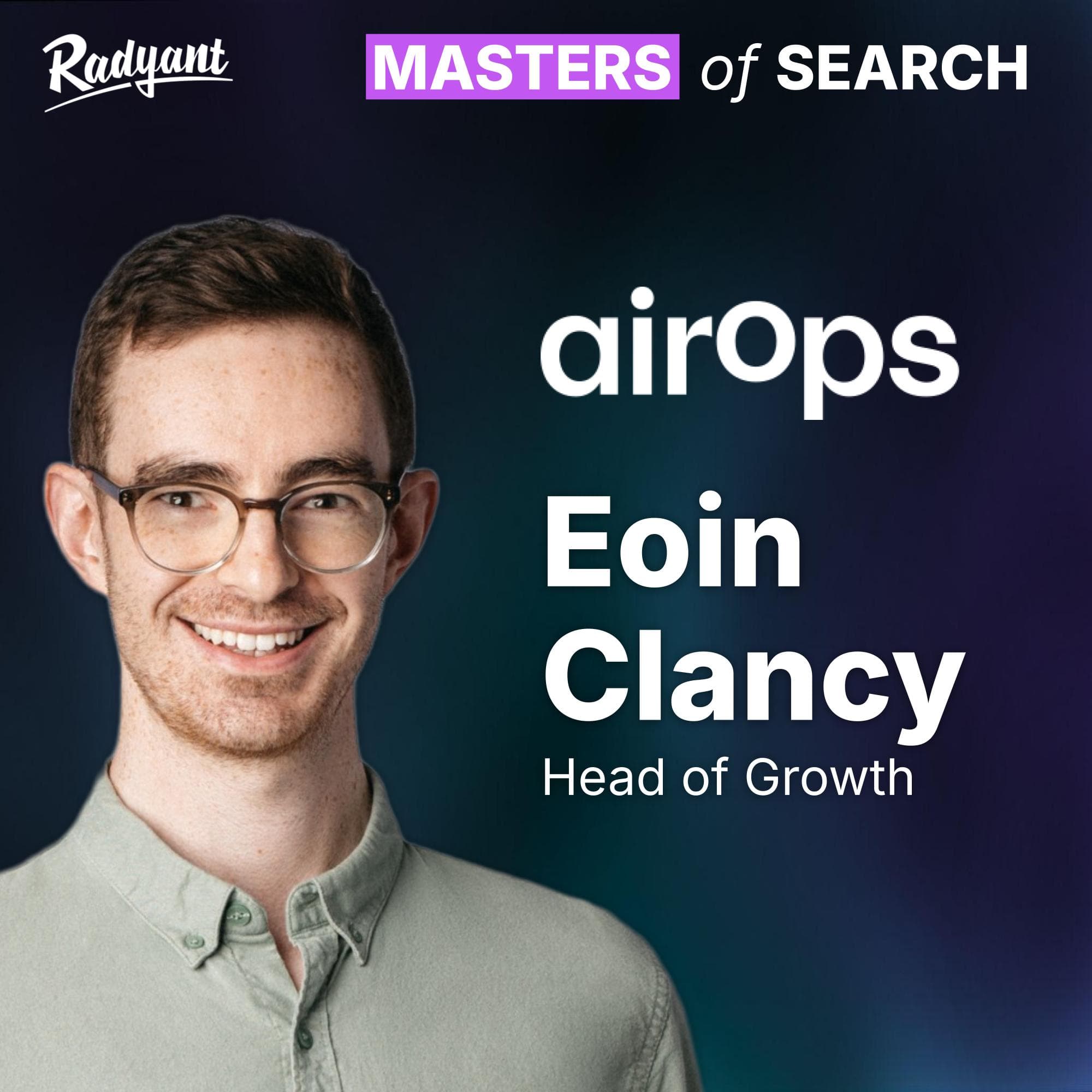
HOW TO WIN AI SEARCH | Eoin Clancy, Head of Growth @ AirOps | #12
Show notes
Eoin Clancy is Head of Growth at AirOps, one of the most exciting AI platforms currently helping marketers scale content operations.
Before AirOps, Eoin spent over 6 years at Telnyx, scaling from Growth Engineer to Head of Marketing, where he also got his first taste of AI tooling. He founded "Build AI-First" in late 2023, positioning himself at the forefront of AI-driven growth strategies.
▶ Let's connect! 🔗 Niklas on LinkedIn: https://www.linkedin.com/in/niklas-buschner/ Radyant on LinkedIn: https://www.linkedin.com/company/radyant/ Eoin on LinkedIn: https://www.linkedin.com/in/eoinclancy/ AirOps on LinkedIn: https://www.linkedin.com/company/airopshq/
Transcript
Full conversation
via podigee
- 00:00:00Welcome to a new episode of the Masters of Search Talks.
- 00:00:03I'm super happy to introduce today's guest, which is Owen Clancy, who is head of growth at Aerobs, one of the most exciting AI platforms currently helping marketers scale content operations.
- 00:00:16Before Aerobs, Owen spent over six years at Telnix, scaling from growth engineer to head of marketing, where he also got his first taste of AI tooling.
- 00:00:28He founded Build AI first in late, twenty, twenty three, positioning himself at the forefront of AI driven growth strategies.
- 00:00:37So, Owen, first of all, thanks so much for being here.
- 00:00:39Thanks so much for doing this.
- 00:00:40Can you give a quick intro about your role at Aerobs and what made you jump into the AI search world?
- 00:00:48Yeah, I love it.
- 00:00:48Thanks for having me as well, Nicholas.
- 00:00:50I think you gave a very good intro there that covered all the bases.
- 00:00:54And so.
- 00:00:55Prior to AirOps, as you mentioned, I was at Telnix.
- 00:01:00We were in the CPAS space where Organic drove a large portion of our pipeline.
- 00:01:05We were both a sales-led growth and PLG company, so having great content was a huge part of our engine.
- 00:01:12So I was actually an AirOps customer for about a year before I jumped on the team.
- 00:01:17And it was kind of that year after OpenAI released Shad GPT, like I ran RevOps, I was like super deep in the weeds there.
- 00:01:25So was a deep clay user.
- 00:01:27And then I was like, wow, like under the hood, AirOps has like all of these LLMs, I can like stitch stuff together.
- 00:01:32I can create like really personalized emails and outbound and lead magnets.
- 00:01:38So that's really where I started like tinkering.
- 00:01:41And then after that, I was like, actually, AirOps is very much focused on content.
- 00:01:44We should probably bring it on to the content team.
- 00:01:47So it took us a couple of weeks to really organize what workflows we wanted to port over.
- 00:01:53We've done a lot of programmatic.
- 00:01:55We've done a lot of thought leadership.
- 00:01:56We've done listicles, articles.
- 00:01:58We've done everything.
- 00:01:59So we narrowed down to one type of content and then really started to rearchitect our entire content operations.
- 00:02:07on top of AirOps.
- 00:02:09So it was very familiar.
- 00:02:11It was kind of like an air table like grid.
- 00:02:14We could like orchestrate workflows left to right.
- 00:02:17We could do keyword research all the way to fully fleshed out briefs.
- 00:02:21And what we really liked was it maintained like the human nature.
- 00:02:26Like we had like human reviews at the points we really wanted, which as we were trying to like like enforce or like adopt these different tools.
- 00:02:35We wanted to make sure that people felt comfortable with it.
- 00:02:38So even as we went from like full human writing to like human assisted, even that nature of like the term human in the loop was like helpful in trying to like help someone internally adopt it.
- 00:02:49So I saw the light.
- 00:02:51I saw that a company like AirOps was not going to get displaced by model improvements.
- 00:02:56In fact, it's going to get like better.
- 00:02:58And I thought the value that it could deliver to a team, we were a small content team of like two or three people, very heavily focused on SEO.
- 00:03:06So overall, I was like, I want to try and democratize access to this tool a lot more.
- 00:03:11So joined the team about a year ago.
- 00:03:12And then since then, in my role, it's a matter of like trying to find the channels that can help us again, get the tool, get the platform in front of more people.
- 00:03:21And yeah, take bets on the channels that can work.
- 00:03:24So we've done everything from webinars and thought leadership content to a lot of outbound and starting to do paid channels.
- 00:03:31So yeah, it's been a wild year so far, full of great growth.
- 00:03:36I think most importantly leads us to great conversations with the likes of yourself, Nicholas, and amazing customers.
- 00:03:42So in addition to being able to bring the tool to people, it's actually great to still Talk to people and learn what they're seeing and what they're doing.
- 00:03:49So yeah, it's been an amazing year so far
- 00:03:52Super cool.
- 00:03:53I mean full disclaimer.
- 00:03:54We are also an Arabs customer and the content you were doing or the initiatives you were pushing also helped to convince us to implement Arabs and to do Really cool stuff for our customers.
- 00:04:06now Arabs has you already said that grown a lot over the last month and you also raised a good amount of capital.
- 00:04:13Yet it seems and also from What you were just mentioning, you're focusing more heavily on content than on ads or different forms of content.
- 00:04:23Is that true or is it just like an impression from the outside?
- 00:04:26And you mean like content that we produce or like our own growth motion or on behalf of customers?
- 00:04:33I mean your own growth motion.
- 00:04:36Oh, yeah.
- 00:04:36content is huge.
- 00:04:38If we think about what we serve from a customer perspective, it's the ability to deliver great content with amazing distribution.
- 00:04:46Our own growth on the team has very much stemmed from that as the core.
- 00:04:51One of the first things I did when I came in was audit what we had live.
- 00:04:56A lot of it was older listicles.
- 00:04:59It was part of like an older evolution of the business.
- 00:05:02So we really started to try and like express our own opinions and that was taking subject matter expertise internally, putting it through workflows and then like again, keeping a human in the loop to make sure that it was really thoughtful.
- 00:05:16when we had like almost exhausted some of our own opinions, then that led to, okay, let's go outside the building.
- 00:05:21Who else can we speak to?
- 00:05:23And that was customers, that was amazing like thought leaders.
- 00:05:26So that brought us into this whole new surface area of Kevin Indix, Alayla Salas, Eli Schwartz, and then kind of organically out of those.
- 00:05:35internal conversations, spawn our webinar series, and like that's just gone from strength to strength.
- 00:05:41So we basically run an episode every two weeks.
- 00:05:44That becomes the core of our content for that.
- 00:05:46Following two weeks, we're able to like take it, snip it up and put it on different channels, which again, we can get into.
- 00:05:53We can start to promote it with paid as well, which we do a small amount of.
- 00:05:57But we've even like stemmed it off from like an SEO series to also like a CMO series.
- 00:06:02So as we as a business have evolved in terms of the customer or the persona that we serve, our content is like changing with it.
- 00:06:11So yeah, content is key to how we've kind of gone on our growth curve over the last couple of months.
- 00:06:17Another webinar is like a key pillar of content that contributes also to pipeline.
- 00:06:22Correct.
- 00:06:24I've had mixed success with webinars in the past, like other companies.
- 00:06:29They're a significant driver of pipeline for us.
- 00:06:33It's just great to be able to give value to people in terms of live conversations.
- 00:06:38We don't gate them.
- 00:06:39like anyone can sign up, anyone can join us any Wednesday or Thursday for an hour to hear from these amazing people.
- 00:06:46So we feel that by giving off value, we actually don't do that.
- 00:06:50many like product demos.
- 00:06:52Generally, we focus on what's working for these people.
- 00:06:55What are they seeing across their clients, their customers?
- 00:06:57If they're working at a company, they show off what they're doing in-house.
- 00:07:01And then I think by being part of that conversation, we just gain brand awareness.
- 00:07:06People get into the tool, they tweak and they're like, oh, like they get this, they get this like aha moment, which when people find themselves, they're like, hopefully customers for life.
- 00:07:16But yeah, we're not on a sales pitch with any of our webinars.
- 00:07:20We just want to be the company that seemed to broker these relationships, broker access to amazing insights that just help you if you're in content, if you're in SEO, and if you're trying to win AI search, get you to the forefront.
- 00:07:36And what do you feel are the success factors of the webinars you're doing now at Aerobs?
- 00:07:41What are you doing differently, for example, to the webinar programs you've been running at other companies because you said you had mixed success?
- 00:07:49Yeah, I think just marketers nowadays are super eager to like upscale.
- 00:07:56Like the previous audiences I would have dealt with were developers.
- 00:08:00And again, maybe that mind shift exists today with developers where they're using co-pilots, like a large portion of code can be written by your like GitHub co-pilot or other tools.
- 00:08:10But I think we're in this sphere today and we also run and content engineering cohorts who were there just like intentionally training the best of the best to people who have like high aptitude and really high attitude to learn how to do prompting, how to do orchestration, how to do automation.
- 00:08:28So I think the average marketer today is just like, how can I go deeper?
- 00:08:33How can I use these tools to help me do more in my day or reach a higher quality bar or do stuff faster?
- 00:08:40So I think it's that kind of marriage of like the moment with just the persona that we target which is like marketers that they love seeing another company do great marketing.
- 00:08:51they want to go deep right now and it's the ability to like get their hands dirty and use amazing tools.
- 00:08:57so I would say it's a mixture of like timing and then the content we put out there and whoever privileged enough to get on our events.
- 00:09:04all of that kind of comes together and it just I think delivers amazing value to folks.
- 00:09:10You mentioned the term content engineer and I feel like you guys coined that a little bit and it reminds me of the term GTM engineer from clay, which they coined.
- 00:09:22Can you give us a little bit of your reasoning behind?
- 00:09:28what is a content engineer?
- 00:09:29How is a content engineer different to a content strategist, to a content writer?
- 00:09:34What does it involve?
- 00:09:39really kicked off the content engineer motion back in Qtoo.
- 00:09:44It kind of came again like what I mentioned earlier around, it was just like internal point of view that we had from talking to amazing customers and from our own internal need of wanting to use AirOps more.
- 00:09:58People were asking like, where does my team need to change?
- 00:10:02Where does the skill set need to go deeper?
- 00:10:04How does the average person on my team upscale?
- 00:10:09Kind of between everything.
- 00:10:11we come up with this term of like the content engineer.
- 00:10:13We know we've seen it at like other maybe like agencies meta have like aversion of it But it just seemed like the right Terminology and like you said kind of like GTM engineers been out there for ages but and it was a nice mixture of the systems builder and someone who is like an amazing hinker or strategist.
- 00:10:33and then also They're a marketer at heart.
- 00:10:36They have a core marketing or growth background.
- 00:10:40And I think today, in addition to being an amazing builder, where a marketer stands out, is in having that super high bar for quality and taste.
- 00:10:50So yes, anyone can go into China GPT.
- 00:10:53You can get a load of.
- 00:10:55crap out, but a great marketer is going to use it to elevate what they do.
- 00:10:59They can use it as a brainstorming partner.
- 00:11:02They can use it to, again, just enhance what they're doing.
- 00:11:05But the barrier for taste has now just risen like ten notches.
- 00:11:10For us, a content engineer is someone who can marry the ability to design systems.
- 00:11:16think logically about what makes sense to automate, what makes sense to keep the human of the loop on.
- 00:11:21And then they have that really strong growth or marketing background.
- 00:11:25So that could be you come from brand, you have a really like key knife for creativity and design.
- 00:11:32or you've been deep in SEO and content where you just know the technical aspects of it.
- 00:11:37You've gone super deep there and you know like what structure you need and you can like figure out your tone of voice for the company.
- 00:11:44So I think it's this amalgamation of these three units is what is kind of like making these like Penex content engineers stand out.
- 00:11:52Really cool.
- 00:11:53I think it's a very interesting point of view and it also stuck with me a lot and I thought about this.
- 00:12:02and we're also trying to upskill our people more into these content engineer roles.
- 00:12:08You mentioned the content engineer cohorts.
- 00:12:11Can you share a little bit about what you're doing in these cohorts?
- 00:12:14Is it also an upskilling program or how does it look like?
- 00:12:17Yeah, great question.
- 00:12:19So our cohorts were kind of driven by customer demand.
- 00:12:24So we had amazing customers who signed on who were just like using the platform self-serve and they're like, I feel like I can go deeper and I feel like I need someone to like help coach me.
- 00:12:36So again, I kind of come from like a growth background and reforge was huge a couple of years ago.
- 00:12:41You would do a reforge course to be connected to peers.
- 00:12:44You get really great content and you join this like live session with someone who was like amazing.
- 00:12:49So we try to like almost recreate that.
- 00:12:53With our cohorts, so they're all live.
- 00:12:56We take about thirty five forty people for three weeks.
- 00:13:00We do a couple hours a week with the onus or like the.
- 00:13:03our attention is directed towards a lot of the live sessions.
- 00:13:06So we have amazing builders.
- 00:13:08Cindy and Andrea on our team have been implementing air ops for some of the biggest brands you will all know and they're the ones taking time out of their day to create the materials to upskill people.
- 00:13:20Again we started to build this like massive bank of best practices around prompting orchestration like even as I mentioned about like decoding if you're a programmer like working with a co-pilot.
- 00:13:33That alone is like a massive skill set where people can improve on today.
- 00:13:38So that's a lot of the asynchronous material that we have.
- 00:13:41And then part of the fun of being in a cohort is getting to talk to your peers, learning what other people are doing.
- 00:13:47So in our most recent one, we have some shining lights.
- 00:13:50We're putting in loads of hours.
- 00:13:52They're building some amazing stuff that even before the end of the three weeks, they have hitting production.
- 00:13:58So like one person I'd call out is Deep Sheikah, who's like a product marketing manager at Stripe.
- 00:14:04She, maybe not within like the roles and responsibilities of her typical job, she's just gone super deep in Aerox.
- 00:14:12And you can imagine Stripe is kind of like financially regulated.
- 00:14:15I presume there's a lot of red tape to get stuff live.
- 00:14:18She already has a lot of her workflows like in production, helping her out creatively, like open new ideas, positioning tactics.
- 00:14:26So it's just amazing that our goal by the end of the three weeks is that everyone has kind of like their capstone project complete.
- 00:14:32We do a big demo day where everyone gets to like share what they've learned.
- 00:14:36but it's amazing that people even before the three weeks are off have stuff in production, have stuff that's like benefiting internally their own company, or they've already like deployed it to different customers.
- 00:14:46So Core is like kind of this magical moment right now where everyone can learn from each other, they can learn from our team, and then it's really trying to like upscale people in those key areas of prompting, orchestration, using a co-pilot on AirOps and then not to, and then all at the aim of like, what will be your capstone project, what's going to elevate you and your team so that you can get some wins on the board.
- 00:15:13I think it's super nice when you build with Aerobs, so I totally get the excitement.
- 00:15:20It feels like when building your first Zap or your first Make Automation or nowadays N-AIDN automation.
- 00:15:27By the way, N-AIDN, it's a company from Berlin, and we are also based in Berlin, so I'm super proud of them that they've... got this international fame, but I also felt the same excitement.
- 00:15:41So I totally get how people, like it just clicks and suddenly you're able to build things that haven't been possible before.
- 00:15:51And you already mentioned that you're also using Aerobs internally for the growth of Aerobs.
- 00:15:56I feel like this feels very meta.
- 00:16:00Can you share a little bit of the behind the scenes, how you're actually using it for yourself?
- 00:16:06Yeah, for sure.
- 00:16:08Just to echo your point there, I think there is this like, aha moment, but like a lot of tools, definitely within NADN as a big clay user and still am, that like... when you get this outcome, you're like, oh my God, like the direction of my career has changed.
- 00:16:22Like how I thought about something is very, could be very different.
- 00:16:26And I think my aha moment, going back to like air ops was more in like the Revop zone of personalization.
- 00:16:33It was the ability to take, and it's one of these workflows that we have right now, which is taking like sales conversations and conversations with like amazing experts, which live in like dong or attention.
- 00:16:46I'm able to turn them into amazing briefs for extra content.
- 00:16:51So we can do a one-to-one mapping, or we can say, OK, let's pull everything around a given topic, which might be schema, and it's important in AI search.
- 00:17:01We can do a lookup on that to our knowledge base, and then start to, again, craft this amazing article that's founded in deeply authoritative quotes.
- 00:17:11It's backed by proof points.
- 00:17:13And then we can put the structure on it that, again, we push it to our website will help us win AI search and get ranked.
- 00:17:19So that's one key example of, again, you saw that aha moment of the first piece coming out amazing.
- 00:17:25You're going to need to tweak it over time.
- 00:17:27But that's the nature of any system.
- 00:17:29It needs to evolve.
- 00:17:31So yeah, turning internal and external subject matter experts' opinions into great content.
- 00:17:38That's one big workflow that we run.
- 00:17:40Another one is around like webinars, which we talked about earlier, which is it used to be super manual.
- 00:17:47Like I was the only marketer on the team for a couple of months.
- 00:17:50So in terms of doing outbound doing coordination with someone trying to get their ideas as to what they want to speak about what's new in their world.
- 00:17:59There's a lot of pre work that needs to be done.
- 00:18:01And then even we host the event.
- 00:18:03And then What I get excited about nowadays is like the live event is just like almost the beginning of the rest of the work that can come.
- 00:18:11We're getting like extra amazing insights within the hour long session.
- 00:18:16And then we turn that into different piece of content.
- 00:18:20we might push to social.
- 00:18:22We're going to push it to our own blog.
- 00:18:24They want to get snippets themselves, their co-hosts and push it on to like their channels.
- 00:18:29pre-work and post-work.
- 00:18:30So we have a number of Aerobs workflows that help us do everything from extra research on the guest.
- 00:18:37And that might give us ideas for topics.
- 00:18:39We can do a double click on any of those and see what are proof points that they've had, what are previous decks where it might just help us get a head start on the materials we need to go and create.
- 00:18:50And then if we think about like post the webinar, we're able to start to automatically refresh our existing content with those quotes.
- 00:19:00So if you and me, Nicholas had a great conversation on content engineering and you said something amazing, we'd be able to like capture that in our workflow and be like, oh, that snippet from Nicholas should go in like this article here and let's give like a backlink back to Radiant.
- 00:19:16So we've all that logic to make sure that.
- 00:19:19for each new conversation that we're adding to the world, the rest of our catalog of materials is going to get improved and enriched because of it.
- 00:19:27So I would say webinars are a huge one.
- 00:19:30Individual articles and listicles, that's another.
- 00:19:33And then I'm a growth guy at heart, so I love a good lead magnet.
- 00:19:37I love giving people value for free.
- 00:19:40So whenever you go to our website and you see something which is just insert your domain, It runs some logic in the background.
- 00:19:46that's all hosted on AirOps.
- 00:19:49And it's like logic that will have built in the builder.
- 00:19:52And we just make sure that it runs sequentially and then gives you value.
- 00:19:56So yeah, everything from really good content to lead magnets.
- 00:20:01We do some around like analysis of like page channels and other like organic channels with some like simpler workflows too.
- 00:20:08But yeah, end to end, we try and like drink our own champagne as much as possible.
- 00:20:14Super nice.
- 00:20:14So even the AEO scoreboard or like the AEO analysis you built, this is based on ERAPS.
- 00:20:23Correct.
- 00:20:24Yeah.
- 00:20:25So once you put in your domain, it's immediately added to a grid in Aerox.
- 00:20:31We have like a number of workflows that get kicked off.
- 00:20:34So if you were to put in Radiant, we're going to go and get some like third party data from like a SEMrush or another provider, and then that gets injected.
- 00:20:42And then we're going to start to crawl all your pages, score them with our own kind of like methodology and models and doing an analysis of the whole thing.
- 00:20:53publish that back out to the web page.
- 00:20:55Very cool.
- 00:20:58You are using the term AEO, so Answer Engine Optimization, at least on this scoreboard analysis thing.
- 00:21:06I saw Andreessen Horowitz claiming, or maybe not coining the term, but putting out this opinion piece where they were calling it GEO, so Generative Engine Optimization.
- 00:21:20I think we should solve this once and for all now.
- 00:21:24What's your reasoning?
- 00:21:25to go with AEO instead of GEO and then maybe already setting the follow up?
- 00:21:32Why should people care?
- 00:21:33Why shouldn't they care about what the correct acronym is?
- 00:21:38It's it's a great question and then it's also like a question We don't need to spend too much time on or like give mental space to.
- 00:21:45I feel like What.
- 00:21:46what we have more?
- 00:21:49Come to terms with over time is just the framing of like AI search and I think it's like broad enough where like It basically does as it says on the cane It's very much no matter if you're talking to a an LLM that has no access to the internet You're dealing with like perplexity or dealing with like a very different agent like an AI overview.
- 00:22:12It's like AI search kind of like umbrella term to me just like captures the essence of everything and it can kind of just like Mute all the noise of GEO or AEO.
- 00:22:22I heard a CMO yesterday talk about LLMO And I was blown away by that.
- 00:22:29So there's like new terms that come out all the time.
- 00:22:31I feel like going back to basics of like AI search is probably just like the easiest place to have a conversation because we can talk about all these acronyms.
- 00:22:40But at the end of the day, they all mean the same thing.
- 00:22:42We want to track the right metrics.
- 00:22:44We want to make sure we take action on the right opportunities that are available on our domain.
- 00:22:50And then we want to measure it.
- 00:22:51So I think we can often get lost in the sauce on the acronyms, but sometimes it's better to pick one and move on with this.
- 00:23:00Okay.
- 00:23:00I like the term AI search.
- 00:23:02We are also using it because I feel like the others are like somehow artificial and AI search people at least.
- 00:23:09clearly understand what this is about because it's like it's at least understandable language and not like an acronym where you're not really sure what stands behind each letter.
- 00:23:19I see a lot of debate on LinkedIn especially but also like when we talk to customers etc.
- 00:23:27about AI search being or not being a distinct challenge from traditional SEO or like being a different like field.
- 00:23:37What's your What are your thoughts on that?
- 00:23:40Is AI search different to SEO?
- 00:23:42Is there an overlap?
- 00:23:44How do you see it?
- 00:23:46I think there's definitely an overlap.
- 00:23:48If you look at a company like Charitya, who've put in amazing work into their content library today.
- 00:23:58I'm a big Charitya user.
- 00:24:01I was recently looking up stuff about stock options and equity.
- 00:24:05I was doing it in AI search engines.
- 00:24:09And every time I was getting an answer back, it was mentioning character, it was citing them.
- 00:24:14So they've done something right.
- 00:24:16And I think that was true as of their content, even up to like, twelve or eighteen months ago.
- 00:24:21So, like, content that was built with the right structure, it was kept fresh, it was iterative.
- 00:24:27I think those key principles have been true, and will continue to be true.
- 00:24:32And if you think about, like, what Google has optimized for over the year, years, it's been the search experience.
- 00:24:38Like as a user, I don't think I would see the experience getting worse or anything.
- 00:24:45It's getting better.
- 00:24:46And how it gets better is that it understands what a user wants more of, which is like direct answers and like the most relevant pages and information brought right up the top of the page.
- 00:24:57So then if you're just to think about AI search as one evolution of that, I think the the bar for quality the bar for structure goes up.
- 00:25:08So you're talking then about like agent readability, sentence complexity, but I think what a human likes, an agent also really likes.
- 00:25:17So core principles, I think remain the same.
- 00:25:20But it's definitely an evolution of, okay, now you got to really double down on your page structure.
- 00:25:27Can you keep pages up to date?
- 00:25:29Can you enrich it with the right content?
- 00:25:31So I wouldn't say that it's a completely new ballgame, just as we spoke about earlier, like a content engineer is kind of like a morph of this content marketer or like an SEO expert.
- 00:25:41So I think it's the same people who are generally doing the same types of tasks, but the bar is definitely higher and there's little tweaks around the edges that you definitely need to be aware of and take action on to make sure that your content lands in the right spot.
- 00:25:56But definitely not a full new ball game.
- 00:25:59I think Eli Schwartz's book on product led SEO.
- 00:26:05I do this app every night called Readwise where it shows you like five highlights from books you've read throughout the years.
- 00:26:12Eli Schwartz's book comes up probably like twice a week and it was written in like, twenty nineteen.
- 00:26:17This is before anything AI ever came out.
- 00:26:20And like a lot of the principles he speaks about then is like answer engines are going to become more personalized.
- 00:26:28Google just like amazingly favors and can start to bubble up great content.
- 00:26:34I think if you take us on six years from what he said then, the same is true if not more true now than it was then.
- 00:26:41So.
- 00:26:42core principles are the same, just like certain tactics of how you can like gain extra mentions, extra citations, certain tactics have changed.
- 00:26:51Very cool.
- 00:26:52Very interesting view on that.
- 00:26:54Another topic or another like debate was AI overviews or Google AI reviews and also AI mode, where like we have to be have to make at least the distinction of AI overviews being rolled out already across the world on a large scale.
- 00:27:13Whereas AI mode is still like in this testing phase and not already part of the default search experience at least at Google.
- 00:27:22And I've seen some posts and also like some, let's say uncertainty around traffic declines at HubSpot.
- 00:27:31Then there were like a few I think last week or two weeks ago, there was a little outcry about Monday.com, their stock price going down, et cetera, all of that.
- 00:27:44Do you see anything that your clients are doing, or maybe also in the larger ecosystem, how they're adapting their content strategies to these new interfaces or these new changes at Google?
- 00:27:57now specifically?
- 00:27:59Yeah, great question.
- 00:28:01I think going back to HubSpot, which is kind of the zeitgeist of the time, or it kicked off a lot of conversations.
- 00:28:07And I think AI Search, GEO, a lot of that has stemmed from that initial bubble.
- 00:28:13Going back to almost what they got punished on, I think it very much holds true that Google started to look more deeply in that algorithm update at your topical authority.
- 00:28:26not maybe trust is not the right word, but you really trust HubSpot to be like the number one ranked URL or domain for like emojis.
- 00:28:36Probably not.
- 00:28:36Like I think the famous one that they always ranked number one for was like the shrug emoji, but at their core they're like a CRM.
- 00:28:43They're like a marketing automation platform.
- 00:28:45So like the signals they want to give out to the world should be to do with like moving your business forward, like tracking your data and like they had inbound this week where like the talks they're giving are on their core platform and not on emojis.
- 00:29:03So I think even though we saw that big dip, like there was nothing in terms of the pages they lost traffic on or the content they would have had to retire that I think the core team would have been overly upset about.
- 00:29:15So I think Google just did this.
- 00:29:18Big reset that happened to hit some big players, but it really just forced everyone to like double down on and rethink.
- 00:29:25Are we creating content within our own subject matter expertise?
- 00:29:30that's adding to the conversation?
- 00:29:31It's like well structured again.
- 00:29:34It's persuasive and it's bringing new opinions into the world that the average person doesn't know like you can imagine.
- 00:29:41all the conversations that happen at HubSpot, even the side of their own company, how they use a CRM, how other businesses are trending in terms of their revenue or what data they want to see.
- 00:29:52If you're a RevOps person or you're a single marketer at a new agency getting started, that's the content you want to see.
- 00:30:00I think that's really where they've doubled down.
- 00:30:02If you look at their overall content strategy now, and I think this is true for everyone.
- 00:30:07It's a lot more multimodal, like HubSpot have gone deep on podcasts, we've done webinars, they really start to do a lot more of programmatic pages that are personalized.
- 00:30:17So you're an inbound marketer at an agency, you're a paid search specialist at an agency, like they're creating very personalized pages, which when you're starting to go to AI mode or your AI overview, Google.
- 00:30:31or chat to PT or perplexity, it has more history on you.
- 00:30:34It knows what role Nicholas has.
- 00:30:37So when you're asking that question, their ability then is the engine to go back to reputable domains, find amazingly rich content, and surface it up.
- 00:30:48That's how HubSpot starts to win that conversation.
- 00:30:51They don't really care for what emoji traffic they lost.
- 00:30:55They care about being a severe or an amazing thought leader.
- 00:31:00where they want to sell their products.
- 00:31:01So I think across our customer base, what we try and bring from our sides would be help on team structure, but then in terms of the qualities of content that gets you cited, mentioned in AI overviews, AI mode.
- 00:31:18One thing we recently learned, again, this is more marginal tactic around the edges, but where perplexity and chat GPT really favor citations of Reddit, AI mode leans far more heavily into LinkedIn.
- 00:31:33So if you really want to make sure that your content is getting cited within that AI overview snippet, you might want to take your blog post and turn it into a LinkedIn article or have your executive team snip it further and do like a video and a LinkedIn post.
- 00:31:49And then I think there's like other topics, there's like newsletters, there's groups that are on LinkedIn as well.
- 00:31:54If you really wanted to make your presence felt more within like the Google surface area, LinkedIn would be one area to double down on.
- 00:32:03And I think that all comes back to... like the underlying incentives, like perplexing each IGBT have a relationship and a partnership with Reddit, Google have done the same with LinkedIn.
- 00:32:14So always follow where the money goes and that can often help you to figure out like what tactics you might want to use to help find your audience.
- 00:32:24Speaking of Google with AI overviews and AI mode, what's your take on this narrative of Google?
- 00:32:31being that and chat, you basically eating up the market share of Google like it was very tasty cookies?
- 00:32:41Yeah, great question.
- 00:32:43I would say I had a much stricter opinion that it was a kind of like winner takes on market up until the last few months, where now we're starting to just see like the total pie is growing.
- 00:32:58And my parents are like technophobes like their ability to use email is negligible.
- 00:33:05But now they're starting to like ask their their most important questions of the day to like chat GPT.
- 00:33:11Now they're still going to go to Google to like find the URL or like do the last mile kind of like purchase or information discovery.
- 00:33:19But I think what we're now starting to see is like the total pie is growing.
- 00:33:23For previously you might have made one or two Google searches, you might have got what you wanted, you found a dead end, then you'd like bounce.
- 00:33:30Now it's like you might be starting ten steps further back.
- 00:33:34You're like I want to do X like.
- 00:33:36what are my options now?
- 00:33:37You're able to like create far more search queries Even outside of Google you might still end up in Google.
- 00:33:44But I think the total pie as a whole is growing as we're starting to address newer markets.
- 00:33:49with a lower barrier to entry You can do deeper research.
- 00:33:52So I definitely given the size of Google and I think the investments they're making which they're willing to cannibalize their own paid search product for.
- 00:34:03I don't think they're going anywhere.
- 00:34:05They still own the vast majority of the traffic and how users find different pages, find your content.
- 00:34:12But I definitely think the search pie is growing.
- 00:34:16But that sliver that answer engines have today is growing exponentially.
- 00:34:21And I think that rate of increase will continue to increase as well.
- 00:34:26Speaking of your customers, there are like some of the, I would say, most AI forward thinking companies out there.
- 00:34:35What's something that you learned from them about like the traffic share from Google or like traffic growth from chativity, perplexity, maybe also other AI search tools, like something that you found interesting that you wouldn't have expected that way.
- 00:34:51Yeah.
- 00:34:52What's really interesting.
- 00:34:54Even before the metrics is just there like mindset.
- 00:34:58So someone called it like clock speed yesterday, but like velocity and experimentation like everyone realizes that.
- 00:35:05okay, it might be a sliver of our traffic today, but that's going to be far bigger in six months time and twelve months time so.
- 00:35:13Each of these things takes a little bit of time to compound and develop over time.
- 00:35:16So they need to be making those investments now.
- 00:35:19So just on like public proof points that are out there, like Josh Grant at Webflow leads their growth team.
- 00:35:25He's publicly shared that they're like percentage of signups.
- 00:35:30And referred by LLMs have gone from like sub two percent to greater than ten percent over the last.
- 00:35:37I think it's like four months.
- 00:35:38So that's you can imagine the size of webflow huge company.
- 00:35:41They're getting more than ten percent through GPT perplexity etc.
- 00:35:45referrals.
- 00:35:46That's a huge chunk that they have like invested resources and time and workflows into and Lightspeed similar sort of like point-of-sales space.
- 00:35:57They're also seeing interestingly And that seems sort of increase on like referral traffic to their website, but kind of like what Kieran Flanagan at HubSpot shared out recently, when that traffic from LLMs lands on the Lightspeed website.
- 00:36:14they convert, like, double the rate of someone who's through organic search.
- 00:36:19So someone has done their, like, research more thoroughly.
- 00:36:23Now when they land on your site, maybe it's in, like, smaller numbers, the funnel is tightened, but they're more educated, they're, like, ready to make a purchase decision.
- 00:36:32They're ready to, like, book a demo.
- 00:36:34And, yeah, I think, like, Descript would be the third one I'd call out, where they were.
- 00:36:39They're an AI company themselves.
- 00:36:41They create a great product.
- 00:36:42And they were one of the first ones to really try and get ahead of other players in the market, creating, or I would say updating rather than creating that new content, but updating their content to have the key principles of structure, freshness, and authority.
- 00:36:58And similar to Webflow, I think they're seeing something like ten to fifteen percent of their paying signups.
- 00:37:04come from LLM referrals today, which is amazing.
- 00:37:08That was not there twelve months ago.
- 00:37:11So again, if you start to forecast this out, it doesn't mean the demise of Google, but just the total search pie is definitely growing.
- 00:37:20Based on the actions that these companies are taking to like not only survive, but also thrive in this new environment.
- 00:37:29I see there's a lot of talk about content on your own side, not being relevant anymore.
- 00:37:34There's a lot of talk about Reddit.
- 00:37:36You also mentioned LinkedIn, like being favorite on AI mode.
- 00:37:40And I'm just wondering how you think about the content you have on your own side, the content or like the actions you can take on other sides, how to balance this and like Also how to to budget in terms of not only money, but also in terms of resources capacities.
- 00:37:57So what's your take on that?
- 00:37:59Great question.
- 00:37:59Um, I don't think it's anything new for this age of like AI search, but there are four buckets that are very like explicitly standing out, which again, they rose around, but now they're content creation content refresh.
- 00:38:19off page mentions, and then what I'll call the last one, social conversations.
- 00:38:24So again, you go back three, four years ago, if you're in SEO, you're in content, you're thinking about all of these things, but where you start to split your calories would have been different.
- 00:38:35Again, you might have focused more on the on page, you were keyword focused, you were kind of like, get to page one.
- 00:38:41Now it's, I would say, more evenly spread.
- 00:38:44You want to be like spreading your calories, fifty percent onsite and amazingly like fifty percent offsite.
- 00:38:51So even taking one of those two offsite buckets, which would be like herd party mentions, it's really interesting when you start to look at the top topics and queries that you care about in your space.
- 00:39:04So for us, it would be like AI search visibility, content creation, content optimization as a topic.
- 00:39:10You break that down and it's like, what's the best tool for X?
- 00:39:13Or I'm a given persona, what should I do to achieve Y?
- 00:39:18Like those are the queries.
- 00:39:19When you look at the content that gets cited and mentioned within those queries, so that means as a backlink, it's often not content from a brand.
- 00:39:28It's content from maybe someone like Radiant who has like a ton of exposure across different tools.
- 00:39:33They're giving their own personal opinions.
- 00:39:36Again, it's authoritative, persuasive, useful content.
- 00:39:39Like that, if it doesn't mention AirOps, should be a trigger for me to go and say, hey, Nicholas, you haven't heard of AirOps, let's try and like get you a demo.
- 00:39:48Or if you have heard of us, maybe I can get like a back link or I can get like a mention in a different way.
- 00:39:53So I think off page where Maybe in the past, we looked unfavorably on people who could give us a backlink for the right site with high demand authority, high reputation.
- 00:40:03That's increasingly coming back as a key activity that you should give time to.
- 00:40:09And then similarly, like we spoke about earlier, be it LinkedIn or Reddit, making sure that your name is in the conversation for the important conversations and subreddits.
- 00:40:19That's so important because when someone's about to make that.
- 00:40:24Like conversion decision of like what e-bike to purchase or what toothbrush to go with like they might have consumed a ton of like oral be hygiene information up the top of the funnel like informational and like middle of funnel.
- 00:40:39when they make that decision they're going to start to look more and be biased towards the pages that talk about reviews that talk about like safety.
- 00:40:47so.
- 00:40:48definitely from like a full funnel perspective, you need to make sure that you're in the conversation across all of these moments.
- 00:40:54But just going back to some of the stuff that you can directly control within your own content, within content creation, like I mentioned earlier, structure is so key.
- 00:41:04So when we looked at the difference between for a given query what got cited and what was on page one in Google but not cited.
- 00:41:15The big difference as we saw amazingly was nothing that new.
- 00:41:19It wasn't as if these pages had like llms.txt installed or anything like from out of this world.
- 00:41:27It was more they used lists over bullet points.
- 00:41:32They really prioritized having a single H one, which a lot of pages on page one of Google don't have.
- 00:41:40And they had consecutive or sequential ordering to their headings on the page two.
- 00:41:45So when you look at like what got ranked on page one, and where some of those pages didn't make it into the AI citation, it was just that the bar for structure got higher.
- 00:41:57So like, simplest.
- 00:41:59The simplest things that an SEO person can do, just like AI and like these agents truly appreciate.
- 00:42:05So that's on the content creation side.
- 00:42:07And then for refresh, obviously that's still important.
- 00:42:10But depending on the space you play in, if you're in like non-profit or education, your industry moves slower.
- 00:42:16So your need to refresh content is kind of every like six to twelve months.
- 00:42:21But if you're in SaaS, and I was speaking to someone yesterday who's at like an AI agentic workflow company, They noticed it too, but our proof point was that content is three times more likely to get cited if it's less than three months old or if it's been refreshed in the last three months.
- 00:42:37So definitely true of SAS where every competitor is making different moves at the same time.
- 00:42:44The more often you can update your content, again, pushing the conversation forward.
- 00:42:49not just updating it for the sake of it, that's going to get you mentioned.
- 00:42:53So, come back to your question, where you can lay your calories.
- 00:42:58in past years might have been closer to creation and then maybe a little bit of a split amongst the other three.
- 00:43:05Now, I would say you need to be very much focused on all of them, but does workflows, does processes, their systems to help you kind of automate that as well?
- 00:43:14Based on all your knowledge, based on all the conversations you had with all those very forward-looking companies, if you had to predict how search will look like in two to three years, based like from a user behavior perspective, what would you tell the CMO or maybe like VP marketing, whatever the best role is, who's planning their content strategy today?
- 00:43:40Like what would you tell them or what?
- 00:43:42Which recommendations would you give to them?
- 00:43:46Great question.
- 00:43:47If I use the exact answer, I would hope to be a millionaire by this point.
- 00:43:52But I think if I were to advise a customer today or CMO, it would be to create deeply authoritative content that is well structured.
- 00:44:04So I might buy myself a little bit of wiggle room there over the next two, three years.
- 00:44:08That structural aspect might change, but who you are as a company is probably the thing that's going to be the least likely to change.
- 00:44:15You have an amazing surface area of who you speak to from your investor standpoint, who your customers are, who your self-serve users are, who are not.
- 00:44:26your customers are equally valuable.
- 00:44:27So what you do as a company, I think is your your greatest bank of this knowledge and how you can express that in the thoughtful content that's well structured for the engine of its time, I think is like where everyone can start to win.
- 00:44:44So that's going to make sure that you can still get your page one ranks in Google.
- 00:44:48It's going to make sure that you're prioritized in mentions and citations for AI agents, but having deep topical authority, adding to the conversation, keeping it fresh, you are not going to go far wrong if you prioritize those given actions.
- 00:45:04And then it comes back to the basics of marketing.
- 00:45:06It's like, Where does your audience live?
- 00:45:09Are they actually using AI search engines or are they living in different communities?
- 00:45:13So where you would start to lay your bets in terms of distribution then need to be very much informed and backed by where your core audience consumes their content and where they live in the conversation.
- 00:45:26Sounds great.
- 00:45:26I think this is a very thoughtful answer.
- 00:45:30Now, we are already talking, I think, around fifty minutes-ish.
- 00:45:35So I think let's wrap it up maybe a little bit.
- 00:45:41One of the last questions I want to ask you is, I think I still see a lot of people wanting to implement AI, but struggling to implement it effectively and efficiently.
- 00:45:55from your perspective also looking at yourself, your team, but also the companies that are successfully using ERAPS.
- 00:46:01What would you say, what are like the treats or maybe like from a mindset perspective or maybe even from team structure, I don't know, whatever comes to your mind.
- 00:46:11What separates winners from those who struggle with AI implementation?
- 00:46:16Great question.
- 00:46:18I think there's like two parts to it.
- 00:46:20One is not to be afraid to experiment.
- 00:46:24So that means like trying to figure out your systems, like what do you today that could be automated?
- 00:46:29Like getting in there, trying to like document how it's done, where the room for opportunity is.
- 00:46:35So like experimentation, come up with hypotheses.
- 00:46:38And then I think the part people get very much stuck on is just like, take action.
- 00:46:44like get the ball rolling, get something built.
- 00:46:48And like even those workflows I mentioned, I know Nicholas on your side, you've like amazing stuff going on as well.
- 00:46:54Like it didn't start that way.
- 00:46:56Like it didn't start with like a hundred steps in NADN or twenty columns in play or two hundred things in AirOps.
- 00:47:05It started with like two.
- 00:47:06It started with like, can I take the input?
- 00:47:08Can I do something with it?
- 00:47:09And can I get like an output out?
- 00:47:11And then you can involve it like really.
- 00:47:14It's kind of like an artist need to see something on the palace to be able to react to it.
- 00:47:18You can see what's good, what's bad, what needs optimization.
- 00:47:21So I think high velocity experimentation.
- 00:47:25And then just start.
- 00:47:27If it's one chat GPT query that gives you a little bit of insight to go further, and you can stitch one more thing onto it, progressively build.
- 00:47:36And it gives something that people get stuck on, where they go way too deep, way too quick.
- 00:47:43A professional engineer, professional content engineer couldn't go and solve it what they try and end up with.
- 00:47:48So start simple and build from there.
- 00:47:54It's a great answer.
- 00:47:55I also think this is something that I learned from enabling my own team.
- 00:48:00I don't know if you were able to look into our Aerobs workflows, but it's especially, I think, the experimentation part.
- 00:48:09I had this moment where I was just thinking about, ah, we could do this and that and then we just try to do it and then we had a first obstacle and then a second one and then I think it's a critical moment not to get frustrated but to actually try to overcome it.
- 00:48:28and maybe use, this is the great time we live in, use a Claude or use a chat GBT to help you understand this.
- 00:48:35I think you also have this co-pilot feature inside of ERABS that can help with that.
- 00:48:40And this is something that I also feel like just from my own experience, so plus one to what you said, if you keep experimenting and if you overcome this frustration, there really comes promised land.
- 00:48:55Totally.
- 00:48:57I think if anyone wants to see someone else experiment in the wild, Jason Lemkin, I think it was early August of this year, founder of Saster, he wanted to get into vibe coding.
- 00:49:08He did a little bit of a documentation every single day.
- 00:49:12What he started off with was super simple, but like four or five days in, he hit this like massive roadblock where he felt like out of his depth, but because he had progressively built his knowledge had built with him.
- 00:49:22He understood the system better and took him a day to get over that then, but what he ended up with was amazing.
- 00:49:27It was kind of like his aha moment of like, I've pushed through the barrier, but I think had he tried to go zero to a hundred immediately, he would have failed and it would have been like more difficult to get past that like break point.
- 00:49:40But yeah, progressively build.
- 00:49:42You're going to encounter some tough moments, persevere, and I think you'll come up better at the fireside.
- 00:49:48Super nice.
- 00:49:51I always like to wrap up these talks with something very actionable.
- 00:49:56I think you already shared a lot of actionable stuff, so it was amazing.
- 00:49:59I really liked it.
- 00:50:01But if we have someone listening today in the audience who runs growth or marketing, Maybe at a B to B SaaS company, what would be from your experience, but also from what you see with successful customers?
- 00:50:14What would be like your top two to three practical recommendations for getting started with AI content workflows?
- 00:50:24Great question.
- 00:50:25Number one, I'll like self-promote, but come to our cohort.
- 00:50:29We're going to have a lot more of a asynchronous version of it as well soon.
- 00:50:33But if you want to work with your peers, experiment, fail, learn, succeed with them, our cohort's a great place to get an early foot in the door.
- 00:50:43It's also catered for people at different levels.
- 00:50:46So if you do have high expertise and you want to just go deeper on an aspect, there's streams there for you.
- 00:50:53So from a practical standpoint, I think trying up skill, super, super important.
- 00:50:59I think learn from your your peers.
- 00:51:02And we're starting to have more like roundtable discussions starting to facilitate people speaking to one another.
- 00:51:08And it's amazing what you can learn from what an individual SEO and a massive enterprise team has done or what like a head of growth of a small hacky startup.
- 00:51:17They've tried stuff I heard yesterday.
- 00:51:19GitHub is this amazing avenue to go down for publishing content that can really interact with a developer audience.
- 00:51:28So I think just talk to your peers and then I'll leave you with just experiment.
- 00:51:33Figure out what is one topic that you want to dominate and then trace the line back to what are related queries.
- 00:51:42Where does your persona live?
- 00:51:44Where does your audience live?
- 00:51:46And then really just try and see if you can build a workflow that can help you achieve that individual stream.
- 00:51:51If you can help automate or add AI enablement to your workflow stream that's gonna give you pipeline, it's gonna give you more users, that's the highest ROI.
- 00:52:04you see your time.
- 00:52:05So figure out a single stream, might be a single content type, it might be a new product line.
- 00:52:11but define something that's like narrow in scope and then progressively build and I think you'll find success.
- 00:52:17Amazing.
- 00:52:18I think these were really, really great recommendations and I think also the talk was like super interesting.
- 00:52:28I already told you before we started to hit the record button that I always like to do this talks out of a very selfish reason to just get insights from amazing people.
- 00:52:39that know a lot about their topic and have very interesting opinions.
- 00:52:44And this really worked out so well.
- 00:52:47And since I have the option to also share it with the world, I think it's okay that it's a little bit selfish of me.
- 00:52:53But if people felt like this was very insightful, they like how you think about this stuff.
- 00:53:02And if they want to read or hear or see more of you, Where can they go?
- 00:53:07Like, where to find you?
- 00:53:08Where to find more about AirOps?
- 00:53:10Yeah, I think the simplest place is go to airops.com.
- 00:53:14Across our nav, then you'll see different resources.
- 00:53:16So if you liked a lot of the first party research I spoke about, you'll find that under reports.
- 00:53:21If you want to join the cohort, that's under our live cohort one as well.
- 00:53:25And then for the webinar series, we have like a SEO track, even a CMO track.
- 00:53:31Again, you'll find all of that under events.
- 00:53:33Otherwise, On social, you'll find Aerobs under the company name.
- 00:53:38I'm Owen Clancy.
- 00:53:39Feel free to connect with anyone on the team.
- 00:53:42But yeah, we'd love to see more of the audience at our events and hopefully more to come in real life as well.
- 00:53:50Thanks so much.
- 00:53:51Owen, thanks so much for doing the talk.
- 00:53:53Really appreciate it.
- 00:53:55I hope you guys keep crushing at Aerobs.
- 00:53:57We try to keep crushing it with Aerobs.
- 00:54:01hopefully speak soon.
- 00:54:03And everyone that wants to learn more about AI search, etc.
- 00:54:07I can just echo what Owen was saying, follow the guys at Aerobs.
- 00:54:11I think you're doing great work.
- 00:54:13So yeah, keep it up, keep crushing.
- 00:54:16Thanks for having me, Nicholas.
- 00:54:18Talk soon.
- 00:54:18Bye bye.
- 00:54:19Bye bye.