

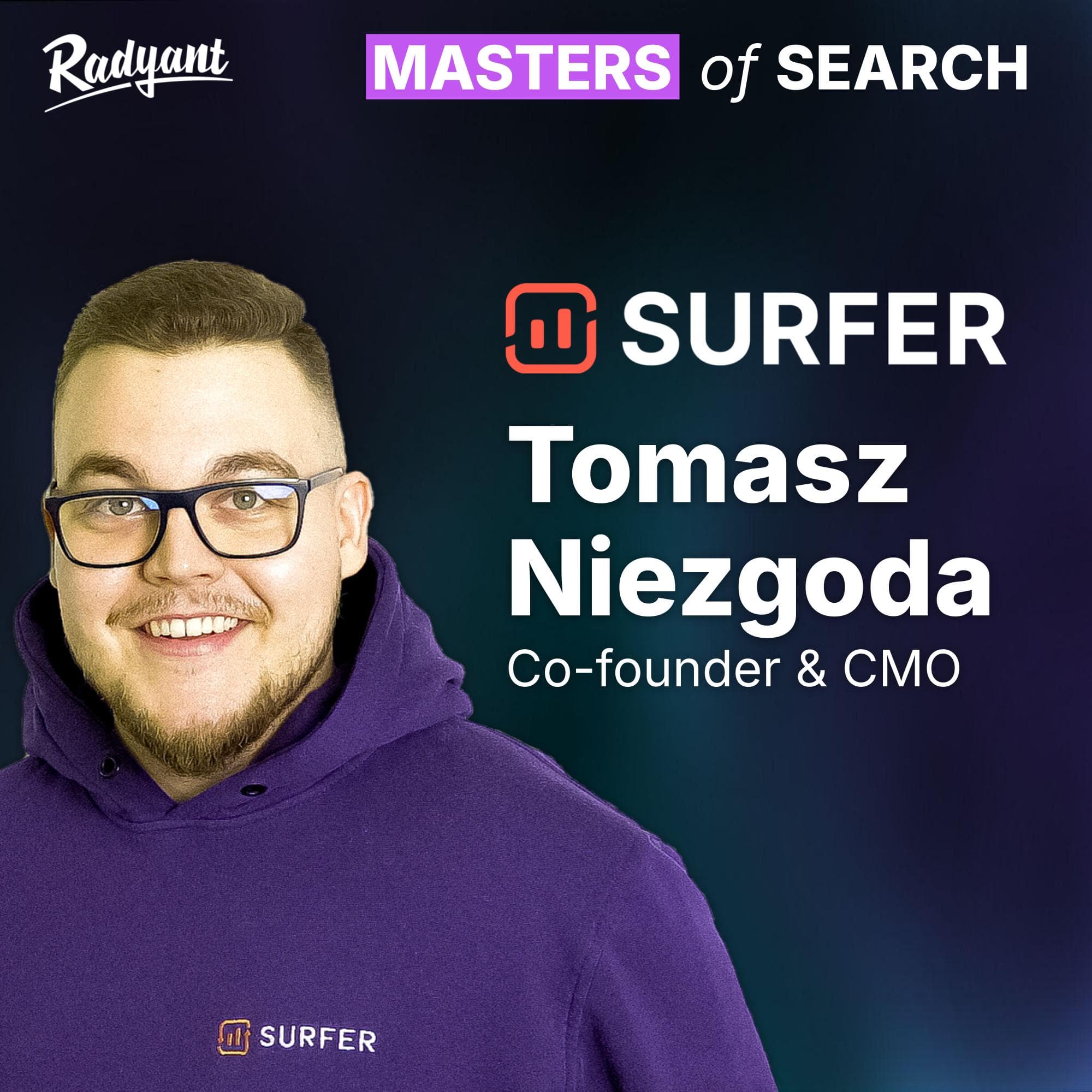
HOW SURFER BOOTSTRAPPED TO €15M ARR | Tomasz Niezgoda, Co-Founder & CMO @ Surfer | #14
Show notes
Tomasz Niezgoda (CMO @ Surfer) let me pick his brain for 60 min on how they bootstrapped to €15M ARR, get ~20% of paying customers from AI Search, and talked to 50+ customers per week in the early days.
If you care about SaaS, bootstrapping, SEO, AI Search, or marketing in general, this conversation is packed with insights.
Here are 5 things that stood out:
1) They didn't touch SEO for 4 years
While building an SEO tool, they focused on community, webinars, and education first. SEO came later when they had the domain authority to compete with Ahrefs and Semrush.
2) 50+ customer conversations per week in year 1
Not async support tickets. Real customer calls. Tomasz and the team split them. The knowledge they gathered became their unfair advantage over competitors.
3) AI search isn't magic, it's discipline
Monitor your prompts weekly. When competitors get cited, create similar content. Track visibility like a hawk. Act fast. Repeat every single week without missing.
4) They killed top-of-funnel content completely
Traffic dropped as a KPI. Now they focus purely on middle and bottom-of-funnel content. "Best alternatives" and "vs" pages feed LLMs with the exact narrative they want.
5) They doubled down on YouTube and it paid off 10x
They started with just 2 videos per month, and it took 3 months to see first signs it worked. Now they have 24K subscribers, published 180 videos, and it's one of their top channels.
This is just 5 of 20+ insights from our conversation.
▶ Let's connect! 🔗 Niklas on LinkedIn: https://www.linkedin.com/in/niklas-buschner/ Radyant on LinkedIn: https://www.linkedin.com/company/radyant/ Tomasz on LinkedIn: https://www.linkedin.com/in/niezgoda-tomasz/ Surfer on LinkedIn: https://www.linkedin.com/company/surfer/
Transcript
Full conversation
- 00:00:00Surfer is a bootstrapped SaaS startup that helps you boost visibility in Google, chat GPT and beyond.
- 00:00:06They scaled from zero to fifty million euros in ARR in just seven years and earned their spot alongside industry giants like Ahrefs or Samrush.
- 00:00:17That's why I'm incredibly excited to have Thomas Nisgoda, co-founder and CMO at Surfer on the show today.
- 00:00:24We'll talk about SEO, content marketing, profitable bootstrapping, the modern-day CMO role, and so much more.
- 00:00:32I think I have way too many questions for too little time, but before we dive in, Tomas, thanks so much for joining.
- 00:00:39Thank you so much, Niklas, for having me.
- 00:00:40Super excited about our upcoming conversation.
- 00:00:44We can keep going.
- 00:00:47Nice.
- 00:00:47Thanks so much.
- 00:00:48I appreciate it.
- 00:00:49So maybe because people always hear these titles and it's like co-founders CMO, obviously it's an impressive title.
- 00:00:55But can you share a little bit with us like what does the day in the life of a bootstrap SaaS CMO look like?
- 00:01:03Sure.
- 00:01:05So every day is a little bit different.
- 00:01:08That's for sure.
- 00:01:10I think that's my weekly routine consists of definitely meetings.
- 00:01:15I meet with marketing team, but also other departments.
- 00:01:20I have this privilege of being kind of target person for this entire organization.
- 00:01:29We always want to build products that other CMOs could use.
- 00:01:36I'm talking a lot with product teams, with our designers.
- 00:01:39I'm sharing some thoughts about how we could improve particular features.
- 00:01:46This is definitely a very important part of my job and also something that brings a lot of satisfaction.
- 00:01:54I'm also on the front line when it comes to any conversations outside of our company, about AISCO, about search, future of search, all of those very important topics.
- 00:02:09I'm trying to find time to look at Reddit, look at LinkedIn, Twitter, currently known as X, and any other platforms where the discussion is happening.
- 00:02:20And if I see that I can bring something to discussion or at least share my thoughts, I always do it.
- 00:02:29And this is also related to the fact that I'm trying to be a filter for the team to filter out what's the noise and what matters as of today, let's say.
- 00:02:41So that's it.
- 00:02:42That's pretty much how my week looks like.
- 00:02:46Whenever possible, I try to also find time for creative work, some deep work.
- 00:02:52I still write my own articles.
- 00:02:55I write scripts for videos.
- 00:02:57I try to write as much as possible on LinkedIn and all things like that.
- 00:03:04Awesome.
- 00:03:05Speaking of your team, can you share a little bit how your marketing, so obviously you also spoke about the product team, but can you share a little bit about the setup of your marketing team currently?
- 00:03:17Sure.
- 00:03:17So we have two designers, one web designer who is also pivoting towards product design, more aggressively than in years before.
- 00:03:29Brand designer, so any thumbnail on YouTube or, you know, OG image you saw from surface blog, that's Eva.
- 00:03:40We have a outreach slash influencer slash partnerships specialist, Tamara.
- 00:03:46Paulina, who is basically my VP, and she takes care of product marketing plus coordinating all of the campaigns.
- 00:03:54Satya, who runs our SEO and AI SEO these days, plus coordinates work between all of the freelance writers.
- 00:04:03We have Christavia, content marketing specialist.
- 00:04:06She's mostly responsible for making sure that we have relevant data studies.
- 00:04:12sometimes case studies, some baffle content.
- 00:04:14that's important for, for example, people who are about to make decisions to sign up for Serfer.
- 00:04:23We have Paweł, who's a video guy, and Dani, who's brand manager.
- 00:04:31She is the face of Serfer, basically.
- 00:04:34If you notice, we recently released a search master class.
- 00:04:39and Dani, this person that's doing this entire video course.
- 00:04:46And on top of that, we also work with some partners like, for example, Matt Canyon, who is our face on the YouTube channel.
- 00:04:53We work a lot on those things together.
- 00:04:57Nice.
- 00:04:59I think a lot of people in the audience might already know Surfer, but if someone has never heard of you guys before, how would you describe like your product or your main value proposition.
- 00:05:13So Safari is essentially a platform that allows all of the customers to create content that's already optimized for Google and AI search.
- 00:05:25Think chat GPT, Perplexity, any other LLM.
- 00:05:30And it does it by offering one end-to-end workflow.
- 00:05:36So you can research your topics, write content, optimize it, generate it with AI, add some custom voice instructions or brand knowledge, then automatically insert internal links in all of those pages.
- 00:05:51And finally, which I think it's very often kind of left by content teams to offer monitoring.
- 00:06:01and performance analysis.
- 00:06:03So whatever is happening later on with that content, you are being notified, server monitors, everything that's happening.
- 00:06:09And if it notices, Rangdrops, for example, it send you an email or an in notification inside application that you should prioritize updating this.
- 00:06:21I released a cool data study on my LinkedIn profile yesterday about the fact that the content that's Not updated is slowly declining in rankings, while the content that you update is two times more likely to hit top ten within the next thirty days.
- 00:06:41Clearly, leaving those pages that you wrote a year ago is not the smartest decision, so I would always prioritize keeping an eye on it and then updating, of course.
- 00:06:54And how did you come up with the idea for server initially?
- 00:06:57Because I mean the SEO and content and the space is so crowded and I think when you guys started, I think Ahrefs or SamRush and also other players were still around, but obviously you saw something that was missing.
- 00:07:10Yeah, we focused on something that was definitely not on the HS or Sembrash radar, so to say.
- 00:07:18There were solutions like that on the market, but in many areas, we kind of brought something unique and definitely the most useful for some customers.
- 00:07:35So initially, server focused on scraping pages from top ten, top twenty, and we filtered out around five hundred different ranking factors.
- 00:07:50We allowed people to create different charts to compare potential coloration between a particular ranking factor or a group of ranking factors and positions.
- 00:08:03Currently, this product is named Serp Analyzer, and it's available at Serfer Steel up to this date, but it's pretty much technical solution, and only very, very data slash.
- 00:08:15SEO heavy folks are using it.
- 00:08:20And so, you know, another iteration that our users asked for was, okay, I love the fact that so much data driven, but what should I look at?
- 00:08:32where are the things that I should look at and then improve?
- 00:08:35that would make a biggest difference for my particular case.
- 00:08:39So we developed audit where you put your URL keyword and we were looking at all of the ranking factors and then we've picked those that your page needed the most to optimize.
- 00:08:53So to say those outliers.
- 00:08:56Then people came to us and said, that's great.
- 00:09:00why I need to publish my page and then check what I need to improve in it, publish it again, and see ranking boosts, why I can't do it right away inside some sort of content editor.
- 00:09:15And this is how we came up with an idea for content editor, which is by far the most popular and the most successful product we ever built.
- 00:09:25Every month, two hundred fifty thousand content editors is being created new content editors.
- 00:09:33and may I remind everyone that some people create contentators and use the same coordinator to optimize you know pages from time to time.
- 00:09:41uh which by the way it might not be the ideal uh solution for for that very particular case but it's secondary.
- 00:09:49two hundred fifty thousand contentators every month.
- 00:09:52uh that the most successful product we ever built and it came from iterating on the same idea, how to make sure that on-page SEO could be used by literally everyone.
- 00:10:09I feel like if people would look at Surfer now and they see everything that you've built, like the big product portfolio, the awesome brand you have.
- 00:10:19I went through the website just yesterday again and you have so much content on there.
- 00:10:24You have explainer videos, all of that.
- 00:10:26I feel like if we would have someone that is fancying also starting in the software space now because they have the same feeling as you had back then.
- 00:10:36So there is something missing in the current big players in the market.
- 00:10:41What gave you the confidence to pursue this idea despite the big competition.
- 00:10:48What would you tell like a potentially first time founder with the idea,
- 00:10:53like,
- 00:10:54should you still pursue this idea?
- 00:10:56It sounds bad.
- 00:10:58So what's your reasoning behind that?
- 00:11:01There was not so much business thinking when we were doing it.
- 00:11:08We were doing those things because we felt very passionate about it and everyone had It's his own, because they were like five founders of Surfer.
- 00:11:18Everyone had his own idea of what success could look like for our current CEO, previously CTO, Lucian.
- 00:11:29Even if we wouldn't make any business out of it, he could master his skills when it comes to very specific technology, infrastructure, and the programming language, right?
- 00:11:41For me, I wanted to go deep into SEO.
- 00:11:45I wanted to work with data.
- 00:11:47I wanted to develop myself as an expert in that industry.
- 00:11:52So everyone had his own idea of what we could learn from when running Serfer, and business was secondary to all of that.
- 00:12:03So we didn't spend much time thinking about business model or our competition or whatever.
- 00:12:11We just, we have been and we are passionate about what we are doing.
- 00:12:16And it turned out that so many people loved using Serfer.
- 00:12:20So we were doubling down and then everyone left their jobs to fully focus on building Serfer.
- 00:12:29And in two thousand eighteen, so seven years ago with.
- 00:12:34finally founded Surfer as a separate entity and we started spending almost every working second building adding value to this organization.
- 00:12:46I said it in the introduction that you have this tremendous growth trajectory now, especially also Bootstrap, so without venture capital raised to now, fifty million ARR.
- 00:12:59What do you feel like was most important to grow Surfer?
- 00:13:03to where you are today despite passion because this is the first nugget you drop that you should look more or follow more your passion and your energy than looking at business models.
- 00:13:13but what was key to your growth?
- 00:13:17Past iterations, that's for sure.
- 00:13:22The way Lucian was able to iterate on product, introduce new features, improve existing features.
- 00:13:29was blowing my mind, still blows my mind, really.
- 00:13:32I think that the scale we currently have versus how fast we iterate and how fast we improve server is still unmatched.
- 00:13:42There are literally a few companies out there who can match that pace with the number of employees and the scale of our operations.
- 00:13:51So this is definitely at core of this organization.
- 00:13:54Second thing is networking, talking with those users.
- 00:13:58Back in the days, Miho Suzuki, another co-founder, head of innovation, and also we like to introduce him always like the first customer of Senfer.
- 00:14:08Entire app was built around his needs eight, nine years ago.
- 00:14:15So he spent every day, many hours, talking with users, then because he just couldn't handle a lot of that, I joined him and I started talking with those customers.
- 00:14:27So we basically split all of the charts, all of the support queries, and all of the onboarding meetings between us, and we ended up having like fifty-sixty conversations every week.
- 00:14:43So if you consider that one meeting is approximately thirty minutes to one hour, it's already a work week, right?
- 00:14:51So yeah, that was definitely intense.
- 00:14:55But the amount of knowledge we've got from those users about their needs, about the feeling from the market.
- 00:15:04is unmatched was unmatched and this is probably some of the biggest lever you can have over your competitors because really everyone knows that you should talk to your customers but not everyone is doing that.
- 00:15:18from my experience this is probably one of the things that most companies don't do and they just.
- 00:15:25think they are gathering feedback from users because they analyze whatever the people are sending them on chat.
- 00:15:33But that's something else, really.
- 00:15:35Having those conversations like we currently have is a different level of immersive experience and also in the way it creates connection between you, your brand, and potential customer.
- 00:15:50And on that note, Those conversations were not about surfer only.
- 00:15:56They were about helping those people, right?
- 00:15:58Sometimes we couldn't help them by offering any service or any product that we built.
- 00:16:05But we could just talk with them, listen to their problems, suggest some potential solutions, sometimes even referring to other other companies and products.
- 00:16:15And that's why that's how you basically build trust.
- 00:16:20So those people that we've talked to seven, eight years ago are still there.
- 00:16:25As long as they are in SEO space, they're still there and are using Surfer and are being in touch with us.
- 00:16:35Yeah, so I think that that's it.
- 00:16:38Maybe also don't be so obsessed about chasing monetization in early days.
- 00:16:44you know if you have product market feed there will be time to monetize it properly but don't be obsessed about it in early days.
- 00:16:55Awesome I feel like also the part with talking to customers.
- 00:16:58so you can talk to customers meaning that you talk to one customer every two weeks and you can talk to customers the way you did it where you have to.
- 00:17:07so I feel like the passion is like the basis.
- 00:17:11to be able to pull this off.
- 00:17:13So because how can you have fifty meaningful conversations per week if you are not passionate about the people about the problem you're solving?
- 00:17:19Yeah,
- 00:17:20it's like
- 00:17:21a necessary condition, right?
- 00:17:23Exactly.
- 00:17:23And I'm looking at it from distance right now, you know, the time distance.
- 00:17:29And I just can't believe how we did it.
- 00:17:33You know, it was so much time involved into this.
- 00:17:37But then I remember I just I wasn't doing anything else.
- 00:17:42I was waking up, eating breakfast, and then I was working for like ten, twelve hours.
- 00:17:47Didn't have much of the, let's say, life back in the days outside of work, but I was so passionate and so energetic and optimistic about what I was doing that it didn't bother me, you know?
- 00:17:59I'm not saying that everyone should grind.
- 00:18:03There should be some balance, but I didn't feel I needed.
- 00:18:06it back in the days, right?
- 00:18:08So if you feel that way, kind of obsessed about work, about what you are doing, why to limit yourself?
- 00:18:16I don't know, maybe it's not needed.
- 00:18:20Another thing you're obviously super passionate about is SEO and content.
- 00:18:24And it's like this little meta lever where you basically have a product that helps people with SEO and content and obviously also like a lot of other things.
- 00:18:35But Then you also used SEO and content for yourself.
- 00:18:40So can you give us a little bit of a behind-the-scenes look, which role SEO played in your own growth at Surfer?
- 00:18:48You would probably be surprised.
- 00:18:50But we didn't invest in SEO for the first four years.
- 00:18:56Because you always need to take into consideration the investment you need to make.
- 00:19:05competition, potential ROI, and I would say timing.
- 00:19:11We had much better channels to reach our customers back in the days, to name a few.
- 00:19:19Our community on Facebook, the way we interacted with people on conferences, our webinars and education materials outside of our blog, even some data studies, that kind of content marketing.
- 00:19:34work like a charm, even video courses.
- 00:19:37The first one we did in two thousand nineteen, then two thousand twenty, it was, it was a massive success, right?
- 00:19:43We've been teaching people about our, our, our niche.
- 00:19:48We found a hundred percent focusing on, on pitching surfer.
- 00:19:52The value was absolutely at the most important.
- 00:19:56So if you take into consideration potential rate of investment, competition and your own potential.
- 00:20:07SEO for many companies is not something I would recommend starting with.
- 00:20:12But then you achieve plateau in those channels that I mentioned, for example.
- 00:20:19And you start thinking, okay, we are a mature company.
- 00:20:23We've been investing into marketing activities for curious already.
- 00:20:27We have so much.
- 00:20:28uh back links pointing to our domain that you know the domain on its own is already strong enough to compete with hrefs with samrush with backlinko with nil patel and with all of those other big brands.
- 00:20:43big domains at least in some in some niches for some keywords.
- 00:20:49so let's start using that as a lever.
- 00:20:52let's focus on some long-term keywords.
- 00:20:54Let's focus on some keywords that are relevant for our niche like content optimization, SEO copywriting, things like that.
- 00:21:03This is exactly what we did.
- 00:21:04We gradually started investing into content.
- 00:21:08I hired the first SEO specialist to the marketing department who is also an editor, Satya.
- 00:21:18I've mentioned him before.
- 00:21:20And he started growing our blog and it was like two thousand twenty one twenty two.
- 00:21:26I don't remember precisely right now, but it was, you know, years after we launched the company.
- 00:21:33Interesting.
- 00:21:34I also heard it from pipe drive where they had this early success with the sales course they did.
- 00:21:40So I think it really resonates also with the webinars and the courses you did, which is obviously also still.
- 00:21:46part of your playbook today, that you don't necessarily should go just for the hard sell channels, but you should also build community, build trust and educate people, right?
- 00:21:57Would you say that this is also something that pushed you at the beginning, so not going for the sale, but rather going for building up a network, building up a community, like bringing value first.
- 00:22:12and then You also said that thinking about monetization and thinking about growth.
- 00:22:16Yeah.
- 00:22:17Yeah.
- 00:22:18Absolutely.
- 00:22:19That's at our core up to this date.
- 00:22:22I personally feel weird.
- 00:22:26You know, it's it's very it's like personal, right?
- 00:22:31Because I don't like hearing people pitching.
- 00:22:35So I'm not going to do it myself.
- 00:22:40But then there are some areas where our product is best suited to help you with the job.
- 00:22:47We've designed it precisely to help you with, for example, updating existing content or writing new content that will show up frequently on Google and in LLMs.
- 00:22:58So then it fits naturally to just explain how those things work.
- 00:23:04And this is why I believe webinars, video courses, even LinkedIn posts.
- 00:23:09are so great, right?
- 00:23:10You bring a lot of value, you educate people.
- 00:23:13If they want, they can just get that knowledge and go to your competitors.
- 00:23:18You know, no one will be offended.
- 00:23:21If they find the competitor better suited for them, for example, because they have some very specific feature that they require or whatever, that's okay.
- 00:23:31At least we are still in their head.
- 00:23:34We did something nice.
- 00:23:36We help them at some stage of their journey and maybe they will recommend us sometime later or not.
- 00:23:43And that's fine too.
- 00:23:46Our entire job in our marketing team is to constantly increase reach that our brand has and to kind of pop up frequently when the discussions about our category are happening, no matter where.
- 00:24:08Either it's YouTube, TikTok, Reddit, we always aim to be part of the conversation by ourselves or at least by the people who can bring up the server organically.
- 00:24:23Speaking of the where, I saw you did a post on LinkedIn.
- 00:24:27I feel like this is also something where you just went with your philosophy of sharing and giving value where you posted about the share of paying customers you get by channel.
- 00:24:41So first of all, I have to say I really honor such transparency because I feel like it's so important for other people that are like two, three, four steps before you in their journey to understand.
- 00:24:53things like on that in that transparency.
- 00:24:57But I think it was really interesting because you had a quite diverse channel mix like between YouTube and word of mouth, but then also Google search and then chat GPT.
- 00:25:09So what do you feel like?
- 00:25:12How did you come up with this so diverse channel mix?
- 00:25:15Like, was it by accident?
- 00:25:17Was it planned?
- 00:25:18Like, how did this come about?
- 00:25:21It's just years of testing and doing different things and leaving stuff that works.
- 00:25:30I think that we still do plenty of things that are not moving the needle, but we just don't know what are those things yet.
- 00:25:39Once we figured out that we are doing something that don't move the needle, we'll just don't do it anymore.
- 00:25:45But currently, as we speak, I don't know, right?
- 00:25:49So we keep pushing, we keep doing what we believe is helpful.
- 00:25:53And after years of investing in, for example, YouTube or in SEO, invisibility in LLMs, I know that they're fundamentals to our go-to market.
- 00:26:05So we just can't afford losing that and can't afford kind of losing the momentum.
- 00:26:12keep pushing, keep doing it.
- 00:26:14And of course, you can't do it the same way for years.
- 00:26:17You need to experiment with new formats on YouTube, for example.
- 00:26:22You need to feel the basic need.
- 00:26:24So create tutorials for your product, kind of orientate your product around very specific use cases.
- 00:26:32But then what?
- 00:26:33Keep doing the same videos over and over again?
- 00:26:36I don't think so.
- 00:26:38What you need is to reach new folks.
- 00:26:40who might look for a product like yours, but without knowing that they need it at the stage, with a different format.
- 00:26:51Maybe with some entertainment content, maybe with some top of the funnel education on YouTube.
- 00:26:57that just sparks those ideas around content optimization or LLM visibility, AI search visibility.
- 00:27:04So yeah, our channel mix is huge, but we definitely have a few channels that are moving the needle.
- 00:27:11And this is where we focus our attention on the most.
- 00:27:14And that's AI search visibility, Google, obviously, YouTube, word of mouth and peers.
- 00:27:23So we try to foster that.
- 00:27:24But to be fair, the best way to foster it is to create amazing product that just works really good.
- 00:27:33Then people are recommending it pretty, pretty organically.
- 00:27:37Then external advisors, also partners and affiliates.
- 00:27:41And lastly, it's LinkedIn.
- 00:27:43Then this is just a mixture of things, like pretty much everything from events to Facebook, to Reddit, threads and Facebook groups, things like that.
- 00:27:57You already mentioned AI search visibility and A couple of weeks ago, I think there was this chart all over my LinkedIn feed from Webflow, where Ethan Smith from Graphite, San Francisco based SEO growth agency, posted about that Webflow now already gets like eight percent of their signups from AI search.
- 00:28:23Now, I think everybody was super hyped.
- 00:28:26But then I saw your post and I saw that you, at least from the data you shared at that point, you're getting twenty four percent of your paying customers from Chatchity or other AI.
- 00:28:38This is three X. Now, my first question is, why is everybody so hyped about Webflow and not talking about server more?
- 00:28:47My second question is, how did you do it?
- 00:28:51How did you achieve twenty four percent of paying customers from Chatchity and AI?
- 00:28:56This is like incredible.
- 00:28:59Yeah, yeah.
- 00:29:00I mean, Webflow is huge brands.
- 00:29:03That's a big success.
- 00:29:04Ethan is an amazing guy.
- 00:29:06I love what they are doing for Webflow.
- 00:29:09And that's not that that's a solid number,
- 00:29:12right?
- 00:29:13For us, I'm looking at the average number from the last three months.
- 00:29:18We have nineteen point five, so almost twenty percent of people that are registering to server are coming from LLMs, like ChudGPT and any other AI assistance.
- 00:29:27So it's like twenty percent of people who registered to server are coming from those platforms and twenty three percent of customers.
- 00:29:36So, you know, as you see, slightly better conversion.
- 00:29:42on acquired customers than registered users.
- 00:29:45That's a lot.
- 00:29:46And I would also probably surprise you, but there's no magic tricks to it.
- 00:29:52That's just years of investing into fundamentals in general SEO visibility, making sure that we win in all of those software review sites if there is, you know, G-II.
- 00:30:09we've been asking our customers to leave those reviews for years.
- 00:30:13We never ever paid or did something in order to get a positive review.
- 00:30:21But even if that's semi-positive review, it's still better than none.
- 00:30:27So we've been inviting all of our customers for years to leave those reviews.
- 00:30:31We developed Affiliate program a few years ago where we offered very, very generous commissions.
- 00:30:40And back in the days, plenty of affiliates were promoting that kind of software by just ranking their blog posts.
- 00:30:49And because of that, there are hundreds or maybe thousands of different blog posts mentioning server in the web.
- 00:30:56So this is pretty solid training base for those models.
- 00:31:01But then, you know, there are new rankings and listicles.
- 00:31:05And whenever we see the article that mentions surfer about, for example, on relatively low position, like third or fourth, we try to reach out to those authors and just discuss, you know, to ask them what made them put us.
- 00:31:24let's say, so low.
- 00:31:26And that's another reason to get so much useful insight, so much great feedback about it.
- 00:31:31But sometimes it's just the fact that they were doing it kind of automatically.
- 00:31:38They were basing some of the things on stuff that's available on the web, not precisely the experience they had with application.
- 00:31:47And that one conversation can change entire perception of the product because you just show them what what Serfer is capable of, you sometimes offer a free account for them for like one, two months to give it a try.
- 00:32:02And then what's happening is that they naturally do it on their own to update the article.
- 00:32:08And that's a big lever.
- 00:32:11We also monitor around a hundred different prompts in Serfer's AI tracker.
- 00:32:16And whenever we see that there is this source that's super important for LLM when they are bringing up the answer, when they are creating answer, and it's on our competitor's side.
- 00:32:30We know that we need to create similar content on our own blog as well.
- 00:32:36If we see that competitor X is being cited as a source hundreds times every month, and there is no competition to it, no one is touching that kind of topic, We just do it.
- 00:32:50And it works.
- 00:32:52It really works.
- 00:32:52Then Serfer becomes the source.
- 00:32:54And obviously, if we are the source, we own the narration.
- 00:32:57We own everything around what Serfer is known for.
- 00:33:05And yeah, that's pretty much it.
- 00:33:09I would say the biggest lever is the discipline to do it every week.
- 00:33:14and to monitor those things, to act when it's possible, and to never miss a week on optimization, basically.
- 00:33:23So I learned that there's no magic trick, but as you were speaking and talking about your affiliate program, for example, or people writing about server and promoting it, I was wondering if maybe setting up affiliate program is sort of a magic trick because we know that the brand web mentions somehow correlate with visibility in AI search.
- 00:33:51So maybe setting up affiliate program and having a product that people like being like promoting is a magic trick.
- 00:34:00Magic tree.
- 00:34:02I don't like the naming of it.
- 00:34:05But if you if you have a product.
- 00:34:10a SaaS business that could benefit from having an affiliate program, then I would definitely advise giving it a go and then trying.
- 00:34:22Affiliates are amazing partners, could be amazing partners.
- 00:34:26But keep in mind that the world has changed a little bit and the affiliate baseline that used to be, yeah, I have a very popular blog post.
- 00:34:39I'm going to put some affiliate links and it's going to print me money.
- 00:34:42It's not working like it used to years ago.
- 00:34:45Now be successful affiliate.
- 00:34:47You need to have YouTube channeling to record some videos, TikToks, things like that.
- 00:34:53So the format has changed.
- 00:34:55But it doesn't mean that you can't get those mentions on blogs.
- 00:34:59You still can, but it might require you having an outreach specialist or you outreaching on your own.
- 00:35:10Okay, so it's something that still has to be maintained and still has to be taken care of and it's not something that just you set it up and then passively runs on your runs on its own.
- 00:35:20Got it.
- 00:35:21Yeah, definitely.
- 00:35:24You can even look up, you know, where your composers are getting mentions from and start there, right?
- 00:35:33Try to steal that strategy and try to go and talk to those sources, go with those publishers to see if you can kind of convince them to include you as well.
- 00:35:48Got it.
- 00:35:49As you guys are obviously absolutely on the frontline of AI search and all the shifts in the ecosystem, I'm curious to understand how you have maybe adapted your approach to content and SEO, especially in the last six to twelve months with all the changes going on?
- 00:36:09Oh, yeah.
- 00:36:09Yeah, yeah, yeah.
- 00:36:10Biggest change is that we completely stopped investing in top of the funnel type of content on our blog.
- 00:36:19We are focusing on Bofu and Mofu, right?
- 00:36:22So bottom of the funnel, middle of the funnel, things like best alternatives, competitors, versus pages.
- 00:36:30This is very important.
- 00:36:31People are having conversations with LLMs.
- 00:36:34And if they are shortlisting some products in different categories, they might have follow-up questions like, OK, so why should I pick HubSpot over MailChimp or whatever, or Intercom?
- 00:36:48And if you can provide good arguments for LLMs on your own blog, that's probably the easiest win out there, right?
- 00:36:58It ranks on Google because it's on your domain.
- 00:37:00And if this is about you, it should be easy.
- 00:37:04to reach top ten and then it feeds LLMs with the knowledge that you want them to actually pass over to the user.
- 00:37:16So yeah, this is the biggest change.
- 00:37:18We basically stopped investing in top of the funnel and we focused on the middle and bottom of the funnel plus some useful tools, right?
- 00:37:26This is the intent that we also kind of grab with our tooling towards server humanizer detector, some writing tools, that kind of things are helpful for people.
- 00:37:39And we also developed some, let's say, content strategy around this.
- 00:37:47For some people, it might be obvious why you stopped investing in top of the funnel content.
- 00:37:52But can you quickly explain the why?
- 00:37:55So why did you stop?
- 00:37:57Yes, thanks for following up on this.
- 00:38:00Top of the funnel content is basically very, very high level informational content and a very high level informational intent that people have behind looking up for that kind of queries.
- 00:38:15So back in the days, you wanted to go to target top ten or top three preferably for very popular phrases like what is SEO or what is three or one redirections because you could wrap traffic to your website and then try to kind of warm it up, maybe run some remarketing campaigns.
- 00:38:36Basically entire motion go to market strategy could be oriented around this and it worked.
- 00:38:42But now majority of those top of the funnel type of queries.
- 00:38:46is handled by AI Overviews and ChargedGPT.
- 00:38:51People have those questions, they get the answer, they are happy with it.
- 00:38:54They don't need to go and visit your website, the traffic shrink for that kind of queries.
- 00:39:01While bottom of the funnel and middle of the funnel where people have clear intention, for example, they already know that they are looking for a solution for content optimization and now they're researching the best options.
- 00:39:14This is where the true battle happens.
- 00:39:18We need to build up the arguments, we need to convene them that we are better over competitors.
- 00:39:23This is why we just ditched completely top of the funnel queries because we don't believe it's worth our time anymore.
- 00:39:34Got it.
- 00:39:34I recently spoke to the head of growth at HubSpot for the Dach Market, so for Germany, Austria and Switzerland.
- 00:39:43And she told me that they have buried the traffic.
- 00:39:48So to say that they stopped focusing on traffic as a metric for itself, like as a proxy for success, because they know that it's like.
- 00:39:58There are so many changes with AI overviews and maybe also people going to chat GPT and then maybe AI mode around the corner.
- 00:40:06I would like to hear your perspective on it.
- 00:40:08So how much are you still looking at traffic?
- 00:40:12Or have you also buried the traffic as a KPI on its own?
- 00:40:16Yeah, definitely.
- 00:40:18We don't use it as a KPI on its own.
- 00:40:22What we are looking at is how much quality traffic do we have?
- 00:40:28So what's going on?
- 00:40:29What keywords do we rank for?
- 00:40:33how our visibility is improving in key prompt in AI search?
- 00:40:38So we, for example, we want to grow visibility in certain areas, certain cluster of prompts.
- 00:40:46Our current visibility is, let's say, eighty percent.
- 00:40:49So we show up pretty often, but there's still space to improve it.
- 00:40:54And how we can get to this magical one hundred percent.
- 00:40:59You need to create plenty of different content to target all of the query found out queries that Charlie PT searches for when it's building up the answer.
- 00:41:08You also need to improve position in top ten for key articles that you already have.
- 00:41:14And they are sometimes sourced, but not that often as they could.
- 00:41:21And then if the visibility is growing, we know why.
- 00:41:28And we can replicate the same process, repeat the same process over and over again.
- 00:41:34So definitely, I'm not stressed about traffic drops in Google Search Console that much anymore.
- 00:41:41The same with impressions.
- 00:41:43We just focus on what we know that will move needle.
- 00:41:47So for example, how well he articles are positioned, right?
- 00:41:54For example, to us, content optimization tools, that kind of article, best content optimization tools, we wanted to keep ranking on the first position on Google, right?
- 00:42:05That's the priority.
- 00:42:06And if we notice drops in clicks in rankings of that website, we are going to act on it.
- 00:42:18Got it.
- 00:42:18A lot of people will will tell you that now Reddit is super important to drive AI visibility.
- 00:42:28I think there was this phase when it was all over on LinkedIn.
- 00:42:30Now, I don't know if it stopped or if I just unfollowed all the people that I found so annoying.
- 00:42:35But are you including Reddit in your AI search strategy in any way?
- 00:42:41And if yes, how?
- 00:42:43Reddit is very, very important.
- 00:42:45But I think that it's just the community on Reddit and the way the Reddit works makes it very, very tough for companies to just pop into conversation, bring up the tool, they are promoting the service and call it a day.
- 00:43:04No, it doesn't work like that.
- 00:43:06You are going to be banned, removed from the community or your post won't even be accepted in the first place.
- 00:43:12So what I'm doing, I'm trying to have very pragmatic approach.
- 00:43:17I wasn't using Reddit that much years ago.
- 00:43:22I'm trying to get convinced that it's helpful for me on like even personal level that I can learn and grow within the community.
- 00:43:33And I'm trying to have honest conversations there.
- 00:43:36I'm trying to be part of the trends.
- 00:43:38I'm trying to answer questions.
- 00:43:40I'm trying to help people.
- 00:43:41I'm trying to give people much more than I'm asking for.
- 00:43:46the way I operate.
- 00:43:48But I never used it to promote server or to improve our visibility in AI search because I don't think it's going to stick.
- 00:43:59It's very difficult and I think that you just need to build up your karma.
- 00:44:04You need to build up your authority on Reddit to be able to perhaps allow yourself or be allowed to start.
- 00:44:15But I don't know, maybe not.
- 00:44:17Maybe people will just, you know, remove your comments anyways.
- 00:44:25And what do you feel like would be more important?
- 00:44:27So if you could only focus on one thing, would you focus more on YouTube?
- 00:44:32So like generating awareness for people that might not be aware of the product already, but like some sort of also branding measures.
- 00:44:43or rather focusing on Reddit and doing this like reverse engineering thing where you try to look at the citations and then try to say, hey, where can I go into the conversation?
- 00:44:54So if you could only focus on one of the two, what would you focus on?
- 00:45:00I think that YouTube is difficult and it requires significant resources relatively to being active on Reddit.
- 00:45:09You want to be active on Reddit?
- 00:45:11Go get the phone, install applications, start writing those comments and engage with people, right?
- 00:45:17You want to start YouTube channel?
- 00:45:19You'll at least need some time, good lighting, good mic, right?
- 00:45:25And also some editing capacities.
- 00:45:28In general, you know it.
- 00:45:30Creating one video can take days of your work.
- 00:45:35While being active on Reddit, it's basically just... You're writing stuff getting engaged and so on so forth.
- 00:45:43So I would say depending on the stage your company's apps right now.
- 00:45:48prioritize Do both but balance things.
- 00:45:55I Start with Reddit.
- 00:45:56start being active.
- 00:45:57comment some things.
- 00:45:59be active for like fifteen minutes every day.
- 00:46:01That's what I'm aiming for personally to be active there for like fifteen minutes.
- 00:46:07It's few threads, few comments, few people that I can help, and some potential new topics that I can learn from also.
- 00:46:16And for YouTube, if your company is matured enough, can have resources, starting something simple, start creating two videos a month, that's how we started.
- 00:46:27But if there are people listening, I wouldn't prioritize YouTube if you don't have those resources, really.
- 00:46:35It's it could be at that and it could be very very costly and Entire marketing team will be working around those videos instead of focusing on other aspects of marketing as well.
- 00:46:48and how like we we already talked about the the share of users like paying customers you get from the different channels.
- 00:46:58And so depending on the data you posted on LinkedIn and the data you have right now, which is real time.
- 00:47:05So I think the data you shared there, YouTube was around.
- 00:47:11Ten percent.
- 00:47:11Ten percent
- 00:47:12on average for the last three months when it comes to acquisition.
- 00:47:15It dropped a little bit, but mostly because other channels kind of
- 00:47:21lifted
- 00:47:22up like LLMs.
- 00:47:24Now what I would let what I would be interested in.
- 00:47:27so obviously you guys started YouTube at some point.
- 00:47:31But the numbers weren't there yet.
- 00:47:34so you didn't have ten percent of paying customers saying they came from YouTube probably week after you started.
- 00:47:40so I feel like when I talk to people about YouTube.
- 00:47:44It's it's not necessarily that they don't see the value in it but I think they like the patience and the conviction.
- 00:47:51so what would you say to someone.
- 00:47:52So how long does it take or how long did it took for you to actually see that it's working and that it's contributing to paying customers?
- 00:48:04First signs that it's working, we saw on the bottom line after three months.
- 00:48:11But there were signs before that, right?
- 00:48:13People saying thank you for doing this video.
- 00:48:17I learned a lot.
- 00:48:18Our support team reaching out and saying thank you so much for doing it because now we can kind of use this material to help people understand different concepts slightly better.
- 00:48:29So this was proving that we are onto something.
- 00:48:33But then we achieved plateau.
- 00:48:36The channel stopped growing.
- 00:48:37The numbers weren't going up.
- 00:48:39And we knew that we need to find another idea for it.
- 00:48:44And we need to find amazing guy or a lady native speaker that could allow us to scale up the production so it can reach.
- 00:48:53hundreds of thousands of people in US.
- 00:48:56And this is how we found Matt Kenyon, and he took over the YouTube channel from me.
- 00:49:01As you hear, I'm not a native speaker, right?
- 00:49:04I have Polish accent, and this is not the most appealing way to learn stuff if you are a US native speaker.
- 00:49:14That's true, right?
- 00:49:15I fully understand it.
- 00:49:16I have the same exact thing when I hear some folks that are not Polish native speakers trying to speak Polish.
- 00:49:24I love the fact that they do it.
- 00:49:26I love people that are learning the language, but it's not very, very appealing for me to listen it for like thirty minutes straight.
- 00:49:35If there is another way, there is another channel native speaker who can do the same exact thing but do it.
- 00:49:42you know, kind of slightly more comfortable for me.
- 00:49:47Pretty good insight.
- 00:49:50Let's get back to the course topic again.
- 00:49:54So we already talked about webinars and courses initially, and now you guys also released, I think, relatively recently an AI search optimization masterclass and it has twenty modules and like hours and hours of content.
- 00:50:09So obviously we don't have hours and hours here still, but can you share a quick rundown for the audience of like the most important takeaways you teach in this masterclass?
- 00:50:22Yeah, we've touched plenty of things already and the course is free.
- 00:50:27We released it a week ago.
- 00:50:29I mean, depending on when you will publish the podcast, but At least, as we speak, it's just a week from the premiere.
- 00:50:36I think that one of the key things that weren't mentioned up to this moment is that fact coverage is super important for LLMs and also for ranking on Google.
- 00:50:48So if you want to have your page optimized to be cited, make sure you cover all of the facts, all of the relevant facts.
- 00:51:01how to get the list of all of the relevant facts.
- 00:51:04You can compare your page to top ten ranking pages that are currently ranking on Google for a different keyword.
- 00:51:11You can also run deep research with perplexity, with chat GPT, to kind of get an idea of what people are asking for, what's important, what's not.
- 00:51:21And then you can compare what your article writes about what your article covers already versus what's missing.
- 00:51:29That's a manual process.
- 00:51:30You can also use pull like server, does it automatically under three minutes total.
- 00:51:38That's one thing.
- 00:51:39Second, in that, LLMs love grid structure, bullet points, tables, lists, all of that.
- 00:51:48They absolutely love it.
- 00:51:52not using it properly is just missing on opportunities.
- 00:51:57One idea very practical is that when you have an article that explains something, you can explain it by writing a very good paragraph, but then just turn that paragraph into a table for people to be able to fund the information and also for LLMs to be able to assess it properly.
- 00:52:22to then make you a suitable source.
- 00:52:27Lastly, sources, becoming a source or asking existing sources to include you is probably the biggest lever you can have.
- 00:52:38At least now, we've covered it a few times during our conversation.
- 00:52:42But in the course, we teach you exactly step by step how to approach it, how to find sources that you need to kind of reach out to or how to become a source yourself.
- 00:52:52So I highly encourage everyone to take a part of it.
- 00:52:56It's over two hours of purely full meat education, not so much pitching only when it naturally fits and it's free.
- 00:53:07So go check it out.
- 00:53:08It's serferesio.com slash academia and then you will find it in navigation.
- 00:53:14Okay, awesome.
- 00:53:16We're already talking and the time has flown, I think, for around fifty minutes.
- 00:53:21And before we have to close the conversation, I always like to give people, besides everything that we already covered, which was super helpful, I guess, I always like to give people practical takeaways.
- 00:53:38So something that they can take away from the conversation and ideally start implementing immediately.
- 00:53:48So if you would have to give two to three practical takeaways to a fellow CMO or maybe a marketing executive on whatever stage, on how to drive growth from search, no matter if it's Google or AI chatbots, what would it be?
- 00:54:05The first and most important thing is start, right?
- 00:54:08Start investing it.
- 00:54:10start researching the topic, start practicing it.
- 00:54:15Go buy AI tracker, build AI tracker yourselves, and add fifty to one hundred key prompts to start gathering data.
- 00:54:26So whenever you and your team feels ready to pick off content strategy around this, you are not starting from scratch.
- 00:54:34You already have weeks or months of data to act on and to properly prioritize.
- 00:54:40you know, what to do in what order.
- 00:54:43So that's absolutely the first thing.
- 00:54:45Second is that fundamentals still work, right?
- 00:54:48So don't abandon Google.
- 00:54:50Don't do it.
- 00:54:51It's just you need to add another layer.
- 00:54:55not change Google with LLM optimization, so to say entirely.
- 00:55:00Keep in mind that the perspective is very, very important, right?
- 00:55:03Google is huge.
- 00:55:04And the traffic that LLMs are generating is just a fraction of what Google offers.
- 00:55:10So don't abandon Google, add LLM optimization, AA search optimization on top of it.
- 00:55:20Third thing, I'm trying to figure out the most important things.
- 00:55:26It's
- 00:55:27also
- 00:55:27something we kind of covered a little bit, but focusing on the middle of the funnel and bottom of the funnel type of content is also something that companies are not doing that much.
- 00:55:38While it's very, very important also, it's super easy win.
- 00:55:43I say it's low hanging fruit.
- 00:55:46You can also consider writing articles on LinkedIn because they are indexed very fast on Google, they are ranking high, and they allow you to also be frequently cited in AI overviews.
- 00:56:02We've published data around this, and LinkedIn is one of the most frequently sourced domain in AI overviews.
- 00:56:09We analyzed thirty six million AI overviews, and LinkedIn was among top five domains, if I'm remembering that correctly.
- 00:56:19How to get there?
- 00:56:22Just publish articles directly on LinkedIn.
- 00:56:27It's that simple, really.
- 00:56:29You can get great engagement on the platform and also rank your own content about yourself on Google.
- 00:56:36Perfect.
- 00:56:37Win-win scenario, right?
- 00:56:39Awesome.
- 00:56:40And if I may add to the folks that are listening or viewing this, learn something from the surfer.
- 00:56:48Story because if you still look at the if you still come up with topics based on a keyword research tool where you just try to go for high volume low difficulty as we did back in the days but you do not talk to customers this.
- 00:57:04Has probably already stopped working and this will not leave any meaningful return in the future.
- 00:57:09but I mean you don't have to do fifty customer conversations per week but try to learn a little bit from what.
- 00:57:18Thomas and the team at Surfer has done and applied to your own business, and I think you will probably have a lot of success.
- 00:57:26Yeah, yeah, don't ignore it.
- 00:57:27The whole system already collapsed.
- 00:57:32New is being formed and forged.
- 00:57:35We are not there yet.
- 00:57:37Fundamentals still work, but it's very important to be active now, right?
- 00:57:43Don't wait.
- 00:57:45to the moment where the new system is fully operational because your competitors will be there faster than you.
- 00:57:53Now everyone has relatively... We all start from the same position, right?
- 00:58:00Why to wait and to lose the any hedge that you might have?
- 00:58:07I wouldn't allow ourselves to just sleep on it.
- 00:58:12So I encourage everyone to start, to start lurking, start learning, and to definitely buy access to one of the trackers out there.
- 00:58:23I highly recommend Surfer's AI tracker.
- 00:58:26It's the price to value is probably the best out there.
- 00:58:32And go get at fifty prompts, start tracking it.
- 00:58:36You will have amazing data to act on in like three months from now.
- 00:58:42Awesome.
- 00:58:43Thomas, it has been a really insightful conversation and time has flown.
- 00:58:48If people want to follow you for more insights, follow Surfer, learn more about what you do, learn more about Surfer, where it's best to follow you.
- 00:58:57We will put the links in the video description.
- 00:58:59Thank you for that.
- 00:59:03I'm the most active on LinkedIn.
- 00:59:04This is where I publish all of the recent findings.
- 00:59:07I try to write stuff three to four times every week and I would very, very much like to connect with all of you.
- 00:59:16Thank you so much for having me.
- 00:59:17I hope that we've been able to entertain you and maybe you've learned something useful during this episode.
- 00:59:25Absolutely.
- 00:59:26I think this was... great education and also a little entertainment.
- 00:59:32Awesome.
- 00:59:33Thank you so
- 00:59:33much.
- 00:59:34Thanks so much.
- 00:59:35Hopefully speak soon and see you around.
- 00:59:36All the best for server and for yourself.
- 00:59:40You too.
- 00:59:40Thank you.
- 00:59:41Bye-bye.