

EP 11·Nov 19, 2025·3742
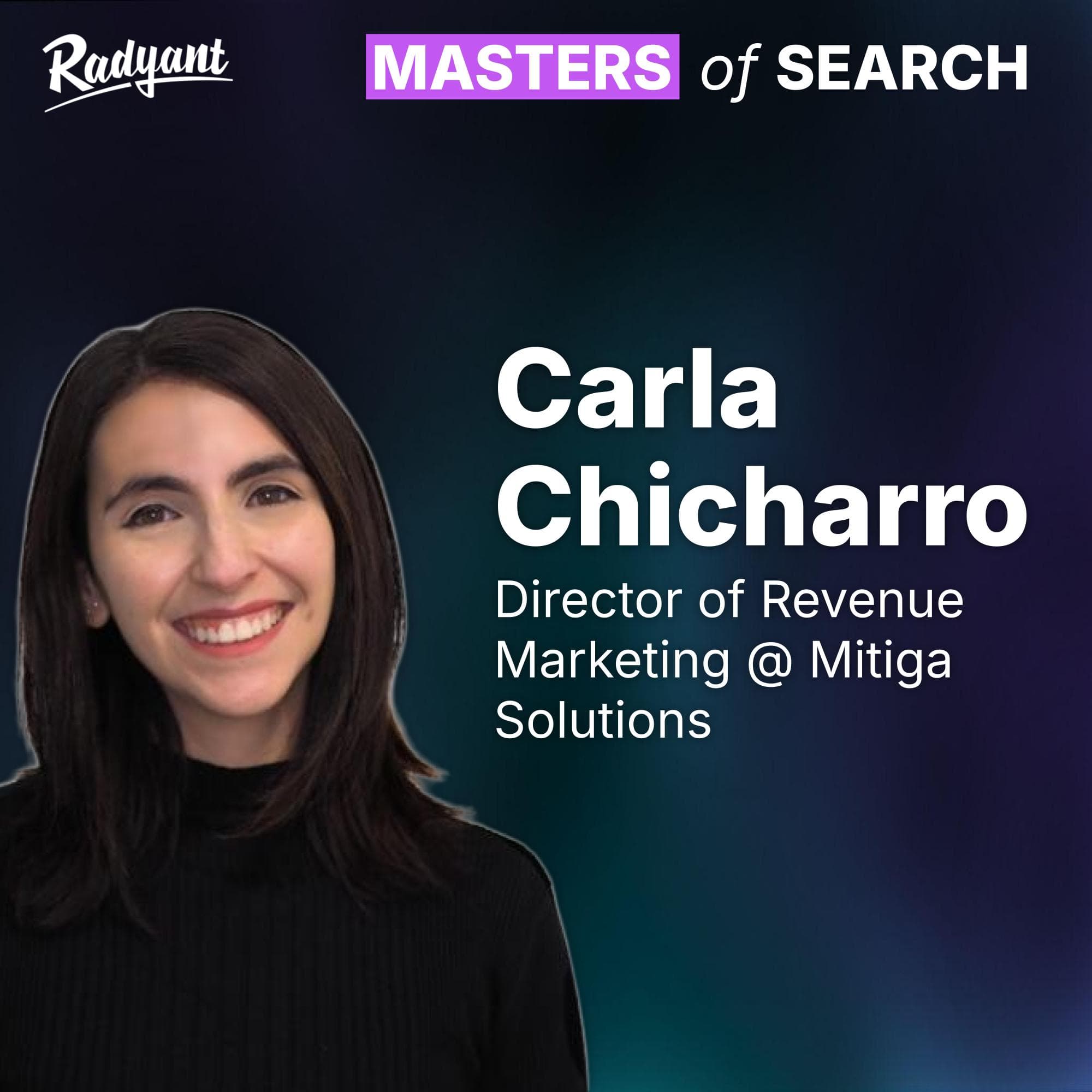
DRIVE PIPELINE FROM SEO | Carla Chicharro, Director of Revenue Marketing @ Mitiga Solutions | #11
Show notes
Carla Chicharro is Director of Revenue Marketing at Mitiga Solutions, one of Europe's most innovative climate tech companies specializing in climate risk intelligence. What makes Carla particularly fascinating is her long journey from the travel and hospitality tech industry, especially at Lodgify, now switching gears to climate tech.
▶ Let's connect! 🔗 Niklas on LinkedIn: https://www.linkedin.com/in/niklas-buschner/ Radyant on LinkedIn: https://www.linkedin.com/company/radyant/ Carla on LinkedIn: https://www.linkedin.com/in/cchich/ Mitiga Solutions on LinkedIn: https://www.linkedin.com/company/mitigasolutions/
Transcript
Full conversation
via podigee
- 00:00:00Welcome to a new episode of the Masters of Search Talks.
- 00:00:03I'm super happy to introduce today's guest, which is Carla Cicciaro, who is Director of Revenue Marketing at Metiga Solutions, one of Europe's most innovative climate tech companies specializing particularly in climate risk intelligence.
- 00:00:20What makes Carla particularly fascinating is her long journey from the travel and hospitality tech industry, especially at Logify, where she stayed a couple of years, now switching gears to climate tech.
- 00:00:35So Carla, first of all, thanks so much for doing that.
- 00:00:37And thanks so much for joining today.
- 00:00:39Can you give us a quick intro about your current role at Metica Solutions?
- 00:00:44Yeah, of course.
- 00:00:45And thank you so much for having me and for the invitation.
- 00:00:48Really happy to be here.
- 00:00:50And if you don't mind, I'll start with a little bit about me first to put some context into Matiga as well.
- 00:01:00So I'm a growth marketer at heart.
- 00:01:04For the last twelve years, I've specialized in SaaS startup.
- 00:01:08So as you mentioned, Logify is one of them.
- 00:01:12So what I've done there is building marketing functions that drive real revenue.
- 00:01:17And that's brought me to my role title let's say today.
- 00:01:22and what that means is like not just generating traffic or leads but actually like pipeline and measurable impact.
- 00:01:30right my sweet spot has always been writing.
- 00:01:35so content SEO and then I discovered organic growth let's say because I love that mix of creativity but also data.
- 00:01:48And over the years, I've touched different sides of marketing from performance marketing, which for me was a very eye-opening experience to CRM, lifecycle, growth, and all that.
- 00:02:02But what connects all of that, all of those, let's say, chapters in my professional experience is curiosity.
- 00:02:12I've always been drawn to figuring out how to turn really messy funnels into clean scalable systems.
- 00:02:23And now at Matiga Solutions, I get to apply that in a whole new context.
- 00:02:29So as you said, we're a climate risk intelligence company.
- 00:02:33The team is built of climate scientists, people that have multiple PhDs, not just one.
- 00:02:45Wow, but it's in some way.
- 00:02:49Data engineers, high performance like computing experts, all that, and us marketeers as well.
- 00:02:57Our mission there is to turn all of this research that the internal team had into actionable insights that can impact.
- 00:03:10This is globally, let's say worldwide.
- 00:03:13So I joined as director of revenue marketing, as you said.
- 00:03:18I reported to the VP of revenue along with sales and customer success.
- 00:03:25So the way the company sees it is we're not just doing marketing for branding, let's say.
- 00:03:33We're also doing it in the form that eventually it's going to bring revenue.
- 00:03:37So my main goal is really like scaling demand, pipeline, and there is a side of branding as well.
- 00:03:46And as you can imagine, it is a very regulatory driven industry.
- 00:03:53It's a very niche industry, right?
- 00:03:57But that for me is very exciting because it's also like not just growth for growth, but also about building trust.
- 00:04:06and resilience in the face of what we're all going through, which is the face of climate risk.
- 00:04:15But applying that into a business landscape, let's say.
- 00:04:20Very nice.
- 00:04:21Thanks so much for the introduction.
- 00:04:22I think you already mentioned a lot of things that we should dive into each individually.
- 00:04:27First thing that I find interesting, how is it working with people in a day to day that have multiple PhDs?
- 00:04:37very interesting to put it some way, unique, interesting, intimidating.
- 00:04:47But at the end of the day, so those are like the key words, let's say, right?
- 00:04:52Because they know so much, but at the same time, they know so much about their field.
- 00:05:00And there are experts in that, but they don't, well.
- 00:05:04I'm not going to generalize.
- 00:05:05there are some people that do but most people they don't know how to translate that into simple words.
- 00:05:10let's say and you know keep in mind that our audiences are people that work in this field.
- 00:05:18so they are looking for climate tech solutions of course but at the same time a lot of them are might be consultants.
- 00:05:25they might you know go through different types of solutions and climate tech might just be one of them which means that They get that the technical keywords.
- 00:05:36Yes, but if we can translate that into more approachable and simple terms It'll be easier for everyone to understand what we do, right?
- 00:05:48so that's That's our function in marketing and that's why I like yes, it's intimidating on one end, but at the same time it's It's exciting because it's like I get to pick their brains and I get to use that to build.
- 00:06:04Pains content and anything around that.
- 00:06:07so so it is.
- 00:06:08it is very interesting.
- 00:06:12But that's what ultimately makes a lot of companies that are especially operating in let's say let's put it simply complicated fields.
- 00:06:21successful right or what separates the successful runs from the not successful ones.
- 00:06:26acknowledging that.
- 00:06:27Even though we have super experts of the field inside the company, our customers, it's just one of many fields they have to deal in their day to day.
- 00:06:39And it's something where they probably have less knowledge than we.
- 00:06:42So we have to somehow translate all that knowledge into actionable stuff.
- 00:06:46Is this also something where you Because you just i mean you you've you've been very long at logify and now at mitiga you are i think a couple of months in or almost a year something like that.
- 00:07:01What's the something where you felt like?
- 00:07:02this is the first strategic pillar of how you build up the revenue marketing function.
- 00:07:08really.
- 00:07:09Shaping that mindset we have to translate our knowledge into something actual for customers.
- 00:07:15Exactly, yes.
- 00:07:17Keep in mind that when I joined Logify, so Logify for those that don't know, it's a property management system for vacation rental hosts, which means that the audiences of Logify are people that manage vacation rentals anywhere in the world, right?
- 00:07:35I don't have a vacation rental, right?
- 00:07:37I didn't even have a property back then when I joined.
- 00:07:43I was writing about things I had no clue about because I was not even an entrepreneur.
- 00:07:48So, you know, you can imagine it's the same thing.
- 00:07:52It's the same application to climate technology just with the complexity that there are a lot more technical terms and a lot of jargon.
- 00:08:00There are so many.
- 00:08:03What do you call it?
- 00:08:05I don't know what you call it in English right now, but you know, there's like these words where it's like IPCC, CSRD, like all these terms, exactly acronyms.
- 00:08:15So, so yeah, like I agree, I think, and in my team right now, we have a product marketing lead and a content marketing lead.
- 00:08:24And the three of us, none of us have technical background, right?
- 00:08:28So, however, we do have B to B SAS background.
- 00:08:33And I think that is something that is very important because we see We see it as, yeah, it's a product that we have to, we have to turn into, you know, revenue.
- 00:08:46It's the same thing.
- 00:08:46It's the same project, just with those complexities, right?
- 00:08:50And that's why, to your point, like, it's very important to work closely with our scientists, our data engineers, our strategy team.
- 00:09:00We have a strategy team, right?
- 00:09:02That's also for me was, New it was like.
- 00:09:06Oh, okay.
- 00:09:07Cool.
- 00:09:08Like someone is actually looking through like the vision of the company where the business is going all that it makes things a lot easier.
- 00:09:16and in that team they have advisors of specific products that we offer for example in Climate risk reporting, right?
- 00:09:28So having that those like key people that know about that because they were consultants at some point pushing for these regulations, let's say, like these reports that you have to basically do generate.
- 00:09:44It makes things easier for us because we're like, okay, guys, what is this CSRD term?
- 00:09:50Explain it to me.
- 00:09:53I'm a baby, let's say.
- 00:09:56I'm a toddler.
- 00:09:58Explain it to me like I'm your mom.
- 00:10:00it's.
- 00:10:01I will say it is hard because they still explain it in in complex terms but at the same time we're like okay let me let me record this and then I'll come back to you.
- 00:10:11So yeah I think building revenue marketing teams I think you need to have people that are like have that mindset of this is a challenge that I need to take on.
- 00:10:22and this is It doesn't matter that I have no clue about this, but I'm willing to learn and I'm willing to put in the effort to work together too and deliver this together.
- 00:10:37Yeah.
- 00:10:37Super interesting.
- 00:10:38By the way, the thing you mentioned with how you ask your tech people, can you explain this to me in very simple terms?
- 00:10:47One of my favorite use cases of chat UPT or Claude, can you explain?
- 00:10:53um, uh, diminishing returns to me as if I was a five year old or if I was your mom or your grandma.
- 00:11:01Yeah.
- 00:11:02I think it's really, it's a really cool, uh, cool use case.
- 00:11:04Yeah.
- 00:11:05That that was actually one of the not hiring questions, but post hiring questions or like onboarding questions that I would ask everyone in the, in the team, um, at Logify because.
- 00:11:18Even then, like, Logified, people didn't really understand it.
- 00:11:21They're like, oh, it's Airbnb.
- 00:11:22And it's like, no, it's not really.
- 00:11:26And I would ask the new hires, like, explain it to me like you had to, you have to explain it to your mom or your grandma.
- 00:11:35So, yeah.
- 00:11:37Very nice.
- 00:11:38Now we already crossed Logify multiple times because you obviously worked there for quite some time, I think for around or almost ten years or eight years.
- 00:11:50Maybe can you share a little bit about your journey there?
- 00:11:54Because I mean, over the course of so many years, I can imagine that your roles changed a lot.
- 00:11:59I mean, I could also see it in your LinkedIn profile, but just Where did you start and where did you end, so to say?
- 00:12:07Yeah.
- 00:12:08So I started, it was like a whole ride.
- 00:12:12And it was.
- 00:12:14the reason also why I stayed for so long is because maybe not every year, but almost every other year, it was a whole new company.
- 00:12:21So keep in mind that I started there when it was a series A, or it was just about to confirm the series A. very early stages.
- 00:12:33I was employee number eighteen and I was a content strategist.
- 00:12:38I was hired to be a content strategist.
- 00:12:41Curiosity also about that role is that it was supposed to be one role and the CEO decided to hire two people for it.
- 00:12:51and the way we ended up splitting it is that she, my colleague, ended up focusing more on writing.
- 00:12:59She was really, really great at writing and I focused a little bit more on strategy and eventually SEO.
- 00:13:05So that's how it started.
- 00:13:08Literally writing blog posts as well.
- 00:13:11Doing SEO when it was all about still about keyword stuffing.
- 00:13:18And, you know, learning the craft hands-on, let's say, because, you know, in the early stages, you do everything.
- 00:13:26You have many hats.
- 00:13:29That's how I started.
- 00:13:31And then how it evolved.
- 00:13:35Basically, it was very, excuse the pun, but it was very organic, how it all happened.
- 00:13:42Because once we started generating content in English, because our main market was the US, we started seeing that what we were
- 00:13:55writing and what we
- 00:13:55were creating because we were also creating freebies and we were creating different assets as well.
- 00:14:02We saw that it was converting into pipeline.
- 00:14:06It was converting into customers.
- 00:14:07Like we were able to link that and we were like, okay, so we have our website in five different languages.
- 00:14:16What if we replicate the same thing in the other different languages, right?
- 00:14:20So that's when, you know, we started doing more like, I wouldn't really call it like SEO, internationalization or SEO, I don't know, as different names, right?
- 00:14:33Like multi-language SEO strategies.
- 00:14:35In the beginning it wasn't really that, it was more like a test, right?
- 00:14:39Eventually it did become into each market, each language, because it was more of a language thing, eventually it then became uh market thing because you know we're talking about you know Germany.
- 00:14:52it's not the same in Germany Austria and Switzerland right but it all started that way where it's like.
- 00:14:59let's let's give it a go.
- 00:15:01it worked out really well.
- 00:15:02um for example we didn't even have France uh French sorry um we didn't even have that language.
- 00:15:09the rest Spanish Italian and Germany.
- 00:15:12I German sorry we're already there.
- 00:15:15so we're like let's add more to.
- 00:15:17it worked well but France and French was actually a huge thing because we had an assumption.
- 00:15:26we thought there are vacation rentals in France.
- 00:15:31There are different businesses there so let's try it.
- 00:15:36and we went all in meaning we were like okay we're going to translate the website we're going to create a lot of content on this Plus, our product is going to be translated.
- 00:15:45Plus, we're hiring sales, customer support, and everything.
- 00:15:50It was a bet that the company did.
- 00:15:52And in the first six months, it already performed way better than, for example, German.
- 00:15:59Because in German, again, initially, it was just test translating, kind of localizing.
- 00:16:05But after a few years, we realized that it wasn't enough.
- 00:16:09We had to talk about things that actually mattered for the hosts in Germany, for example, right?
- 00:16:16So that's when I would say it was more like SEO, multi-language SEO strategy and all that.
- 00:16:25And, you know, I had the opportunity to build different teams because at that point, that's when I built the content team in different languages.
- 00:16:35When we saw that we were converting that content into at least leads.
- 00:16:43We saw that, you know, we were creating workflows for it.
- 00:16:47We were creating landing pages.
- 00:16:49You know, we were testing different things and we saw, okay, we need someone to, because at that point it was just me, we need someone to own this.
- 00:16:58We need someone to create these workflows.
- 00:17:00We need someone to be testing different landing pages and all that.
- 00:17:05And we expanded the team there.
- 00:17:06We hired, so Lifecycle or CRM or I think it has different names in different companies.
- 00:17:13We called it Sierra.
- 00:17:16And we ended up hiring one for each stage of the journey, one for acquisition and conversion, another one for activation, and then another person focused on retention and renewals.
- 00:17:31So yeah, that was all because with the content, it was converting.
- 00:17:39And then another thing that we saw is that Paid was there, but I initially I wasn't reporting like they weren't reporting to me.
- 00:17:46They were in parallel and Content or SEO was performing way better than Paid at Logify.
- 00:17:58Maybe not to this day.
- 00:17:59I think it's already outranking a little bit Paid, but It's very close.
- 00:18:05It's almost a fifty-fifty share.
- 00:18:08So I'm very proud of that because it all started in our blog post, right?
- 00:18:15And you know, eventually when I left, I built a team of twenty-five people.
- 00:18:19We had so content.
- 00:18:22We had CRM.
- 00:18:24We had growth.
- 00:18:25We had performance marketing and a brand team, which was Brand strategy, but also creative.
- 00:18:34So we had our own designer.
- 00:18:36We had our own video editor Social media as well, which you know over the years we tested social social media so many times and it wasn't until the last year year and a half Before I left that it actually worked.
- 00:18:53and it was because you know In the US they started using influencers and we there were influencers and I think it was a generational shift that happened in the industry where Millennials were finally able to purchase.
- 00:19:10So yeah, I left as head of marketing and you know over the years it was like content strategist inbound marketing manager then marketing manager, which was just something like, okay, because you're not managing paid, you're a marketing manager, but you're not the head of the team.
- 00:19:31And then eventually I was managing everything, so I was promoted to head of marketing.
- 00:19:37But yeah, that's my run at Lotify.
- 00:19:41And yeah, I was there for eight years.
- 00:19:44So I was there through Pre Series A, Series A, Series B, and Series B Plus, let's call it, because it wasn't exactly a Series C. And what that means is that I saw the company grow in different stages.
- 00:20:00When I left, we were three hundred fifty people in the company.
- 00:20:05So yeah, it became a lot more, let's say... corporate, but not really because it's still.
- 00:20:11it's still.
- 00:20:15What a journey.
- 00:20:15It's like there were so many things that I want to a little bit more.
- 00:20:21I think one of one of the key things you mentioned about your multilingual approach and that in my view, a lot of people get wrong is internationalization versus localization.
- 00:20:34And you made this different this difference specifically.
- 00:20:37So What would you explain this to a five-year-old?
- 00:20:43What's the difference?
- 00:20:44And what's the difference in terms of your experience from internationalization or translating to actually localizing content to different markets?
- 00:20:54Yeah.
- 00:20:55So I'm not going to put it in a way for a five-year-old because it's very complicated.
- 00:21:02Then for my mom.
- 00:21:04It may be later.
- 00:21:05Let's start with you and me, and then let's see if we can translate it for a kid or your mom.
- 00:21:11But the difference is that translating can work maybe for some type of content.
- 00:21:20It can work.
- 00:21:22Yeah, I think for some type of content, it can work because if, for example, you're talking about your product, a new feature that you've released.
- 00:21:32translating or and a little bit of localization I think can work if it's just a product update.
- 00:21:39Another thing would be if you're trying to position that product to that market right or that language.
- 00:21:47Then I do think that you need not just localization which you can start there at least.
- 00:21:54I think you also need to look into the market as a whole.
- 00:21:58so I think it's very important because you will see that the audiences, even if a company is like, this is who our ICP is.
- 00:22:07These are our personas.
- 00:22:10The complexity, though, is that every market might be different in terms of who you want to target to.
- 00:22:21At Logify, for example, there are a lot in Italy.
- 00:22:26There are a lot a lot of BNBs.
- 00:22:29So there are a lot of families that own their own BNB and they're considered in logifiers like ICP as small property owners.
- 00:22:41And the way they manage or the way they access Logify or a software like Logify is very different to someone in the US who is so used to SaaS subscriptions, software, everything that for them it's like.
- 00:23:00you don't even need to sell me what what a software is or likes what a software like this can do for me because I know that it's already going to save me time.
- 00:23:10but in Italy for example or even Spain I consider they're more or less similar in this sense.
- 00:23:17They're used to using notebooks.
- 00:23:20They're used to using maybe an Excel.
- 00:23:23And they're fine with it because they have, it's not like they have a thousand guests a month, right?
- 00:23:28So they're able to use that.
- 00:23:33So like you need to approach them in a different way.
- 00:23:37It's not about saving time for them.
- 00:23:39Because they're like, well, yes, you're saving time.
- 00:23:43It's not that bad for me.
- 00:23:44Like I don't mind it because it's cheaper for me to use this notebook, right?
- 00:23:49So so all of this like you find out when you start talking to your customers, right?
- 00:23:55And we started assessing them differently and I know this is like more of a product marketing approach, let's say, but it needs to translate into your content.
- 00:24:05because if I write about saving time to Italians in, you know Italian property managers at Logify, they're gonna be like, that's great, but that's not a pain point for me, so I'm not gonna subscribe and I'm not gonna pay for this.
- 00:24:24But if I then approach it another way, which maybe is about scaling, maybe it's about, I don't know, delegating, maybe, you know, there were things like families that were trying to give their businesses to their their kids or their grandkids and and those grandkids are trying to modernize and scale and make you know things like that then it will resonate with you.
- 00:24:56so so yeah i think translating is okay in some settings.
- 00:25:02in general i would at least recommend localization.
- 00:25:06but if you want to scale seo especially if you want to end Even or any any sort of organic growth if you want to scale You do need to know your audiences and your markets because they're all different.
- 00:25:22Super
- 00:25:22interesting.
- 00:25:23I think this is already maybe it's not the first but it's one nugget definitely that you have to have a really deep understanding of your customers because I think actually you did a. So i have to be honest i think you did a very good job in explaining the different also to a five year old.
- 00:25:40because if i say the five year old hey you know.
- 00:25:44your older brother likes to play more with a PlayStation and you like to play more with Lego or Duplo or whatever.
- 00:25:51So you have completely different interests.
- 00:25:53So you might want to go to different shops.
- 00:25:55This is like, this is target group knowledge, right?
- 00:25:57And in another family, maybe it's the other
- 00:25:59year round, right?
- 00:26:00Exactly.
- 00:26:04Exactly.
- 00:26:05Although five year olds probably shouldn't play PlayStation, but that's for another topic.
- 00:26:10That's not our expertise.
- 00:26:11No judgment.
- 00:26:12No, no, no, no.
- 00:26:14But I mean, one point you made, and I think this is something that probably people listening to this already feel eager to understand better.
- 00:26:22You said that you saw actual impact to pipeline from the content.
- 00:26:26So from SEO and from organic growth.
- 00:26:28And I think this is something that a lot of people don't see yet.
- 00:26:32And they haven't experienced how this feels.
- 00:26:35And I think it feels magical, but I'd like to just Maybe understand a little bit.
- 00:26:41What do you think?
- 00:26:42What did you do differently?
- 00:26:44Because I mean this is something that a lot of people struggle with and I'd like to give them a helping hand on what they can assess.
- 00:26:54What should we do differently so we can replicate what Kala has seen with Logify.
- 00:27:01At Logify, I tried to replicate this in my next experience after Logify, which was a burto.
- 00:27:08And I'm trying to replicate this now with Matiga.
- 00:27:12But I'm seeing differences already in this business.
- 00:27:16But basically what I saw is that if you write a blog post and you don't have any sort of conversion path, I feel like you're just writing a diary entry.
- 00:27:32right?
- 00:27:32So we made sure I was very on top of this, my quantity will agree and will confirm, but I was very on top of the fact that every single piece of content needs a next step.
- 00:27:49So okay, you're writing a blog post about, let's say, here's a real example.
- 00:27:56So we were writing about Airbnb the amenities that Airbnb like to rank higher.
- 00:28:06So if you have a property listed on Airbnb and you have these amenities and you haven't yet showcased it on your listing, you should because these are gonna rank you higher, right?
- 00:28:21So this is a blog post, which is very helpful.
- 00:28:24Yes, it's educational.
- 00:28:29Yeah, it's informative.
- 00:28:30But at the same time, what can I give you?
- 00:28:34So what can I give the user out of this besides just knowledge?
- 00:28:39So in that case, we generated a checklist.
- 00:28:45But we could have perfectly generated an ebook.
- 00:28:48We could have perfectly generated a course.
- 00:28:52We could have generated a freebie.
- 00:28:55It's kind of like what we're seeing these days on LinkedIn, where people are like, yes, I'm giving you a nugget of truth, but then at the same time, I'm giving something away.
- 00:29:05Leave a comment and I will share it with you, right?
- 00:29:08It's the same application.
- 00:29:09So I give you something and I'm also giving you another thing.
- 00:29:15But in return, I'm getting your contact details, right?
- 00:29:19I'm seeing that you're interested in this field and this topic.
- 00:29:25And I will use that to my advantage, right?
- 00:29:28Like this is not just charity, let's say it is a business at the end of the day.
- 00:29:34So I'm giving it to you because I want to help you, but at the same time I want to help myself and I want to learn about you and I want to give you my product eventually.
- 00:29:44So what I did is that always offering a freebie once we had that contact information.
- 00:29:53So the moment that they filled in the form, basically, we landed them on a landing page.
- 00:30:00That landing page was like, yes, thank you for downloading.
- 00:30:04But it was very much focused on what we wanted them to do next, which was either start a free trial or book a demo with sales.
- 00:30:13So how we saw it is that we have your attention now.
- 00:30:18We need to make use of this attention.
- 00:30:20We need to try to squeeze it to the maximum.
- 00:30:24So, okay, we land in the landing page.
- 00:30:27You then have all of the information for you to try to get to, you know, persuade you to get to do the next step.
- 00:30:34If you don't at that moment, we're going to follow up, you know, with the sequence.
- 00:30:39So we had a very, it went through different versions of like a lead nurturing sequence.
- 00:30:48very much tested several times.
- 00:30:50every time we had someone new we tested it again but that sequence actually started with an email from the CEO just saying thanks.
- 00:31:03like this is my baby thank you.
- 00:31:05I'm so proud and all that.
- 00:31:07and funny enough that email looked really Badly in the sense that it looked like someone was writing it.
- 00:31:15For me, that was genius.
- 00:31:17But for most people, it was like, Carla, this looks like spam.
- 00:31:20That email brought us most of the trials, right?
- 00:31:26So I was very proud of that spammy looking email that converted really well, right?
- 00:31:32So again, like right, but with a conversion path in mind, and then think about what is the next step there also and always follow up like yeah we after that nurturing sequence we had sales on top of it and we tracked what they were looking at.
- 00:31:50you know like all the signals right so you know.
- 00:31:54of course when there's a lot of volume eventually you don't have time to look at all of the signals but when you're getting started that gives you you know content ideas it gives you a lot of information.
- 00:32:07i find it really fascinating when i listen to you talking because you have this.
- 00:32:15you're rooted in this deep passion for content for writing also but then at the same time you have these growth marketer treats like always tying everything back to revenue thinking about the next step.
- 00:32:31these are all things that make total sense to me and that.
- 00:32:34When we, for example, support clients with organic growth, it's the same things that bring in the most results.
- 00:32:39But the thing I see is that a lot of people in SEO and content, they don't think like growth marketers, they primarily still think like editors or writers.
- 00:32:49What did you do to build up this mindset?
- 00:32:51What are like your mental models?
- 00:32:53So if someone listens to this and feels like, yeah, I'm an editor at heart and.
- 00:33:00But I don't know how can I become a growth marketer?
- 00:33:03I don't know how to do this.
- 00:33:04like what what what's like the path that you made also like in your thinking and all of that
- 00:33:14Great question because I wouldn't say it was anything super concrete like it's not like I had One mentor or you know like I didn't.
- 00:33:27I guess the thing that helped me first of all curiosity a lot of curiosity, and second, opportunity to test that curiosity.
- 00:33:39So I think I was very lucky at Logify that I was able to test everything that I was curious about, but also my hunches, like hypothesis, right?
- 00:33:51Like what if we tried this?
- 00:33:52Let's see what happens, no?
- 00:33:55So I think building that, You know now with AI people are getting a bit lazy, right?
- 00:34:02Because it's like it's everything's there, but I think if you use AI to build that curiosity You know like I don't know research things that have nothing to do with what you do.
- 00:34:13I think That's what I do in my free time.
- 00:34:18But I did read you know different newsletters.
- 00:34:23I'd say my biggest reference at Lodgeify was HubSpot, Shopify.
- 00:34:31So I did study like what they did and that's where I saw, okay, they're doing it for, like especially Shopify.
- 00:34:39They're doing it for e-commerce.
- 00:34:42Yes, they're doing it for B to C kind of B. Is this similar to the audience that we have at Lodgeify?
- 00:34:50Like they are entrepreneurs at the end of the day.
- 00:34:53So could they have, you know, translatable?
- 00:34:56content right.
- 00:34:57so I'd say like also comparing.
- 00:35:02Look at different examples.
- 00:35:03look at different sass.
- 00:35:05look at different AI companies.
- 00:35:07look at Compare yourself.
- 00:35:09Okay.
- 00:35:10What are they doing?
- 00:35:11Right?
- 00:35:12Is there anything I can copy?
- 00:35:14and I'm very you know, I tell my team this I Nothing is new anymore Even in art.
- 00:35:22I feel like everything was copied.
- 00:35:24It's just it was Improved on.
- 00:35:28so I feel like that's something that you need to do like look look it Inspire yourself in different things.
- 00:35:35I Wouldn't say copy as in copy as is at all.
- 00:35:39That's not what I'm promoting.
- 00:35:41But maybe there's something there that you can grab and you can translate to your Company audience brand whatever.
- 00:35:50it is not because that's what I did like.
- 00:35:54Let's see what happens if I try this thing that Shopify did or Mailchimp did and see if it works.
- 00:36:01So that's the secret.
- 00:36:04Test everything and be very curious
- 00:36:08about everything.
- 00:36:13think about when you mentioned this idea of a creative strategic mindset, because I read this interview you did and you mentioned this idea.
- 00:36:21There was also lots of other cool stuff in the interview, but that struck with me because I think some people see this as opposites.
- 00:36:29So you can either be strategic or you can be creative, but creativity, some people still attribute something like a little bit chaotic a little bit all over the place etc.
- 00:36:40whereas strategic has this feeling of very streamlined very like clear path.
- 00:36:46so how do you how do you bring this together?
- 00:36:51that reminds me that i once did a job interview and they asked me are you more creative or analytical?
- 00:36:57and for that job the job i was applying to this was like two i don't know.
- 00:37:02fifteen years ago the the job i was applying to was very analytical.
- 00:37:06so i was like I guess I'm analytical and they brought me this exam that I had to complete and I was just like, I have no clue how to do this.
- 00:37:16So I will say I'm a little bit more creative and I had to train myself and learn how to be more analytical and eventually strategic.
- 00:37:29But I don't think there's a difference.
- 00:37:33It's one or the other.
- 00:37:33I think it can be both.
- 00:37:38How I see that is that you know.
- 00:37:40for example for marketing I think you have to be both Original enough to grab attention.
- 00:37:49So that could be creative.
- 00:37:51It could be unique.
- 00:37:51It could be maybe in someone's You know subjective mind, it's not creative, but it is unique, right?
- 00:37:59So it has to be something that's unique enough to grab attention but it has to have a purpose.
- 00:38:06And I feel like that is the strategic side of things.
- 00:38:12There has to be a purpose behind it that's gonna move business forward.
- 00:38:16I don't know, I grew up writing.
- 00:38:19I thought I was gonna be a designer at some point.
- 00:38:23And over time, I've had to learn how to create reports and all that.
- 00:38:29And I think that's how I build up my strategic side.
- 00:38:34But as well, I think it was because I was able to test so much that I started learning, okay, what works and what doesn't, you know?
- 00:38:44And even like in day-to-day setting, I think you can be a creative, strategic person.
- 00:38:54Because for example, I don't know, when you're writing a LinkedIn post, I keep repeating LinkedIn because I've been investing some time on that.
- 00:39:04And I think I have it as a top of mind topic.
- 00:39:06But something as simple as writing a LinkedIn post, the creative side is finding the hook, the comment, the word, the sentence that's going to get people to stop scrolling.
- 00:39:22But then a strategic side is making sure that that content is not just fluff.
- 00:39:28And it's tying back to you as a personal brand or your company.
- 00:39:33Like, what is your company's positioning?
- 00:39:36What is it that you actually want to convey?
- 00:39:38So again, purpose.
- 00:39:41So yeah, I think, you know, creative strategic mindset means that you don't have to choose between art and science.
- 00:39:49You merge them.
- 00:39:51Kind of like a Matiga or... Merging that creativity, you know, gets the attention and strategy, make sure that that attention translates into something which hopefully is revenue.
- 00:40:06It makes a whole lot of sense.
- 00:40:07And I think this there's a lot that people probably have to process around this but also with like the link and post.
- 00:40:17it's a great example because you can do a very creative post very cool and lots of attention but in the end.
- 00:40:23People feel like hey but it didn't translate into anything meaningful for the business.
- 00:40:28probably you're lacking a little bit of strategic thinking behind what you're doing there.
- 00:40:32so would you agree that like the strategy.
- 00:40:36somehow defines a little bit the corridor you want to work in and the creativity is like just maybe jumping but ensuring that you're jumping into the right direction exactly
- 00:40:47exactly.
- 00:40:48yeah yeah you can.
- 00:40:49you can be chaotic and creative let's say but organized in an organized manner.
- 00:40:55yeah that's you put this so nicely um but now drawing this back to metiga i mean you as you said it's like it's.
- 00:41:03it's a it's a regulatory driven market and it's a market where I can imagine like compliance is a topic etc.
- 00:41:13some like EU regulations.
- 00:41:19You're a creative person and you're also strategic person.
- 00:41:22but how do you approach like the scale up of your marketing efforts there given that it's a very regulatory driven market.
- 00:41:32So, you know, the difference with other markets, let's say, or other industries is that it's a bit harder to test things that you think might break, you know, in hospitality, it can't break really.
- 00:41:52Like, there's nothing that can break there, but, well, I don't know, maybe there are, but like, it's easier to test.
- 00:41:59Here, it's a bit harder to test.
- 00:42:01You really need to look into all of the possible consequences which I think in all tests you do have to have a plan behind.
- 00:42:13but you know the most important thing here actually is credibility and trust and that's what we're leaning more towards.
- 00:42:22so I can't just wing an experiment.
- 00:42:26I have to make sure that I could try it, but I have to make sure that it won't break the trust of my customers.
- 00:42:34It won't affect the credibility that we're building as a brand.
- 00:42:40One of our main pillars is science you can trust.
- 00:42:46Everything we write has to have scientific rigor.
- 00:42:51Even if we're trying to put it in simple terms, it still has to be.
- 00:42:57It has to work for climate scientists as well.
- 00:42:59They have to look at it and be like, yes, that is correct, right?
- 00:43:04And as you said, regulatory driven, yeah, there are mandates, there are frameworks, there are laws, but at the same time, that helps us because it gives us structure, right?
- 00:43:17So you can see it, the thing is you can see things in different ways.
- 00:43:22You can see that as a negative.
- 00:43:23but I like to flip it into a positive because it's like.
- 00:43:27that is my guideline like I can use that while if there's nothing like that I'm starting.
- 00:43:34I have to wing everything and I have to build that great like credibility from scratch when no one else is talking about this right and that is harder.
- 00:43:43I feel here we're like okay these are the complex terms most people like.
- 00:43:50even if they're working in this Don't even know like how that applies to their business.
- 00:43:55Let me be that voice of like, okay, I have this and we translate it for you.
- 00:44:00Let me show you like how this is going to affect you how this is going to help you and Maybe without anything in return.
- 00:44:07It's like in the beginning, right?
- 00:44:09We'll be here when you're ready, right?
- 00:44:12so it's you know focusing on that trust and you know building that the credibility as well, I think The fact that we have these very intelligent people internally helps us a lot, but also having those mandates also helps us to create that structure.
- 00:44:34And another thing that we're trying to build is education.
- 00:44:39As I've already said, all of this is very new, complex.
- 00:44:47There are a lot of things that haven't been updated yet.
- 00:44:51and our world is changing so fast.
- 00:44:54So we need to ensure that at least we know how to apply these things and how to translate it to the world.
- 00:45:05That's really at credibility, trust, which is more or less the same, education and internal alignment.
- 00:45:12So we can deliver all of it.
- 00:45:15You mentioned that the world is changing really fast and you also dropped the obvious keyword of AI earlier in another response.
- 00:45:25I'm curious, how do you feel about AI, like in content and marketing?
- 00:45:28Are you rather worried or excited?
- 00:45:31And do you like, where do you use it?
- 00:45:34Because I feel like a lot of people are talking about it, but not... too many people share actual workflows or tips like operationalized knowledge.
- 00:45:46So I'm curious to hear what your thoughts about it.
- 00:45:50Yeah.
- 00:45:51So I'd say I'm more worried about AI, like its impact over the society overall, more than how it is going to affect or is affecting already marketing, right?
- 00:46:04That worries me more because in our setting, in marketing and content, let's say, I think the way I see it is that it's a great co-pilot, let's say.
- 00:46:17Oh, I just thought that maybe I'm thinking of that because Microsoft's AI told us called co-pilot.
- 00:46:24They did great marketing.
- 00:46:25There
- 00:46:25you go.
- 00:46:25That's branding.
- 00:46:27You don't even know.
- 00:46:28But I see it as like a partner, let's say.
- 00:46:33I think it makes us faster at things that before would have taken us maybe more time.
- 00:46:39I don't think it would have been impossible to achieve the things that AI achieves, but you know, it would have taken us way longer to get there.
- 00:46:48So I think it's helping us with that.
- 00:46:50It's also helping out with like manual work as well.
- 00:46:54And I also have like a hot take is that, which is that, you know, if as a marketer, AI can do your job, I feel like you probably were not doing marketing right.
- 00:47:09I feel like maybe you were just typing maybe, right?
- 00:47:14So I think, I don't think it's going to replace us if that's the question too.
- 00:47:20But I do think that marketeers that don't know AI will be replaced.
- 00:47:25So that I do see.
- 00:47:27And in terms of application, we're using it for creating, for example, content pillars.
- 00:47:36So, you know, when we first started, there were so many things that we wanted to talk about.
- 00:47:42We knew that the climate scientists wanted to talk about volcanoes, let's say, that's one example.
- 00:47:48There are so many other things that they wanted to talk about, but volcanoes, they were especially really, really, really interested in letting the world know about that.
- 00:48:01And we used AI or Chatchapiti in this case.
- 00:48:05We used Chatchapiti to put some order into our thinking.
- 00:48:11Once it created the outputs, from there we worked on that because it wasn't just like, oh, great, thank you, Chatchapiti.
- 00:48:18Let me do this and just do this.
- 00:48:20And that's it.
- 00:48:20No, there was thinking behind it as well.
- 00:48:23It's like, OK, this is a good output.
- 00:48:25Let's look into more and then, you know, iterations and iterations of that.
- 00:48:29So that's one application.
- 00:48:31The other one, which is not really related to Matiga yet, but I'm testing on my own is I have two GPTs that are working really, really well for Maple.
- 00:48:44One is create content for me for LinkedIn based on specific topics that I give it.
- 00:48:54I think it generates really, really good content.
- 00:48:57I always have to rewrite some things, of course, to give it to the human side.
- 00:49:01But the other GPT that I have is it grabs that, and it tells me what freebie to create, or what to give away.
- 00:49:11And I was like, wow.
- 00:49:14For me, it was just fine-blowing.
- 00:49:15I was like, OK, I don't even have to think of how to create that freebie.
- 00:49:21Because then it also gave me ideas of what freebies like how to create it exactly Like for example the SQL scoring that I shared the other day.
- 00:49:31It gave me like exactly what to put in it and I was like Hmm because but also it does have a lot of context of my background.
- 00:49:42It has a lot of context on the scoring systems in that specific case like that I have built in the past, you know, so context is very important, but those are just some examples of applications that we've used.
- 00:49:53And I think for social media, it's a really great tool for generating content on social media, especially.
- 00:50:03Not so much in blogs, I would recommend.
- 00:50:07Okay, nice.
- 00:50:08Thanks so much for sharing the insights.
- 00:50:12So when you started
- 00:50:13at
- 00:50:14Meetiga, you wrote a post where you talked about your new role.
- 00:50:19And one of the things you mentioned is that you want to tightly align marketing with sales and product and strategy and partnerships.
- 00:50:28And I feel like this reads very well.
- 00:50:31And a lot of people would say, hey, yeah, of course, like aligning.
- 00:50:36all these functions makes total sense.
- 00:50:38But there's this big question of how.
- 00:50:42So how do you actually do it?
- 00:50:44So do we do meetings with like, pan people from all different departments and but like, and can you share a little bit about how you structured and how you how you how this looks like in the day to day?
- 00:50:55Yeah.
- 00:50:56So being fully transparent, this is still a work in progress.
- 00:51:00Okay, because yeah, we are Trying to find the best way for all of us, right?
- 00:51:07But for me alignment is not just, you know Fancy word something that looks good in your CP, you know, it it's actually showing up.
- 00:51:20Sorry, it shows up in your calendar meaning you have meetings with all of these.
- 00:51:24Yes But also in the decisions.
- 00:51:29so in the decisions and in the comments meaning like when someone from sales or marketing says something, everyone is aligned and agrees on that.
- 00:51:40It's not like, wait, what?
- 00:51:41What did they say?
- 00:51:42So I think that's how it's visible, that alignment.
- 00:51:48In terms of actual app, how does it work?
- 00:51:53With sales, for example, it means that I'm or my team is actually in the pipeline reviews.
- 00:52:03We're looking at what's converting, where deals are stalling, we're calling it out.
- 00:52:12Why are these deals still in prospecting stage or why are they still in the new phase?
- 00:52:20And having them share, okay, they're at this stage because I'm missing this and that.
- 00:52:26Okay, then I see, okay, then you need a case study.
- 00:52:29I'll produce that case study for you.
- 00:52:31I'll share it with you.
- 00:52:33And that way, you know, we're aligned because we're working together towards closing that deal together, right?
- 00:52:40Product, we sit on roadmap discussions.
- 00:52:44Something that I loved is that when I joined, I was really surprised because product every week shares what the roadmap is and where they're at in that roadmap.
- 00:52:55So so the with the whole company not just marketing, right?
- 00:53:00So that that's very refreshing Because you you know, you know, what's coming what's not.
- 00:53:07there's no question there, right?
- 00:53:10And that way we're also not surprised when okay, we have to launch this new thing.
- 00:53:15Oh shoot I have only two days to produce this.
- 00:53:18No, there's nothing like that because we were aware every week and strategy It's making sure that what they're seeing in the market, for example, what they're seeing with competitors, we're putting that into practice in our plans, our campaigns, content, anything.
- 00:53:40So that means we have, we used to have a weekly meeting.
- 00:53:44We're now doing a monthly meeting because we saw that we're aligned.
- 00:53:48There's a lot of discussion, internal discussion, a lot of chats.
- 00:53:54So we're fully aligned there.
- 00:53:55And partnerships, they are very collaborative with different teams.
- 00:54:02I'm in calls with one of our biggest partners, which is Microsoft.
- 00:54:08So I joined those calls as well.
- 00:54:11We work together in co-branded campaigns.
- 00:54:14So yeah, for now, it means being in all of those meetings.
- 00:54:20It means being in the room, people are making decisions having the opportunity to give your you know point of view as well and your what you believe in.
- 00:54:31and um yeah I just I just think also we are pre-series like series A as well.
- 00:54:39um so we are a small team and we're able to do these things now right in the future we might not be able to have that much time bandwidth all that but because we're already building this, like we're already building like an alignment, let's say, like a trust thing between us, at least having a channel on Slack or Teams, whatever.
- 00:55:04I think we will have in the future to align all of us together and all that.
- 00:55:09But yeah, I think marketing is not just like a separate function.
- 00:55:14I don't think it is.
- 00:55:15It has to be like a connective tissue, let's say.
- 00:55:21across all of these departments.
- 00:55:23So I think that's what keeps us moving towards the same direction.
- 00:55:29What I'm also hearing between the lines is information flow, right?
- 00:55:33Yes.
- 00:55:34The flow of information between the different stakeholders.
- 00:55:39Perspectives I mean people might otherwise.
- 00:55:41I just want to make this point.
- 00:55:43otherwise might hear okay meetings.
- 00:55:45everybody is very restrictive with meetings now.
- 00:55:49but I think the key point here is rather really understanding what the other functions are working on getting everyone together and like.
- 00:56:00Making sure that you're moving in the same direction right
- 00:56:02exactly.
- 00:56:03it's not just meetings for meetings right like it's a meeting with a purpose.
- 00:56:08either to share what we're doing, see where there are gaps, or sometimes we're like, do we need this meeting?
- 00:56:16Can it be a Slack message?
- 00:56:18Sometimes it becomes a message instead of a meeting.
- 00:56:22But when you do need to discuss things, debate, let's say, I do think you need a meeting for that sale.
- 00:56:29Very nice.
- 00:56:30Kala, we are already approaching like an hour of talking and it has been like time has flown.
- 00:56:36So it was really interesting already.
- 00:56:38I would like to wrap things up a little bit and I always want to like at the end, I want to give some actionable advice.
- 00:56:47You have already given a lot of actionable advice.
- 00:56:50I want to be very clear about that.
- 00:56:52But still, I think If someone is listening or watching this running marketing at a climate tech company or maybe generally in the compliance or more regulatory space, what would be like your top three pieces of advice for this person for building a strong marketing function?
- 00:57:14Yeah, great question.
- 00:57:16Oh, can't give up, give away my playbook just in case competitors are listing.
- 00:57:24I'm still in Matiga, so I can't give that away.
- 00:57:28No, I'm just kidding.
- 00:57:28But I will share three pieces of advice.
- 00:57:32So first, I think it's building credibility.
- 00:57:38I think in regulated industries or yeah, regulated industries in general, like trust is the currency.
- 00:57:47I think you can't just create clever campaigns and all that, though I will challenge it because we did do memes and we did some ads, LinkedIn ads with memes and it worked out really well, but it still has to tie back into the regulation or the mandate and all that.
- 00:58:11So like, yes, you can be human because there are humans behind it, but make sure that everything is you know, well written, it's the acronyms that they're looking for.
- 00:58:24all of this, right?
- 00:58:25So credibility show up as credible and reliable.
- 00:58:30Second, I think it's key to have cross functional alignment.
- 00:58:34I think like all of these frameworks, relations, all of this evolve constantly.
- 00:58:44So you really can't work in a silo because you know it's really hard to be on top of everything on your own or on your like your team on its own.
- 00:58:53It's easier if everyone is looking you know towards it and we share that information together.
- 00:58:59so I think at least you need marketing sales and product moving together especially product two and third revenue accountability.
- 00:59:12I think it's really easy to get lost in.
- 00:59:15like I wrote a blog post, I got a lot of engagement in my post.
- 00:59:22All of these vanity metrics, traffic, for example, has not become a vanity metric with AEI.
- 00:59:29at the end of the day try to find a way to link marketing to business outcomes whether that's maybe just adding a form so that way you can track contacts for example or like leads that come in you know try to tie it always back into something that makes an impact towards the business.
- 00:59:51otherwise I think it's just noise or something that's nice to have.
- 00:59:56and you know like Finitech is just as technical as marketing to developers, to government agencies.
- 01:00:06It's just as technical as all of those.
- 01:00:08But the playbook, I think, is the same.
- 01:00:10So be accurate, incredible, be useful, and earn the right to be heard.
- 01:00:18Because there's so much information everywhere, like you can ask chat to be there all day, or perplexity all day.
- 01:00:26But yeah, if you feel like that credibility and all that, you're going to be the source of truth.
- 01:00:31So that's going to translate it to everything else.
- 01:00:36Very nice.
- 01:00:36I think this was very actionable.
- 01:00:38And although you mentioned that you can't share your secret source, I think it's uh very very good advice from there.
- 01:00:47yeah more or less.
- 01:00:48um kala thanks so much for doing this.
- 01:00:51i think it was a very insightful talk and i'm pretty sure that everyone actively listening to this or watching this uh could took away a lot of like very also i think new school very modern and also actually very timeless advice.
- 01:01:08so i think the things you shared it's like it's very foundational also like mental models about marketing and how to build this up.
- 01:01:17If people feel like I like her way of thinking, I like to follow her more, what's the best place to reach you or to follow you?
- 01:01:28I'd say now is my LinkedIn.
- 01:01:30I'm trying to build my personal brand out there.
- 01:01:34So I'd say my LinkedIn page.
- 01:01:37So yeah, Carla to Cheryl on LinkedIn, you'll find me there.
- 01:01:42Very nice.
- 01:01:42We also put your profile in the video description below, so it's easier for people to find you.
- 01:01:48Other than that, I'll say it again, thanks so much for doing this.
- 01:01:52I hope you will keep crushing with Metiga.
- 01:01:55I think based on what I heard and based on what I've seen, you are more than set up for success.
- 01:02:02Thank
- 01:02:03you.
- 01:02:04Thanks so much.
- 01:02:05Keep crushing.
- 01:02:06Hope to speak soon.
- 01:02:09Yeah.
- 01:02:10Thank you so much.
- 01:02:11Thank you so much for having me.
- 01:02:12It was really really insightful.
- 01:02:15Yeah, it was really really helpful to talk to you.
- 01:02:18It was nice.
- 01:02:18Thank
- 01:02:19you.
- 01:02:20Thanks so much kind of.