

EP 13·Nov 19, 2025·3682
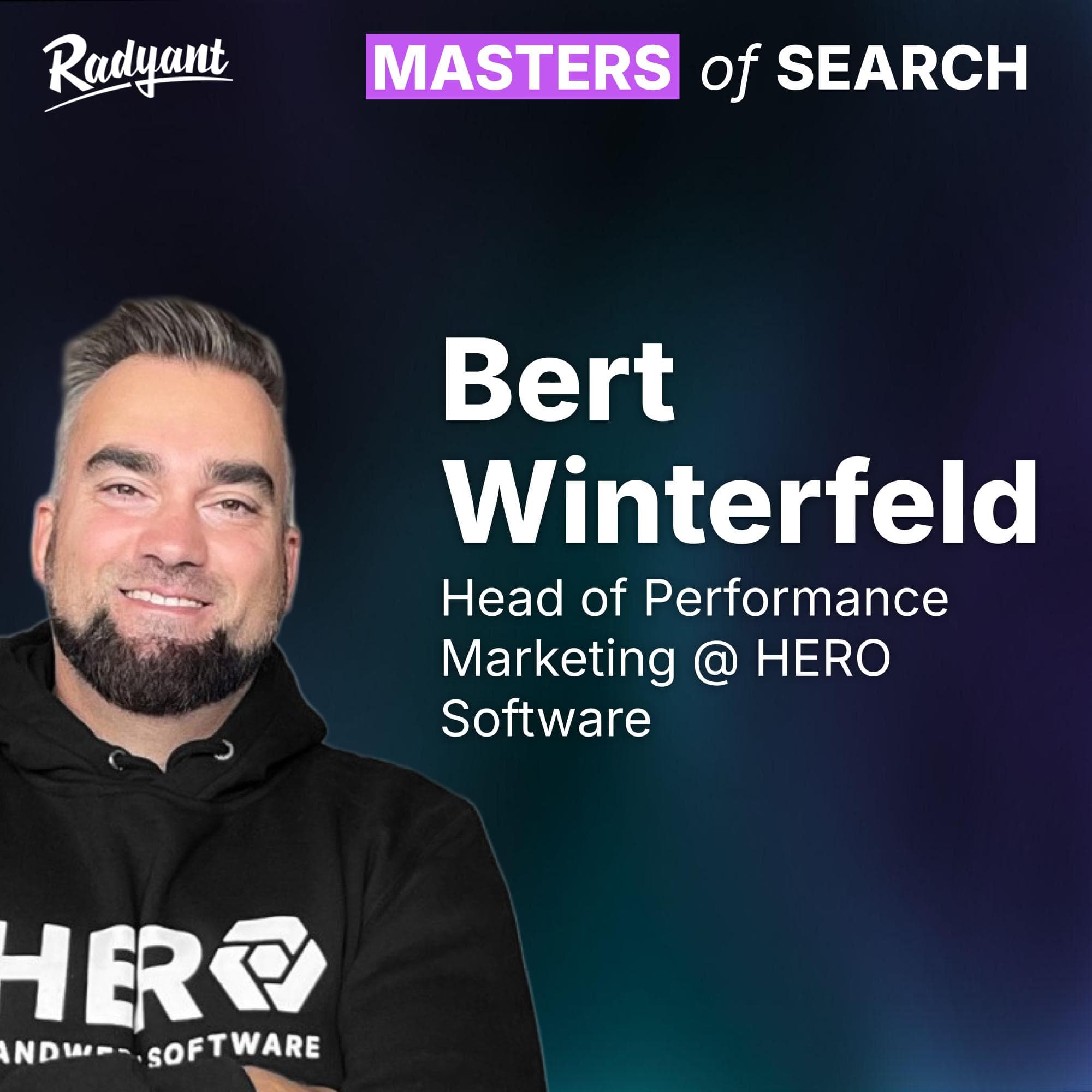
B2B SAAS MARKETING MASTERCLASS | Bert Winterfeld, Head of Performance Marketing @ HERO Software | #13
Show notes
Bert Winterfeld runs performance marketing at HERO Software (B2B SaaS, Series B, >$50M funding) with 6-figure monthly budgets. One of the key insights he shared in our Masters of Search interview was: Paid search in B2B always hits a ceiling, and only branding breaks through it.
If you're running performance marketing at a startup with serious search budgets, this episode is packed with insights you won't find in any LinkedIn carousel.
▶ Let's connect! 🔗 Niklas on LinkedIn: https://www.linkedin.com/in/niklas-buschner/ Radyant on LinkedIn: https://www.linkedin.com/company/radyant/ Bert on LinkedIn: https://www.linkedin.com/in/bert-winterfeld/ HERO Software on LinkedIn: https://www.linkedin.com/company/herosoftware-gmbh/
Transcript
Full conversation
via podigee
- 00:00:00If you're running performance marketing at a startup or scale-up, especially with a big paid-search budget, this episode of the Masters of Search is for you.
- 00:00:10My guest today is Bert Winterfeld, who is head of performance marketing at Hero Software, a super successful German B-to-B ZARS startup.
- 00:00:18They most recently raised a € Forty Million Series B in July, twenty-twenty-four to become the operating system of tradesmen across Europe.
- 00:00:27Bert works in online marketing since twenty-ten, so he has seen the rise and shifts within the ecosystem firsthand.
- 00:00:34So I asked him to join the Masters of Search to pick his brain on all things paid search and performance marketing.
- 00:00:41But before we dive in, Bert, thanks so much for joining.
- 00:00:45Niklas, thanks for the invitation.
- 00:00:46Since two thousand ten, that sounds like I'm really old.
- 00:00:49But then again, I'm over forty and I was doing online marketing even before Facebook was this thing here in Europe.
- 00:00:57Let's do this.
- 00:00:58Happy to be here.
- 00:00:59I think from what I saw about your work before the talk, I feel like you're still pretty much on the cutting edge.
- 00:01:09I try to stay there, yes.
- 00:01:11Nice.
- 00:01:12So maybe to give listeners of yours a better understanding about your role, can you describe a little bit how your role at the head of performance marketing at Hero Software looks like?
- 00:01:27So it's a bit like a middle management role, I'd say so I'm reporting of course to direct the marketing into the sea level and then I have my team.
- 00:01:35So we have four people in my team.
- 00:01:38It's a small team.
- 00:01:39We don't try not to like load up the team a lot of a lot of people.
- 00:01:44So yeah, I'm in kind of sandwich position to try to manage the expectations of the sea level and trying to spend the budget in the most efficient way and also try to of course motivate my people.
- 00:01:55and A very important part of my role, which I didn't really plan, but it's just what it is in BtoBsars, is trying to chase the sales folks.
- 00:02:07So you have to, of course, marketing and sales, they're always like companions and they have to run together.
- 00:02:12But my role, especially, it looks a lot like, okay, what is happening to our elites that performance marketing is doing, is bringing in the demand capture and the demand gen channels.
- 00:02:26Super interesting.
- 00:02:26since you already mentioned the team Can you take us a little bit behind the scenes of how you've structured your team?
- 00:02:34like which?
- 00:02:35which roles do you have and Which responsibilities do people have in the team?
- 00:02:41Yeah, of course.
- 00:02:42So we have only one person for paid search.
- 00:02:45That's a senior senior position for paid search.
- 00:02:48Maybe I have to say beforehand that we are focusing on Germany right now.
- 00:02:53We have like some you know, go to market motions in France and the Netherlands.
- 00:02:58So it's not not pure German, but I would say also if you take like the time we spend on the account or the budget, it's ninety percent Germany.
- 00:03:06So because that's where we want to it's our home turf and want to gain market shares.
- 00:03:11So I have only one person for paid search and this one person is a senior role.
- 00:03:16He has very experienced like ten, ten, seven years and in Google ads being ads.
- 00:03:22YouTube has seen everything display, you know, whatever is out there, paid search.
- 00:03:28That's the role of my paid search manager.
- 00:03:32Then I have one paid social manager.
- 00:03:36That's a woman.
- 00:03:37She's also senior position.
- 00:03:39And she's taking care of our new, actually, I have a new channel.
- 00:03:43It's Meta, Meta Ads.
- 00:03:45So we tried out Meta Ads in the past, didn't work out well.
- 00:03:48And then when I come to it later, because paid service under pressure, we try to open up new channels.
- 00:03:53So then we hired one person for paid social.
- 00:03:57And she's also doing a bit of data management and reports for the sales team.
- 00:04:01Then I'm a third person and he's like, you know, the Swiss Army knife a bit of not not like the classical performance marketing manager, but he takes care of, you know, all the affiliate platforms or comparison platforms, you know, when you search for craftsman software.
- 00:04:15They're also comparison sites, so we want to make sure that we are found there, that we rank highly if we can.
- 00:04:22Of course, that's always not on our side, but he also tries to generate reviews from existing customers to get like five out of five stars because that's a certain ranking logic on these pages.
- 00:04:35And he's also running our referral program.
- 00:04:38So for example, when you are an existing customer and you want to recommend Hero to a friend, You can get up to a three hundred euro for a successful referrer.
- 00:04:48That's also his role.
- 00:04:50So it's a bit of.
- 00:04:51it's a mix.
- 00:04:53Two specialists for two specific channels.
- 00:04:56And once was army knife with a working student was doing a bit everything in between.
- 00:05:00And then that's me trying to juggling everything.
- 00:05:06Yeah, let's get a little bit more into that juggling.
- 00:05:09How does your day to day look like?
- 00:05:12Do you spend most time?
- 00:05:13in dashboards, accounts, meetings, or in the coffee shop next to the office?
- 00:05:19I'd say I start my day always with a coffee on my couch.
- 00:05:22So I work from home, I'd say three days a week and two days a week in the office in Berlin.
- 00:05:28It's actually heroes from Hannover, but there's also a Berlin office.
- 00:05:32And yes, when I start my day, it's always the coffee and project management and checking the accounts or more the dashboards.
- 00:05:40So I don't really look into the Google account on a daily base because I have a senior person on this.
- 00:05:45So I know it's running.
- 00:05:46But of course, I check the number of leads.
- 00:05:48I check what's happening to these leads.
- 00:05:50How do they progress into the journey into the sales team and so on.
- 00:05:54So that's a big part.
- 00:05:56And then of course, it's a lot of meetings.
- 00:05:58It's a management role that comes with the role.
- 00:06:01So it's a bit less operational, more organizational, I'd say.
- 00:06:07So yes, to answer your questions.
- 00:06:08not in the accounts a lot, but in the dashboards, which then leads to questions for the accounts, basically.
- 00:06:15Okay, great.
- 00:06:18I said in the intro that you're already in online marketing since twenty ten.
- 00:06:22In your role at Hero Software, you are like about a year or a little bit more than a year.
- 00:06:28Can you take us a little bit With you through that time, have there been any important or interesting milestones during your first year in your role at Tiro?
- 00:06:39Actually, next week
- 00:06:39is my first anniversary.
- 00:06:40I started first of October, in the year of the year of the year of the year of the year of the year of the year of the year of the year of the year of the year of the year of the year of the year of the year of the year of the year of the year of the year of the year of the year of the year of the year of the year of the year of the year of the year of the year of the year of the year of the year of the year of the year of the year of the year of the year of the year of the year of the year of the year of the year of the year of the year of the year of the year of the year of the year of the year of the year of the year of the year of the year of the year of the year of the year of the year of the year of the year of the year of the year of the year of And I would say it was not messed up.
- 00:07:00So Hero was always able to track things, but we could do things better.
- 00:07:04So for example, I took Google Analytics IV to a whole new level.
- 00:07:10We set up server-side tracking.
- 00:07:13We have Salesforce in the background where all the leads are coming in.
- 00:07:15So also we had to set up some Salesforce logic, some reports.
- 00:07:20So I'm close with the revenue operations team.
- 00:07:22They are running Salesforce.
- 00:07:24And the big milestone, I would say, If you know BtoB is us, you have different lead stages mostly, right?
- 00:07:31You have like a raw lead, in our case, it's called unconfirmed lead, then they click on the email, they say, okay, I want to really have a test account, that's a confirmed lead, and then they progress until the sales team calls them, it's qualified for sales lead, and then it's a demo, and then it's an opportunity whatsoever.
- 00:07:48And what we were not really good at is to know the value of these stages.
- 00:07:54It's always a bit tricky, right?
- 00:07:55So when it comes to e-commerce, you have like, of course, the price of the product and the margin, whatever, you can work with this.
- 00:08:04And sales and BtoB is asked, you don't really have this.
- 00:08:08So what we had was like very static conversion value.
- 00:08:11So we said like a demo is worth like, I don't know, five hundred euro, while a raw lead is only worth fifty euro, whatever.
- 00:08:20And we are trying to optimize with this.
- 00:08:22But you had the tendency or hero had the tendency then to overspend or to overvalue the actual stages.
- 00:08:30Leading Google to spend way too much money because they think, oh, they are doing so much return on ad spend because the values are so high.
- 00:08:39So what we did now with success, doing kind of dynamic conversion values.
- 00:08:44That was a big, so for all the paid search geeks in the audience or the tracking geeks, so basically when you Let's say you type in a keyword, it's craftsman software, you click on our ad, you land on our website, and there's a form on a typical test sign up form for a test account.
- 00:09:02So we also ask what kind of industry or branch are you in, like electrician, plumber, roofer, photovoltaic whatsoever, they're like, twenty six industry or so.
- 00:09:13And we ask you for the number of employees to the size.
- 00:09:17And then of course we have a database of existing customers.
- 00:09:20We can say okay, that's like an electrician.
- 00:09:23They use like this and that feature mostly.
- 00:09:26Yeah, and you can say okay the company is between two and five craftsmen or tradesmen.
- 00:09:32Then you know like when you price on the number of licenses, you know what kind of monthly recurring revenue is likely to come in.
- 00:09:39Yeah, so then you can automatically put a conversion value behind this.
- 00:09:44right.
- 00:09:45you can say okay.
- 00:09:46There was a roofer only two people.
- 00:09:48then A demo help by the sales team is worth like two hundred euros.
- 00:09:53Let's say I'm not saying the real numbers, but you get an idea.
- 00:09:57And if you have like a photovoltaic, which is our ICP, our core customer profile, for example, photovoltaic company, they put like these solar panels on the roofs and they have twenty installation guys, right?
- 00:10:09Then you can automatically say, okay, that's very likely to be a much higher monthly recovery revenue.
- 00:10:15So you give this dynamic value.
- 00:10:18back to Google and say okay this wasn't a valuable customer.
- 00:10:22try to find more because of course in paid search we have always difficulties to target the real ICPs.
- 00:10:29right because nobody or very few people type in software for electricians that they still search for software for craftsmen and then they want to compare different different vendors.
- 00:10:44because very difficult to target them.
- 00:10:45but at least with this form In this kind of information, you can try to give Google ads and Bing ads an idea of what a valuable lead looks like.
- 00:10:54And the next step would be, of course, having the sales team calling them very fast and actually confirming the value we have in this automation.
- 00:11:04And to confirm the value and say, OK, this opportunity now has a value of, I don't know, x-thousand euro of ARR or MRR.
- 00:11:13And then you give this dynamically back to Google.
- 00:11:16which would be the next step.
- 00:11:17The thing is here, of course, you cannot take very long sales cycle for this.
- 00:11:22So you must have the information quite fast to give it back to Google.
- 00:11:26Otherwise, Google does not allow you to re-upload this conversion value.
- 00:11:31So that's a basic milestone.
- 00:11:33to summarize this from very static conversion values to more of a dynamic approach to train the AI of Google to see what actually could be a valuable lead for us.
- 00:11:45I think it's a great tactic or a great strategy, not necessarily a tactic, but it involves a lot of operational knowledge.
- 00:11:54Can you quantify the impact in any way?
- 00:12:01How have the numbers changed after you successfully implemented this whole very strong offline conversion tracking setup?
- 00:12:14A quantifier would be like in the two-digit percent of cost reduction, I would say, because you're spending less money than on gassing and on leads that are not that valuable.
- 00:12:27So you try to say, okay, this is what a lead is worth.
- 00:12:31Try to give me as many leads for this value.
- 00:12:35So I would say we are not making much more leads because it's not like we are scaling up a campaign.
- 00:12:41but we're trying to be more efficient.
- 00:12:42And it's also a very important lesson I learned on paid search.
- 00:12:46And I would even say this provocative thought here, because the podcast is called Masters of Search, I would say there are no Masters of Search.
- 00:12:54There are craftsmen of search, right?
- 00:12:57So it's like our ICP, our clients, which are craftsmen, they're also, they're never done.
- 00:13:05You can be a master, great, but you always have to.
- 00:13:07If someone in the audience owns a house, you know there's always something to do.
- 00:13:11It's also in paid search and in performance marketing in general.
- 00:13:15So there is no hack.
- 00:13:17I can't give you a Google hack or like this magic trick.
- 00:13:21So what's the saying?
- 00:13:22They would say we are all putting our pens on the same way or the German equivalent would be we're all cooking with water like this.
- 00:13:29Yeah.
- 00:13:29So there is no magic trick.
- 00:13:31So we have these conversion values and other AI analysis and stuff.
- 00:13:36that's coming up right now, it will make you more efficient.
- 00:13:40But I cannot go to the C level and say, with this trick, next week, I will bring you two hundred more leads, valuable leads.
- 00:13:47That's not going to happen, especially in B to B, where the keyword volume is typically low and very expensive.
- 00:13:55So it's not e-commerce.
- 00:13:56It's not something where you have like millions of searches every week.
- 00:14:01So also to ask your maybe your later question, paid search and scaling, It's really difficult.
- 00:14:09Let's save that for now and let's tap into that later because it's a pretty sophisticated setup.
- 00:14:16You've built up there and two-digit cost reduction is still very great.
- 00:14:22I think a lot of people in the audience listening to this that are running at least five-digit, maybe medium five-digit or six-digit budgets a month, they would they would really appreciate a double digit cost reduction.
- 00:14:39Is there anything else you have implemented successfully to improve lead quality at the same level of costs or like while scaling, so to say?
- 00:14:52Yeah, in paid search it's a bit difficult.
- 00:14:54So what we actually did successfully ramp up the channel paid social?
- 00:14:59Because you see when you have these typical campaigns and paid search, like our, let's say, the top non-brand keyword campaigns, it's expensive and only a few people per month are using it or are searching it.
- 00:15:13So there's no real way to scale it.
- 00:15:15So what's your real way to scale?
- 00:15:16it is branding.
- 00:15:19Not even demand, Jen, because there is a demand for software and craftsmen.
- 00:15:22Craftsmen are actually pretty tech-savvy and pretty digitally aware, I would say.
- 00:15:28So we are not really competing against the pen and paper, but we are competing against Microsoft Word, Excel, Outlook, all these digital tools.
- 00:15:37So there is a demand and people are aware of their software for craftsmen.
- 00:15:42So it's not like a whole new product that you have to generate demand in that case, but you have to scale up the branding.
- 00:15:50So when my paid social works, then my paid search brand campaign works even better.
- 00:15:55And this is because more people are searching for hero software.
- 00:15:59That's the case.
- 00:16:00So what we did now, we managed, we found a way to scale paid social from just a couple of leads a month to a couple of hundred leads a month, which is like a huge, a huge increase.
- 00:16:13That's very nice.
- 00:16:13And we see the spillover to the other channels, especially the brand campaign and paid search.
- 00:16:18And what also is a nice way in our, at least in our industry is to use the PMAC shopping.
- 00:16:25campaign where we like fake like.
- 00:16:28we have a CD a software CD and we have it in the shopping ads Because things but that's interesting specific but craftsmen are pretty used to old school on on premise software.
- 00:16:40So they really had this.
- 00:16:41they bought like CDs CD Rom and then they installed the program on their laptop on there on their PC and then they They worked from from there.
- 00:16:50So like like having the cloud and always in the browser software cloud-based.
- 00:16:56That's not so common.
- 00:16:57So people are still searching for program for Craftsman.
- 00:17:03By program, I mean like a CD.
- 00:17:05And then you show up and you fake like a little e-commerce product.
- 00:17:09And then you get a lot of leads, actually, right?
- 00:17:12So my take would be also for the audience, try to learn as much as you can from e-commerce, even if you're in BtoBsass.
- 00:17:21Because if you master e-commerce with all these amazon.com and all these vendors and internet pages.
- 00:17:29If you master this and still make a good business, I bow to you, you're the master of marketing, I'd say.
- 00:17:34So e-commerce is like the Champions League of marketing and whatever you can learn from them, be it tracking, be it conversion values, also conversion values, try to be as close to e-commerce as possible, try to give like the card, the added card value, try to give it back to Google and to all the AIs.
- 00:17:54And yeah, try to use Google Shopping campaigns for your BtoB Zars product.
- 00:17:59Just try it and it works.
- 00:18:03I love the analogy.
- 00:18:04I also saw your shopping ad and you did this mock-up, which looks like a cardboard, like the typical Cardboard packages where you have like the the DVD or CD in.
- 00:18:19and would you say because I feel like this is something that Some B to B sauce companies already do so I think I also saw safe desk doing it.
- 00:18:28So for everybody in the audience that does not know safe desk.
- 00:18:31It's a I would say pretty successful German like invoicing accounting software, especially targeting solopreneurs or like small, medium-sized, so rather on the small side of businesses.
- 00:18:45I saw them doing it.
- 00:18:46I saw LexWare or LexWare Office, LexOffice doing it.
- 00:18:51But would you say like, did you already see a competitor of yours copying that strategy?
- 00:18:57Well, I don't look so much at competitors, to be honest.
- 00:19:01I think I didn't see it yet.
- 00:19:03I mean, we have like two competitors in Germany that are really close to our product.
- 00:19:09And then even LexOffice, It's like a competitor.
- 00:19:13Because we also want to be like the operating system for craftsmen.
- 00:19:18Of course, you compete with one or two that are close to hero.
- 00:19:23But you're competing against three hundred of software vendors that have specific stuff for HR, for finance, sending out offers, getting invoices.
- 00:19:34So that's a lot.
- 00:19:36And I'm sure they are doing these Google shopping campaigns.
- 00:19:40for the direct competition, I haven't seen it, but of course when we are doing it, they will notice at some point, it's no secret, right?
- 00:19:48So it's not like we are doing something magical behind a curtain that nobody sees, so I'm sure they will also try it.
- 00:19:57Yeah, it's something where I think there's the saying, it's hidden in plain sight, right?
- 00:20:01So if they look carefully, they will notice it, but... they might not necessarily look.
- 00:20:08But let's talk about the competitors real quick, because you said something like, I don't look too much at competitors.
- 00:20:15And I find this interesting because I did an interview here in this podcast with Margos Weber, who is head of web at Pipe Drive.
- 00:20:24And I think I would say Pipe Drive generally also relatively successful company.
- 00:20:30And he said the same.
- 00:20:32But still when I talk especially to I would say rather early stage founders or marketing executives there, I feel like it's the complete opposite.
- 00:20:41So they're looking a lot of competitors.
- 00:20:43They're comparing a lot.
- 00:20:47Please just give me a little bit of your thoughts on that.
- 00:20:49Why not looking too much at competitors?
- 00:20:51or what differentiates you from like the, and I don't want to blame them, but what is the key difference maybe in your mindset to these early stage founders I talked to?
- 00:21:02Yeah, I had my my startups to back in the days even earlier.
- 00:21:06So I was a founder to a little agency.
- 00:21:08I tried to have a software business and I was really obsessed with competitors.
- 00:21:12You know, you have the similar web you have some rush you have all these SEO tools and you try to find out who's ranking better who is doing better paid search Blah blah blah, but the thing is is your product really comparable?
- 00:21:24Usually you have like some kind of tweak and function and feature that others don't have and try to focus on this and try to focus on getting this out to your ICPs.
- 00:21:35In Google Ads, of course, I can see my keyword set and I can see who else is in the auction for this keyword set.
- 00:21:42I see my competitors, I see my impression share, I can see am I more visible or not.
- 00:21:47But what really does this information do for me?
- 00:21:52What value has it?
- 00:21:53For me, the value is how expensive is a lead, and how is this lead progressing through the funnel?
- 00:21:59And that's totally on my own metrics and on my own sales team and my own assets, like display ads, whatever paid social ads.
- 00:22:09The competition cannot help me.
- 00:22:10I can sometimes look at them.
- 00:22:12So I do it and paid social.
- 00:22:13You have this ad library, right?
- 00:22:15You just type in the competitor name and you look at this and say, okay, they have a new campaign running for this.
- 00:22:21They have a special offer.
- 00:22:23Does it make sense to have something similar?
- 00:22:26or they have these lately?
- 00:22:28I saw an ad which we don't use.
- 00:22:30they use like some kind of.
- 00:22:32They give a bonus when you switch your current software to their product.
- 00:22:37Yeah, like an exchange.
- 00:22:38so you you get a couple of hundred of euros if you abolish your old software and buy their software.
- 00:22:46Yeah, that's not a USP in the software.
- 00:22:48That's just like trying to get this greedy.
- 00:22:51people who would like to have money for software change, try to get them.
- 00:22:57But I don't really think the approach works for us.
- 00:23:00Because usually when I see craftsmen, they don't even, even in our referral program, they sometimes they don't really care for the money I could give them.
- 00:23:08So it's just like, they don't want to bother with this.
- 00:23:10A craftsman is out there on the construction site.
- 00:23:13He is doing this and that.
- 00:23:15And like killing his own software and buying a new software where he get rewarded one time.
- 00:23:21So I don't feel it.
- 00:23:22I see it for the competitors, but I don't copy it.
- 00:23:27I try to check, OK, what makes my software unique or my solution?
- 00:23:32And how can I market this to my ICPs?
- 00:23:36So in Google Ads, I mean, this game is done.
- 00:23:41Everybody knows the keywords.
- 00:23:43And they're not really evolving that much.
- 00:23:47It's more like you add more negative keywords every day than you add new keywords to your campaigns, definitely.
- 00:23:52So you try to make it even smaller, try to limit your reach, except for PMAX.
- 00:23:58So yeah, I never gained real value from looking at the competition, because they're doing their thing, they have different products, different approaches, maybe different ICPs.
- 00:24:09So try to make the competition look at you and not the other way around,
- 00:24:14basically.
- 00:24:15That's a good one.
- 00:24:16There's also the saying, right?
- 00:24:19Copying is the sincerest form of flattery or something where basically if someone copies you, you know, they really admire you.
- 00:24:29I like that one.
- 00:24:30You already talked a lot about ICP.
- 00:24:33And I think there are a lot of people out there that have a hard time to really understand their customers in detail.
- 00:24:42So really know what their day to day looks like, what their frustrations are, what are the key messages you need to play as a marketer, independent of the channel, be it search or be it social.
- 00:24:58But what do you do to be close to your audience, to really understand them, to have a grasp on the messaging that works the best?
- 00:25:07Because I feel like you're, so you know a lot about craftsmen, I'm just wondering.
- 00:25:13How do you know it?
- 00:25:15Well, first my father is a craftsman a plumber.
- 00:25:17So I'm from this kind of yeah almost Emily.
- 00:25:21so blue color worker is my it's my background.
- 00:25:24So I was the first to study my family.
- 00:25:26So I know this background and you know how to talk to these people.
- 00:25:30Yeah, they also.
- 00:25:32For example You can try LinkedIn, but I will tell you it will not work on craftsmen.
- 00:25:38Sorry because my father Yeah, here's his tablet.
- 00:25:42He doesn't give a damn about LinkedIn, of course, right?
- 00:25:44So you need to have other channels.
- 00:25:47But for being close to your ICP, I mean, as a founder, it's quite difficult.
- 00:25:52You might really have some interviews with people.
- 00:25:54Of course, I came into this company Hero Software that was quite established already, quite a very good brand in the German market.
- 00:26:02So of course, the first thing you do, you talk to customer experience team.
- 00:26:06And you let them show you the tickets.
- 00:26:09the most frequently asked questions like what's the pain point?
- 00:26:13also what's missing what feature is missing?
- 00:26:14so that's like one idea for product and product marketing but also what is their pain?
- 00:26:20and also what are they thankful for?
- 00:26:22so right we have reviews and we ask customers to give us a review and give us honest feedback and they tell us oh this feature it saved me so much time.
- 00:26:31I mean, we are not making craftsmen better, but we are giving them more time to do their craft and spend less time on the weekend to write invoices and stuff.
- 00:26:40So that's your first pool of ideas, how to market to your ICP, because you know the industry, you know it's a Rufa, you know it's a photovoltaic guy, electrician, a plumber, whatever.
- 00:26:50And the second thing is that I really recommend, and I do this, I must do it more often.
- 00:26:56I have to admit, I do this maybe once a month, but I should do it often.
- 00:27:00be part of software demos.
- 00:27:03I just asked the sales team, hey, can I go into the software demo and then you do it for all different industries, for Rufus and Plumberus.
- 00:27:11And then you have, of course, you have to be silent because the sales guy or girl is usually very good at his or her job, but you can listen and learn.
- 00:27:19And they tell you which competitors are in their scope.
- 00:27:22So they know, I looked at this and I looked at that and now I'm having a software demo with you.
- 00:27:27So, of course, you lose the naive thought that you are like the exclusive vendor and they only come to you.
- 00:27:33They have spoken to everybody and they are comparing features and you can learn from this.
- 00:27:38and you can learn from what are the pain points with pricing for user licenses, for example, and you get a very good idea what people need.
- 00:27:47That's not a one-time project.
- 00:27:50I have a task in my project management tool that says I do four sales demos every month, so at least once a week.
- 00:27:57go into the call, just listen to the craftsman.
- 00:28:02So that's really what I can recommend, because otherwise they will not type this into forums, then they will not really type this into Google, so that you can actually try to get a grasp of what they need from automatic tools.
- 00:28:18And now we have LLMs and ChatGPT.
- 00:28:21It's even worse.
- 00:28:23It gets more complicated, but talk to the real people.
- 00:28:27I find it very interesting because a lot of people I see on LinkedIn and it's basically the same type of people that are sharing the NADN workflows where you have to comment NADN and you get a dysfunctional template workflow.
- 00:28:41There are also a lot of people that say, hey, AI made audience research obsolete.
- 00:28:47And I feel like this is probably one of the last things that you should.
- 00:28:52not do yourself anymore right because they say you can go to perplexity and just type in for your example here it would be craftsmen frustrations pain points and then you you limit the search to read it or to something like that and I feel like this is really.
- 00:29:10this is really not how it works right.
- 00:29:13It's a lazy way to the first of all you.
- 00:29:16give your control away and you trust an LLM that you don't understand.
- 00:29:20Where's the information coming from?
- 00:29:21Is it hallucinating?
- 00:29:24Still in Google, you find a lot of weird, weird sources and LLMs is the same.
- 00:29:29I feel like LLMs are bringing back the old gray head and black head SEO times where people try to get paid guest articles everywhere to train the LLMs on this.
- 00:29:42I don't really trust those.
- 00:29:43Always trust your... your own gut feeling and your own experience.
- 00:29:48And talking to the customer cannot be substituted by asking for complexity.
- 00:29:52It's a lazy way.
- 00:29:53I think it's these.
- 00:29:55And I like this.
- 00:29:56I'm in this LinkedIn bubble, too.
- 00:29:59We have this career-driven view in the social network LinkedIn.
- 00:30:03But a lot of stuff there is bullshit.
- 00:30:05It's really like, oh, I can get you rich, quick, and easy.
- 00:30:08Just comment on this post underneath this post.
- 00:30:11I will send you the newest hack.
- 00:30:14And then you will understand your customers.
- 00:30:18As always, I try to report these posts and say, disconnect to the people, actually.
- 00:30:23And really, in the last year, I would say, I disconnected to more people than I connected to new people, because there was a lot of this AI bullshit bubble.
- 00:30:30Of course, everybody labels AI on their product.
- 00:30:33I mean, we have AI in the background, but we don't label it as AI.
- 00:30:38We say, hey, it's hero automation.
- 00:30:40It saves you more time because your processes, they're set up once.
- 00:30:44And the processes are running automatically, and it saves you a lot of time.
- 00:30:48But we're not telling you it's your new AI voice assistant, which is not even a cool feature, instead of typing things, speaking things into the system, and then checking if it's understood you correctly.
- 00:31:02So I think this AI bubble, it makes you more efficient, but it cannot really think for you, at least not for now.
- 00:31:13Yeah, I did the same.
- 00:31:16Most recently disconnected a lot of people and I encourage everybody that is frustrated with their LinkedIn experience.
- 00:31:23So I don't have any commercial interest in this, but do not leave the platform, but rather curate your feed better to see more from people you truly value or you find insightful.
- 00:31:34It will elevate the experience you have in this social network by far.
- 00:31:44Speaking of AI, so AI in Hero, we learned, we have AI in Google, but what about the AI in Bert?
- 00:31:53So how do you use LLMs, for example, in your daily workflows, in your role?
- 00:31:58Is there anything that you can share where you feel like, hey, this is actually something very helpful that I do for XYZ task?
- 00:32:08So personally, of course, I even pay for chat GPT privately because I... like to ask HGPT.
- 00:32:15That's a very good way to actually gather information and also evaluate the information.
- 00:32:22That counts for private life, that counts also for our professional life.
- 00:32:25So for my private life, I bought a new motorcycle last week and I had these ask HGPT.
- 00:32:32I feed like all these classified ads where you can just buy a motorcycle.
- 00:32:38I feed this all to HGPT and say do a comparison on features, on pricing, on mileage and so on.
- 00:32:43get a really great result and I bought a new motorcycle.
- 00:32:46And for professional life, it's the same.
- 00:32:49It makes me more efficient with a lot of data that I cannot really analyze manually.
- 00:32:55So for example, when I started at Hero, we went through keyword lists and say, OK, does this keyword make sense?
- 00:33:01But then the keyword is not really like search behavior, right?
- 00:33:04It's just like a glimpse of the actual search terms.
- 00:33:07And you go to the search term report and look at the words that actually showed your ads to.
- 00:33:14But AI is very handy when you can export the data from Google Ads.
- 00:33:19So let's say the PMAX campaign, right?
- 00:33:21Even in a B to B ZARS, it can run on fifty thousand keywords a month.
- 00:33:26So you have to control it.
- 00:33:27Is there brand in there?
- 00:33:28Is there competition in there?
- 00:33:29Like what kind of keywords that you have to understand it?
- 00:33:32And it's a lot of.
- 00:33:33it will take a lot of time.
- 00:33:34So we what we do is we export it in a Google Sheet.
- 00:33:38And then we feed it to our own.
- 00:33:40We have like a closed.
- 00:33:41AI, because of course we don't want to train models publicly with our own data, which is confident.
- 00:33:49So our own model, our own tool.
- 00:33:52But then I can tell, I can say, OK, these are our competitors.
- 00:33:56Please look for different competitors.
- 00:33:59Are we actually bidding on their brand name when we don't want it?
- 00:34:03Because their product is quite different.
- 00:34:04So we know we are not attracting the right customer audience when we're bidding on their brand name.
- 00:34:10And the same goes for other different keywords, our own brand.
- 00:34:14So we try to keep PMAX away from our own brand.
- 00:34:18So we run our own brand campaign.
- 00:34:20So everything that has like hero or hero software in it.
- 00:34:23But of course I want to have it excluded in the PMAX campaign because otherwise PMAX, because PMAX is going to, okay, give me as many leads as possible for a good price.
- 00:34:33So the PMAX campaign will go for your brand.
- 00:34:35because that's the best lead for the best price, definitely.
- 00:34:38It's just like logical.
- 00:34:39So try to get these exports and get this evaluated by JCPT.
- 00:34:45So my job is not done by AI now, but it makes me, I think, five to ten times faster, at least, more efficient.
- 00:34:55I can spend more time on strategic thinking, on budget planning, even with budget planning.
- 00:35:00AI can help, right?
- 00:35:01You can just feed in the data you had all these years.
- 00:35:05Then you think, okay, give me suggestions where I could distribute my budget better, but you still have to think for yourself.
- 00:35:11It's just a tool of efficiency.
- 00:35:13Very nice.
- 00:35:14Also, like most recently, as I like to use Claude a lot professionally, I don't know.
- 00:35:21I think because it once had this little leap forward in terms of coding to chat GPT.
- 00:35:29But now Claude introduced the capability to create Excel.
- 00:35:34Sheets for you actually and I so I use another to which is called whisper flow which allows me to talk to the computer much better than the integrated.
- 00:35:45Dictation feature in the Mac and then I basically speak to Claude and it creates an Excel sheet for me and then I can export it to Google sheet and then I can work from there.
- 00:35:57it's like things that have that used to take three hours.
- 00:36:02now maybe take one and you come to a significantly better result because you can.
- 00:36:08you can brain dump more of the thing you have in your head.
- 00:36:12Exactly, but you still have to be careful because we found mistakes in the exports or in the interpretation of the export.
- 00:36:18The export was quite straightforward.
- 00:36:20You have NADN and you pull it from there and put it there.
- 00:36:24We use Google spreadsheet because that's our Google Suite, no Excel, but the same story.
- 00:36:30But then in the interpretation, it can be quite cheesy.
- 00:36:34And also, sometimes it puts the wrong data.
- 00:36:36It says, OK, you had these impressions on this keyword set, and you had the clicks, but the costs are zero.
- 00:36:42When you say, that can't be the case for a click.
- 00:36:46So yeah, you have to double check it.
- 00:36:48And so what we have at Hero is actually the person who is responsible for AI workflows in the whole company.
- 00:36:55And then in every department, we have an AI champion.
- 00:36:58So a person that's really, so for a marketing team, we have an AI champion and he really goes to every marketing person, how can AI make your life easier?
- 00:37:08And then we have this AI architect that really tries to get it all together so that not everybody's using like ten different tools, but also maybe one tool set and that we learn from each other and we have AI circles.
- 00:37:21That's a monthly call, we exchange knowledge.
- 00:37:25So we are doing it and we we see the impact it can have, right?
- 00:37:30But it's more like an efficiency tool and not like doing the job for you.
- 00:37:35Interesting.
- 00:37:36We got a touch on at least two more topics.
- 00:37:43One topic you addressed almost initially was scaling.
- 00:37:50And that scaling in paid search is pretty complicated or I don't know how you said it, maybe you even said that it's very hard to do or that it's almost impossible.
- 00:38:01So a lot of people might wonder, hey, bad, but if you're doing paid social, there are also these formats like Demand and PMAX, you already touched on that.
- 00:38:09It obviously has an old channel component in it, but then there's DemandGen and then there's YouTube campaigns.
- 00:38:16Can you share a little bit of your learnings from DemandGen and from YouTube and if you had success with them?
- 00:38:22And if not, why not?
- 00:38:25we had success from them when we looked at the right metric.
- 00:38:29So he read a very lead gen driven approach.
- 00:38:32So there always has to be like a good cost per lead, a good number of leads on every channel, a good closing rate, you know, a good ARR whatsoever.
- 00:38:41That was like the North Star metric of the company.
- 00:38:45But when you have like paid search and you are especially in one market, you could scale through internationalization.
- 00:38:50That's still the case.
- 00:38:53But if you are in one market, And the keyword set is around B to B is us.
- 00:38:57It's pretty niche.
- 00:38:59It's difficult to scale there.
- 00:39:00So you have to go into demand gen or branding.
- 00:39:04And of course, you have to look into different metrics.
- 00:39:07So it's not like then.
- 00:39:07it's not the number of leads, the number of MQLs.
- 00:39:11It's suddenly the reach.
- 00:39:12How many eyeballs did you see my ad?
- 00:39:15Or do I see the impact on my brand campaign or my organic brand search?
- 00:39:20So we are focusing heavily on brand now.
- 00:39:24because you cannot scale the non-brand sector that much.
- 00:39:29So we are doing, for example, what we did this year in May and do next year again as a big event called the HeroCon, which takes place in the stadium of Borussia Dortmund, like a famous German football club.
- 00:39:41And our own goal is to be the online marketing rock stars for craftsmen.
- 00:39:47So do a lot of branding and for paid social, of course, we have a mix.
- 00:39:52We have some lead gen.
- 00:39:53Some campaigns are really saying, okay, save time, because everything is running automatically.
- 00:39:59It's the best software for plumbers whatsoever to really measure the lead gen or to really generate leads.
- 00:40:04But we also have brand campaigns in it that help us.
- 00:40:07It's hard to track.
- 00:40:09But for example, we have this testimonial or the face of Niklas Völkruck, like a famous footballer.
- 00:40:17He's not the most famous anymore.
- 00:40:20Florian Woods would be better, maybe.
- 00:40:23But when we signed Niklas Fühlkrug, he was still playing for Dortmund, so which means yellow and black were the colors, which are also our colors, blah, blah, blah.
- 00:40:30So of course, we had a video shooting with Niklas Fühlkrug, and we play this in all the channels, also on paid social, to really get the name Hero Software out there and to really get our message done, like spend more time doing what you love or what you can, like being a craftsman and actually building stuff.
- 00:40:48And don't spend time on this whole back office.
- 00:40:52thing that actually distracts you.
- 00:40:55So then if you take the region to account, we were successful.
- 00:40:58But of course, it's not the lead impact right away.
- 00:41:01So it's also like a time, it's a delay in there.
- 00:41:06So you have to snick this circle campaign, you have other maybe display campaigns, and then you might see a race and brand search at some point or into other channels.
- 00:41:17But it's really, yeah, it's more like we're going back to the old funnel approach.
- 00:41:21branding awareness and then this legion or demand capture on the lower funnel.
- 00:41:28Yeah, but it still works and you have to do both basically.
- 00:41:31So like a summary for all you out there, scaling works to a specific level, but it will never be like it's exponentially because that's not the case because also the search volume is not growing like this.
- 00:41:44So if you have a startup or your start, you maybe call it scaling a bit because it's always going up.
- 00:41:50for maybe even a year or more, but at some point you will hit like the ceiling, a plateau.
- 00:41:56And then you have to do like all the other channels and demand and branding to actually get the most out of your channel.
- 00:42:06I can imagine people in the audience thinking, how did the head of performance marketing get management buy-in for branding?
- 00:42:15Because I mean, probably you have been judged and you are still judged by a set of numbers kpis pretty data driven.
- 00:42:24i can imagine also hero from everything you you just shared being pretty data driven in all aspects.
- 00:42:32What can you share like what?
- 00:42:34how did this conversation look like?
- 00:42:36so did you just say hey look we hit a ceiling and we have to do something else.
- 00:42:41or did you do like a sophisticated forecast branding.
- 00:42:48Brand formants, modeling, how did it go?
- 00:42:52Actually, the whole development with AI helped me with this.
- 00:42:56Because we saw that paid search was coming under pressure.
- 00:42:59You can see in analytics, you can see like chat GPT referrals on the rise.
- 00:43:03It might be still a small number, but it's growing and it can grow even more.
- 00:43:09So you have to say, okay, paid search, these like ten blue links with some ads above it.
- 00:43:14it's not the future.
- 00:43:15We have to do the hard work, the baseline, we have to optimize every day.
- 00:43:20But if you would like, let's say you cut off all the non-brand performance ads, just because it's expensive, I pay maybe twelve euro per click in some campaigns.
- 00:43:30It's really expensive.
- 00:43:31Turn this off and you will also see brand coming down a couple of weeks later.
- 00:43:37In the other way around, it's the same.
- 00:43:38Try to turn brand off.
- 00:43:40So there was a theory.
- 00:43:41I can tell you this story.
- 00:43:42There was a theory last year that we said, the agency level said, okay, why are we doing a brand campaign and paid search?
- 00:43:49It should all be organic then, right?
- 00:43:52If somebody is searching for hero software, let's put an ad on there.
- 00:43:55Let's not waste our money because there will click on our organic ranking or organic position anyways, organic result.
- 00:44:02That was the hypothesis.
- 00:44:04And we reduced the brand budget by sixty percent.
- 00:44:08like really okay for one month, it was like summer month, so not the biggest impact, not the most relevant quarter in the year.
- 00:44:15We did this with a theory, okay, organic search will catch up everything.
- 00:44:20Guess what, no, didn't work.
- 00:44:22So we said, yeah, we are making now less leads with the brand campaign, but SEO brand doesn't make more leads, because you know, SEO brand is hard to measure, but when you know from which landing page the lead came, then you know, okay, for which keyword is this page ranking for, homepage, of course, for brand.
- 00:44:39So it didn't really get the leads we lost in brand paid search.
- 00:44:44So I said, you see, brand paid search?
- 00:44:47No, because the competitors will book the ads on our brand, and they will get the click then, and maybe they get the lead then.
- 00:44:54So our organic search result, not going to happen with all these knowledge panels and what you have.
- 00:45:00It's really, let's get pushed even more into the lower part of your viewport and stuff.
- 00:45:06So we said, OK, we need to have brand.
- 00:45:09Then I could say as an argument, look, the search volume is not really scaling.
- 00:45:14I can try to have the most impression share, but it's not scaling.
- 00:45:17So I have to do paid social.
- 00:45:19I have to also do lead gen on paid social, but also brand on paid social.
- 00:45:24And then we had this big event, the HeroCon, this year with like seven hundred craftsmen coming there and a lot of influencers, like craftsmen who are actually on Instagram and TikTok and so on.
- 00:45:35Then guess what?
- 00:45:36The brand search was increasing.
- 00:45:38So again, and then you get leads from this brand search.
- 00:45:41They might have seen you on the hero corner or some exhibition whatsoever, but the demand is captured by the brand campaign and paid search.
- 00:45:48So you see your leads going up there because people remember you and then they search for hero software and you click on your ad and they do a test account.
- 00:45:57So that was pretty easy to say, okay, paid search, especially for non-brand will go down.
- 00:46:02We have to go even more on to PMAX and more on to display, more on to Dimanjan, more on to brand.
- 00:46:07And that was pretty much the case.
- 00:46:09And then I got a specific brand budget because it's all linked together.
- 00:46:14You cannot really cut down one channel that you find pretty expensive and expect not to hit the other channels.
- 00:46:23And what we are doing next, we also will ask, we're doing it already, we'll ask the leads where they actually heard from us the first time.
- 00:46:32Because the brand or paid search might capture the demand.
- 00:46:36So people are searching for hero software, click on the brand that they sign up for a test account.
- 00:46:43But that's of course not the real deal because they have to be aware of hero from somewhere else.
- 00:46:49So yes, we know demand capture is paid search brand, but what is the actual, what's the actual channel?
- 00:46:55they heard of us the first time?
- 00:46:57Was it word of mouth on the construction site by some other craftsmen?
- 00:47:01Was it an exhibition, HeroCon, organic social whatsoever?
- 00:47:06And then you get actually a good idea of what really works.
- 00:47:09Then it tells you also not to switch off the brand paid search campaign, which was an idea, but it didn't work out.
- 00:47:16Awesome.
- 00:47:17Do you use any specific text deck to bring together this?
- 00:47:23How do you know about us?
- 00:47:24So self-reported attribution insights and then the... whatever cookie base like last click attribution insights.
- 00:47:33or do you have just your own Triangulation sheets you work with?
- 00:47:39how do you handle this data?
- 00:47:41It's all in Salesforce all the CRM.
- 00:47:43So basically What the website does of course?
- 00:47:47It sends all the the campaign information from UTM parameters into a cookie.
- 00:47:52and who sales force when the lead is submitted.
- 00:47:55So you have this last click is very easy.
- 00:47:57That's like pure pure web tech.
- 00:48:00And then the sales team, of course, they have to be trained or they are trained to really ask this question and fill it out.
- 00:48:07We're also thinking about having this in the onboarding in the software, of course.
- 00:48:13So because in the lead form on the website, you cannot ask everything, like, for example, invoice address and something like this.
- 00:48:20That would be too much.
- 00:48:20It would be a conversion breaker.
- 00:48:22So once you look into the software and your test to come for the first time, It's like an onboarding module that asks you more questions.
- 00:48:30What kind of projects do you want to have?
- 00:48:31and so on and so on.
- 00:48:33And also there you can have like, where have you seen us first?
- 00:48:37Like as a free text field or as a dropdown when you want to do like some channel grouping, let's say internet, TV, radio, etc.
- 00:48:45Whatever you can have like a collection or you because of free text field, people are too lazy to fill this out.
- 00:48:51So in the software, we try to give them like a little collection, a dropdown menu.
- 00:48:56drop down selection and then still the sales team has to ask them on the phone like rarely really heard from us.
- 00:49:03Maybe they even go a bit deeper and say, oh, it was Facebook.
- 00:49:07And then if you think that that guy is maybe digitally savvy, you can ask them, you know, what was an ad on our fan page or like try to get even more data into it.
- 00:49:18And then the sales team has to put it in sales for us.
- 00:49:21And then where it's all to come together like self attribution.
- 00:49:24self-reported attribution and also this normal last click.
- 00:49:29And how do you act on that data?
- 00:49:30Because I can imagine like when I talk to people about self-reported attribution, they generally get, so they get the why, but they have a hard time to figure out the how.
- 00:49:40So not the how in terms of capturing the data, but so let's say you have like a hundred leads and then you have like a variety of different campaigns from paid search and paid social that that are like in your last click attribution data.
- 00:49:56but then like your your set report attribution tells you something like.
- 00:50:02Niklas will cook or tells you hero con or tells you this and I can imagine that people say.
- 00:50:08Yeah but I mean if if now three people say they heard about me from whatever.
- 00:50:16Branding thing that we do is this enough to get.
- 00:50:22like the management buying to get more branding budget?
- 00:50:26or how do I act on these insights?
- 00:50:30What is like a significant amount of data to make confident decisions on?
- 00:50:36You would need a lot of data.
- 00:50:38I would say let this program or this reports run for a couple of months.
- 00:50:44But when you do like, I don't know, four-digit leads per month, Yeah, which is totally realistic for B to B is us.
- 00:50:51So I have like one or two thousand leads every month.
- 00:50:54And then the sales team talked to a lot of people and they all tell you where they heard you or at the first time from you.
- 00:51:02It gives you a pretty good idea.
- 00:51:04You can at least say, okay, they all said, I mean, they will not tell you the ad and what was in the ad.
- 00:51:09Nobody can remember, but they said, okay, I saw Nicholas Philkru.
- 00:51:13I saw the ad for the HeroCon exhibition.
- 00:51:16or I saw you on Facebook, at least it gives you a glimpse, okay, could be organic, could be paid, but then of course the reach is different, right, so paid is way more reach than organically, of course, and then you can see, you get a gut feeling how important brand is, but you cannot do like, okay, they all answered, they saw my Instagram ad, we will push way more budget into the Instagram ad, that's not going to work, but at least like which channel out there It's going well.
- 00:51:47Interesting.
- 00:51:48I feel like you're executing a lot of things on a really high level and also in a very close loop between strategy and operation.
- 00:51:58There was already a lot of insight in it.
- 00:52:03What would you say is maybe one strategy or one operational tactic where you feel like that Others would find it the most surprising.
- 00:52:12So something maybe unconventional, something unusual.
- 00:52:17Unconventional tactic that others would find surprising.
- 00:52:24Maybe I can give you one, I feel like.
- 00:52:26So I feel like doing this hero con.
- 00:52:29This is still something rather uncommon and still so surprising.
- 00:52:36Because getting together, seven hundred people from your ICP, so I guess most of them are more or less, you qualify them in any way, I suppose.
- 00:52:46This is something where most people would say, hey man, this probably costs like, I don't know, mid five digit, maybe even more, I don't know, several hundred people.
- 00:52:56So is it really worth?
- 00:53:00So this is something where I feel like.
- 00:53:03maybe we will see more cool events in the future coming from different B to B SaaS players who say, hey, HeroCon, this looks great.
- 00:53:11And if that tells me it works for them, I should maybe try to.
- 00:53:16So if you ask our CFO, if it was like getting a return on ad spend or on the budget.
- 00:53:23return and invest, he would say, of course, no, because it's not really even measurable.
- 00:53:28But the thing is, so first of all, an event gives you a lot of content.
- 00:53:33for your channels.
- 00:53:34You can be there at your own event.
- 00:53:35You can film the people.
- 00:53:36You can have speakers.
- 00:53:38Even craftsmen, they like to speak.
- 00:53:40Some are really good on stage.
- 00:53:41You get a lot of content for your other channels.
- 00:53:45You get a lot of buzz in the industry because there are not really many events for craftsmen on the scale.
- 00:53:51Of course, they're like little exhibitions for every industry, for every little... Roofer or what's whatsoever but not on the big scale.
- 00:54:00so you get buzz in from the industry you get to trust You get the influencers to be there because hey which influencer doesn't want to be on stage on the online marketing rock stars for example?
- 00:54:09if you work in online marketing Compare this to the craftsman.
- 00:54:12Bam.
- 00:54:13You have the hero con.
- 00:54:14so I would definitely Tell everybody don't underestimate your brand.
- 00:54:20It's worth the budget.
- 00:54:21It's worth the effort.
- 00:54:22It's a lot of work.
- 00:54:24Yeah, but When you start a company, yeah, you serve the non-brand wave for a bit, you might scale, but there's no secret hack, right?
- 00:54:32Also get good Google reviews or reviews from your customers, manage to get a big brand to be like, it's the buzzword like the person in mindset or whatsoever, yeah?
- 00:54:44Top of mind.
- 00:54:45Top of mind was the word exactly.
- 00:54:47So when somebody thinking of software for craftsmen, they have to think of hero.
- 00:54:52Do the merchandise correctly right?
- 00:54:54send it to everybody?
- 00:54:56so it's really really important.
- 00:54:59and Yeah, but hero had to go a long way to come to this conclusion or even now.
- 00:55:04Does this because the hero con was the first time this year?
- 00:55:08Never did it before but it was a huge success.
- 00:55:10We would do it again and we came from this.
- 00:55:13now it has to be it has to be a perfect time has to be good.
- 00:55:16So the lead gen must be cost efficient.
- 00:55:18So we have to close the deal as high as possible Measure every channel by payback time.
- 00:55:24Yeah, but to get to a certain plateau where it works and then suddenly it doesn't work anymore.
- 00:55:29It gets more expensive.
- 00:55:31Our biggest competitor has also now an investment round.
- 00:55:34Basically the same amount we did.
- 00:55:36What would be the impact?
- 00:55:38Most likely some keywords will be more expensive and we will fight for the attention of the craftsmen out there.
- 00:55:45So we'll get more expensive.
- 00:55:46So again, you must be the more trusted brand here.
- 00:55:50And if this comes from a head of performance marketing, it really means a lot.
- 00:55:56And I think also if you, especially if you did something for the first time in an industry, so every other company will be at max the second.
- 00:56:08So the hero con was first, even if the others will launch their own event, you probably have like a first mover advantage.
- 00:56:15And especially if you already had seven hundred people and you have all this, I think it's a great insight.
- 00:56:20Especially if we're talking about creatives also using the material you were able to produce on the event for like ads or organic content, etc.
- 00:56:30It's crazy
- 00:56:32Yeah, and even if you have like these very feature focused ads like okay do your invoices with hero Which is not very very sexy not very branded even the click rates might go up because people have seen you on other channels before and they know you from the hero coin.
- 00:56:46they know you from.
- 00:56:47I don't know.
- 00:56:48we even have a a specific role for PR.
- 00:56:52Or you would say, okay, PR for Craftsman.
- 00:56:55Well, are they really using it or is it really worth it?
- 00:56:59But yeah, you cannot really measure it like down to the last click in your performance ads.
- 00:57:05But I can tell you a good brand, a trusted brand and a happy customer base will have all your performance marketing channels, no matter what.
- 00:57:14So it's like daily optimization.
- 00:57:16There's no quick way, no shortcut.
- 00:57:19no magic trick.
- 00:57:20You do the operations, but try to also build up a brand team because that will help you great deal.
- 00:57:27Awesome.
- 00:57:29We already talked.
- 00:57:30I think, wow, I think it's almost an hour.
- 00:57:34Time has really flown.
- 00:57:35It was super insightful.
- 00:57:37I really enjoyed it a lot.
- 00:57:39And what I like to do to wrap up the conversation, what I like to do with basically all my guests is borrow their brain one last time to look into the future and to help me.
- 00:57:51And so it's a very selfish motivation I have here to anticipate the future better.
- 00:57:56So I'd like to ask you, how do you see the paid search landscape changing in the next, let's say three to five years?
- 00:58:05I would even argue that you can never look into the five year future because look at how AI is changing the world so fast.
- 00:58:11So I would even be happy to make a one year forecast.
- 00:58:15So I tell you what will not happen.
- 00:58:17Maybe let's start it this way.
- 00:58:19I think Google will not die because of chat GPT and all the other LLMs and so people will still use Google and Google has still a Lot of data a lot of reach a lot of market share and they know their revenue is at risk from paid ads.
- 00:58:35That's where I may make the most the most money But they are clever.
- 00:58:39they will.
- 00:58:39they will find ways.
- 00:58:40maybe you have ads and LLMs in the future or whatsoever.
- 00:58:44So I think the industry landscape or paid search will not change so much that you don't need it anymore.
- 00:58:52I think you will have to master AI tools in the future to actually know what your campaigns are doing.
- 00:58:59Because I feel like we spent ten years to get away from these broad-match keywords where every search term is in there and you want to do it like, no, narrow it down to exact and phrase match.
- 00:59:10And now you have these AI Max features in the PMAX campaign.
- 00:59:14which says again, let the AI do all the work, which means you give away all your control.
- 00:59:19So for the next three years, get familiar with the AI tools and try to understand what the AI of Google is doing.
- 00:59:28If you give them the landing page and they're scanning the landing page and create their own ad text of it, try to really monitor this closely.
- 00:59:37It's this in line with your brand.
- 00:59:39Is this in line with what you want to say?
- 00:59:41Does the AI interpret your landing page correctly?
- 00:59:46So I would say, give you one tip, spend a whole day per week with learning about tools and experimenting, but just reading about it on LinkedIn and not commenting to get the latest hack, but really install cursor and MCP server and NADN and try to figure out how it works.
- 01:00:06Nice.
- 01:00:07Makes a whole lot of sense.
- 01:00:10It was awesome, really insightful.
- 01:00:12I really enjoyed it.
- 01:00:15If people feel the same and they want to learn more about what you're doing with Hero or about experiments you're running, whatever, how can they follow you the best?
- 01:00:28On LinkedIn, I'd say.
- 01:00:30In contrast to the craftsman I am on LinkedIn, I would say a bit of... a passive consumer, I would say.
- 01:00:37I don't post that many stuff, but just like Searchpad, Winterfield on LinkedIn, and let's connect.
- 01:00:43Check out our website if you want to pursue a career in marketing or sales or engineering in a B to B SaaS company that is growing, actually.
- 01:00:52We went from one hundred to two hundred people in one year.
- 01:00:55So check out hero-software.de and connect on LinkedIn.
- 01:01:00That's it.
- 01:01:01Awesome.
- 01:01:03Yeah, thanks so much for doing that.
- 01:01:04I hope to speak soon and see you around here in Berlin.
- 01:01:09Until then, all the best and a lot of success with Hero.
- 01:01:14I think you're doing a great job and I really learned a lot today.
- 01:01:18Thanks.
- 01:01:18It's been a pleasure.
- 01:01:20Bye-bye.
- 01:01:21Speak soon.